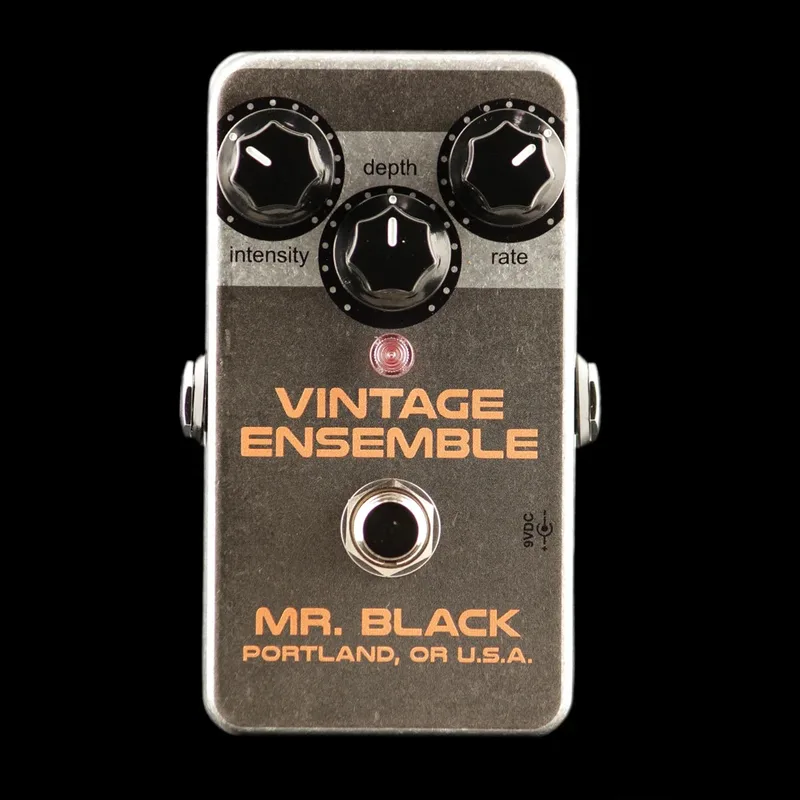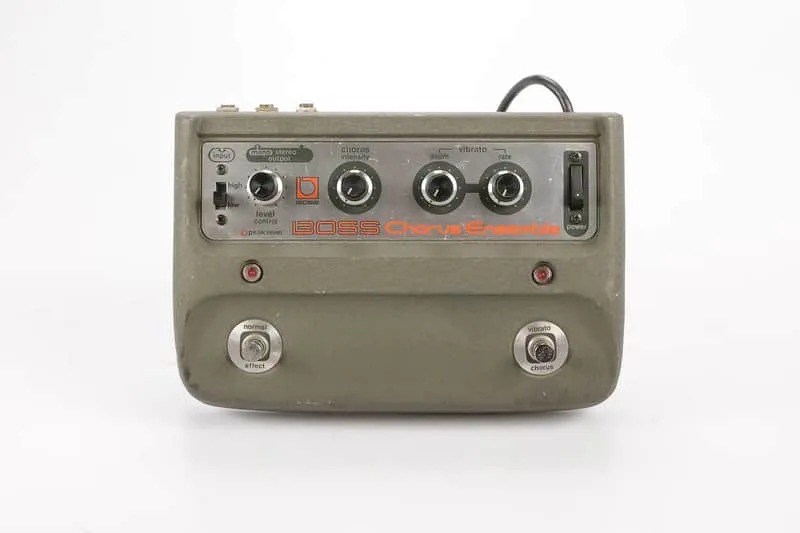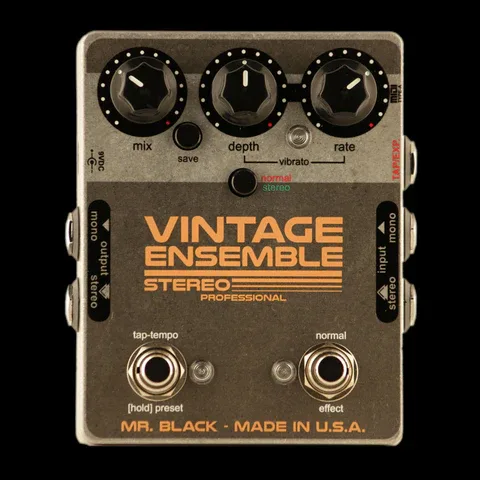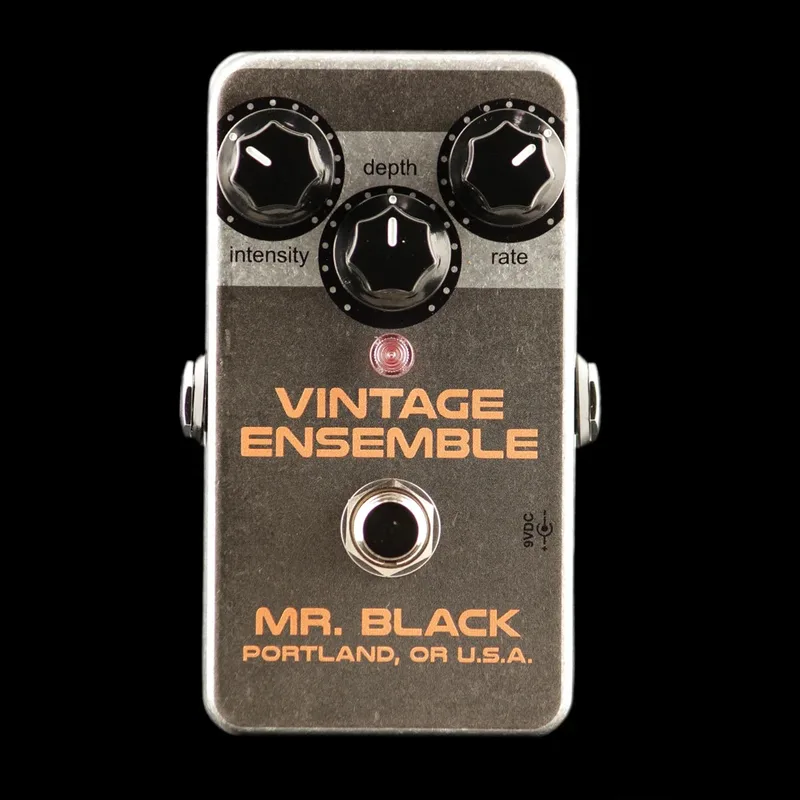


The Mr. Black Vintage Ensemble Stereo Chorus/Vibrato is a stereo chorus and vibrato pedal that recreates the sound of the original 1976 "Chorus Ensemble," the Roland CE-1, in a modern pedalboard-friendly format. Mr. Black describes it as "specially designed to replicate that original 1976 'Chorus Ensemble' sound, with a few modern updates and upgrades like: pedal-board friendly 9VDC power, true-bypass, a full wet/dry mix-control and expanded speed/rate limits"1.
The pedal arrived in 2018, when Mr. Black was building stereo versions of its modulation and delay pedals, and it grew out of the earlier mono Mr. Black Vintage Ensemble of 2015, which had captured the CE-1 style chorus sound in a compact box23. Where the 2015 pedal was mono, this version expands the sound into true stereo.
A stereo take on the 1976 Chorus Ensemble sound
The core of the pedal is a recreation of the legendary Roland unit from the '70s, with delay times carefully tuned to match those of the original chorus circuit2. Guitar Pedal X describes the circuit as "a twin digital delay line modulator recreating and doubling the Boss CE-1 Chorus/Vibrato," a dual delay line recreation of the Boss CE-1 chorus set out of phase for stereo output4. Premier Guitar likewise identifies the design as digital5.
The stereo implementation is what separates it from the mono original. The pedal has a true-stereo audio path with standard and spatial-expansion modes, and true stereo signal paths with independent dry signals per channel23. Delicious Audio's write-up put the emphasis on the Stereo mode:
"The real magic lies within the Stereo mode, which applies a clever application of complimentary modulated delay times to both the left and right channels further increasing the stereo spread via the Haas effect."
The Haas effect, in short, is the psychoacoustic trick where the same signal reaching each ear a few milliseconds apart is heard as width and space rather than as two separate sounds. Applying complementary modulated delay times to the left and right channels is how the pedal turns a mono chorus into a dimensional one.
The controls and modes
The pedal offers two modes, Normal and Stereo, switchable on the fly via a Normal/Stereo footswitch2. Mr. Black describes these as "Normal & Stereo modes for classic or dimensional chorus"3.
| Control or feature | What it does |
|---|---|
| Wet/Dry mix control | Full wet/dry blend, from dry signal to full pitch vibrato12 |
| Normal/Stereo footswitch | Switches between modes on the fly2 |
| Expression jack | Assigns an expression pedal to any control2 |
| Left Input | Chorus input with dry pass-through2 |
| Right Input | Dry pass-through only2 |
| Left and Right Outputs | Chorus output on both2 |
The wet/dry mixer is continuously variable and lossless, letting a player blend seamlessly between classic chorus and true pitch vibrato3. Premier Guitar's reviewer, writing about the related Stereo Professional version, called this "a continuous chorus/vibrato mixer that enables many nuanced mod textures"5. Because the mix goes fully wet, the pedal works as a straight pitch vibrato, the same way the CE-1's vibrato mode did, and the delay times are tuned to match the original circuit26.
Expression pedal control
An expression pedal input allows control of any setting through an external pedal2. Assignment is done on the pedal itself: a standard expression pedal can be applied on the fly to any and all of the control knobs by simply turning the control to its red dot marker2. On the Stereo Professional version, Premier Guitar notes that "the wet/dry blend can also be controlled by an expression pedal via the expression jack"5.
The Roland CE-1 circuit it is based on
The pedal traces back to the Boss CE-1 Chorus Ensemble, released in 1976 as the first standalone chorus pedal. Mr. Black's own history of the line states it plainly: "Inspired by the Roland CE-1, the 2015 Vintage Ensemble captured the lush, dimensional chorus heard on countless records"31.
The CE-1 itself was not designed from scratch. According to GuitarPCB's technical analysis, it was based on the Roland Jazz Chorus JC-120 Amplifier integrated chorus effect, taking the amp's built-in chorus circuit and putting it in a floor unit7. TONEHOME's page on the CE-1 notes that "the CE-1 is a mains powered unit that features both chorus and vibrato modes"6, which is one reason a modern recreation appeals to pedalboard users: the original needed mains power rather than a 9V supply.
Mr. Black has built a family of CE-1-inspired pedals around this circuit. The Vintage Ensemble captured the chorus of the Roland CE-1, and the Stereo Vintage Ensemble Professional is a Dual Digital Delay Line recreation of the Boss CE-1 Chorus, set out of phase for stereo output4. The CE-1 itself was a chorus pedal with a vibrato mode, and its chorus circuit was based on the chorus effect built into the Roland Jazz Chorus JC-120 amplifier37.
The Stereo Vintage Ensemble Professional carries the CE-1 design forward as a Dual Digital Delay Line recreation of the Boss CE-1 Chorus, set out of phase for stereo output4. Its Stereo mode applies complimentary modulated delay times to both left and right channels, increasing stereo spread via the Haas effect2.
Videos
JayLeonardJ
collector//emitter
Jack Deville
Questions
Is the Mr. Black Vintage Ensemble true stereo?
Yes. It has a true-stereo audio path with standard and spatial-expansion modes, and true stereo signal paths with independent dry signals per channel. The chorus output appears on both the Left and Right outputs, and Stereo mode applies complementary modulated delay times to both channels to widen the spread.
What power does the Vintage Ensemble need?
It runs on 9VDC industry-standard power, the same negative-center 2.1mm supply most pedalboards already use. Current draw is around 68mA, which the maker describes as daisy-chain friendly, so it can share a single supply with other pedals without straining it.
Can I use an expression pedal with the Vintage Ensemble?
Yes. An expression pedal input allows control of any setting through an external pedal. A standard expression pedal can be assigned on the fly to any of the control knobs by simply turning that control to its red dot marker, and the wet/dry blend can also be controlled this way.
Which Roland chorus is the Vintage Ensemble based on?
It is based on the Roland CE-1 Chorus Ensemble from 1976, the first standalone chorus pedal, which itself borrowed the integrated chorus effect from the Roland Jazz Chorus JC-120 amplifier. Mr. Black tuned the Vintage Ensemble's delay times to match those of the original chorus circuit.
How big is the Mr. Black Vintage Ensemble?
It has a compact footprint of 4.7 by 3.7 inches, roughly standard pedalboard size rather than the oversized enclosure some stereo pedals use. That is a marked change from the original CE-1, which was a larger mains-powered unit.
Sources (7)
- Vintage Ensemble, Mr. Black
- Mr. Black Vintage Ensemble Stereo Chorus/Vibrato, Delicious Audio, 2019-08-21
- Stereo Vintage Ensemble Professional, Mr. Black
- Guitar Pedal X, Guitar Pedal X, 2026-07-02
- Mr. Black Vintage Ensemble Stereo Professional Review, Premier Guitar, 2026-06-30
- TONEHOME, TONEHOME (www.tonehome.de)
- Boss CE-2 Analysis, GuitarPCB