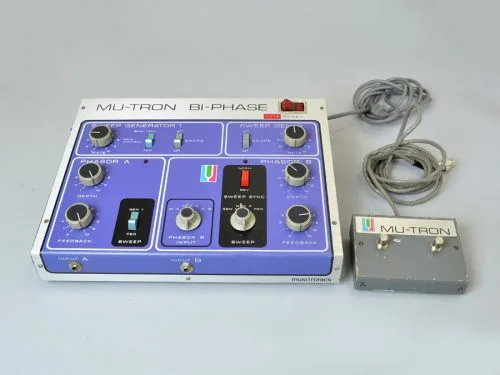


The Mu-Tron Bi-Phase is a dual phaser invented and marketed by Musitronics USA in the 1970s. It consists of two independent 6-stage phasor circuits and two sweep generators (oscillators), and it can be run as two separate phasers or as a single 12-stage phaser, a sprawl of circuitry that made it one of the most flexible phasers of its era123. Mu-Tron describes its sound as a "classic" warm and deep, creamy HiFi phase4.
The controls: sweep generators, depth and feedback
The Bi-Phase's control scheme is built around its two sweep generators and two phasor sections. Each phasor has its own Depth and Feedback knobs, and each sweep generator has a Rate control and a Shape switch. The original owner's manual, still available on Mu-Tron's site, explains what each control does1.
| Control | Section | What it does |
|---|---|---|
| Rate | Sweep Generator 1 | Controls the speed/rate of the LFO wave that controls the effect |
| Shape | Sweep Generator 1 | Switches the LFO between a square and a sine wave |
| Depth | Phasor A | Controls the depth/amplitude of the modulation, the size of the range in which the effect sweeps |
| Feedback | Phasor A | Sets the amount of effected signal fed back into the effect, for a stronger effect |
| Sweep Sync (Norm/Rev) | Phasor B | Switches between normal and reverse sweep; with the same sweep source as phasor A, phasor B moves in the opposite direction |
The square and sine wave shapes give the two sweep generators different characters, and the reverse sweep option lets the two phasor sections move against each other rather than together14. The unit is furnished with a dual foot switch and an optical photoelectric foot pedal, and Mu-Tron says the Bi-Phase and its accessories are solidly constructed to withstand severe professional use1.
Expression and CV control
The pedal has a CV PEDAL socket at the rear that accepts an expression pedal or an external control voltage signal in the range of 0 to 5V. Either method allows control of the LFO speeds and/or manual sweep of the phase sections4. Pedal of the Day noted that the control voltage input on the Bi-Phase II allows real-time control of Rate or Depth, giving the musician what the reviewer called utmost expression and "Leslie Speaker" type sounds6.
Power and connections
The current Bi-Phase runs on standard 9V or 12V DC, negative center tip, through a 200 mA power port, and draws 200 mA4. The Bi-Phase II is similar but draws 260 mA through a 250 mA power port, and Pedal of the Day noted it may be powered by standard power bricks36.
The original 1970s unit's technical specifications, as documented by RockBoard's pedalPedia, include:
- Input impedance: 300k ohms minimum, unbalanced1
- Output impedance: 600 ohms, unbalanced1
- Insertion loss: less than 1 dB1
- Frequency response (bypass): 20 Hz to 20 kHz ± 2 dB1
- Signal handling: 4V RMS minimum per phasor with no feedback; 2V RMS minimum with both phasors in series at 50% feedback, 1V RMS minimum at 100% feedback17
- Weight: 7¾ pounds, less footswitch and foot pedal7
Note that the current reissue's product page lists different physical figures: 1 lb weight and dimensions of 4.75" x 2.5" x 7.25", which describe the modern pedal rather than the original 1970s chassis43.
From the 1970s Bi-Phase to the Bi-Phase II
"Make it as good as if not better (than the original)"
Versions and editions
The Bi-Phase II keeps the dual 6-stage architecture but adds OptoMod Phase-Light technology and a 4-stage mode with a fixed feedback, which Mu-Tron says produces classic rock tones that work well with overdrive and distortion harmonics36. Delicious Audio described the 4-stage modes as offering different feedback levels for various rock tones9. The Feedback control on the Bi-Phase II governs the level of phase feedback in 6-stage mode3. The II also routes right to left, has a symmetrical layout, and packs into a compact, pedalboard-friendly package310.
Both the current Bi-Phase and the Bi-Phase II are made in the US and carry a 1 Year Limited Warranty34. The Bi-Phase Vintage Silver reissue is listed at $479.004.
What reviewers and players said
Guitar World's history of Zappa and the Bi-Phase praised its sweep character: the reviewer found it "sweeps through a frequency range that's never harsh, even at the extreme points of the modulation cycles"11. The Bi-Phase's best-documented studio appearance is on the Smashing Pumpkins' Siamese Dream, where producer Butch Vig ran the whole mix through it:
Pedal of the Day's review of the Bi-Phase II credited Mu-Tron with "reviving this vintage beauty, and making it sound supreme and function perfectly" overall6. On the used market, Vintage Guitar magazine listed original units with the optical pedal at $1,000 to $1,250 in December 201212, and by 2021 MusicRadar's Alex Lynham wrote that "you'd be lucky to pay under fifteen hundred dollars for one"13.
Videos
Reverb
hiwattbob
Pedal of the Day
News
Questions
What did Frank Zappa use the Mu-Tron Bi-Phase for?
Frank Zappa used the Bi-Phase from 1973 onward, and his personal unit is now owned by EMEAPP, the Electronic Music Education and Preservation Project in Pennsylvania. Guitar World documented his use of the pedal through an interview with Dweezil Zappa for the Stompbox book project, and the Bi-Phase became closely associated with his sound.
Is the Mu-Tron Bi-Phase stereo?
Yes. The original Bi-Phase has stereo Input and Output jacks, with two 1/4-inch inputs and two 1/4-inch outputs. The two independent 6-stage phasor circuits can be run separately, which suits a stereo setup, or combined into a single 12-stage phaser.
Is the new Mu-Tron Bi-Phase true bypass?
Yes. Mu-Tron's current Bi-Phase pedal has true-bypass foot-switching for each individual phase channel. It also retains the original's bleed-bypass onto-electronic switching, which adds analog warmth to the signal while in bypass mode, a feature studio engineers requested.
How much is a vintage Mu-Tron Bi-Phase worth?
Vintage Guitar magazine put original units with the optical pedal at $1,000 to $1,250 in December 2012. By 2021, MusicRadar's Alex Lynham wrote that demand had pushed prices to the point that you would be lucky to pay under fifteen hundred dollars for one.
What phaser did the Smashing Pumpkins use on Siamese Dream?
The Mu-Tron Bi-Phase. Producer Butch Vig described it as one of the secrets of the album's sound, saying they ran everything through it. The Bi-Phase could be operated as a single 12-stage phaser or as two independent six-stage phasers.
Is the Mu-Tron Bi-Phase II analog?
Yes. Mu-Tron describes the Bi-Phase II as all-analog and parts-accurate to the original, as much as is possible. It is a re-creation of the 1970s Bi-Phase circuit in about a quarter of the footprint, and it remains in production.
Sources (13)
- Mu-Tron Bi-Phase, Musitronics Mu-Tron (mu-tron.com)
- Hexatron Optical Phaser / Mu-tron Phasor II, Aion FX, 2026-07-03
- Mu-Tron Bi-Phase II, Musitronics Mu-Tron, 1970
- Bi-Phase Vintage Silver, Musitronics Mu-Tron (mu-tron.com)
- Favored by Frank Zappa and Jerry Garcia, the Musitronics Mu-Tron III Combined Wild Sonics and Creative Usability, GuitarPlayer (www.guitarplayer.com), 2023-03-03
- Mu-Tron Bi-Phase II Phase Shifter, Pedal of the Day, 2021-05-15
- Mu-Tron Bi-Phase by Musitronics Corp, RockBoard (www.rockboard.de), 2026
- Mu-Tron Bi-Phase II is here!, Musitronics Mu-Tron, 2020-09-21
- New At NAMM: MU-TRON BI-PHASE II, Delicious Audio, 2024-01-28
- Builder Profile: The Mu-tron Story, www.premierguitar.com, 2013-09-12
- The story of Frank Zappa and the Mu-Tron Bi-Phase, Guitar World, 2021-04-28
- 25 Most Valuable Effects, Vintage Guitar magazine, 2015-05-24
- 5 great phaser pedals guitar players need to try, MusicRadar, 2021-05-17