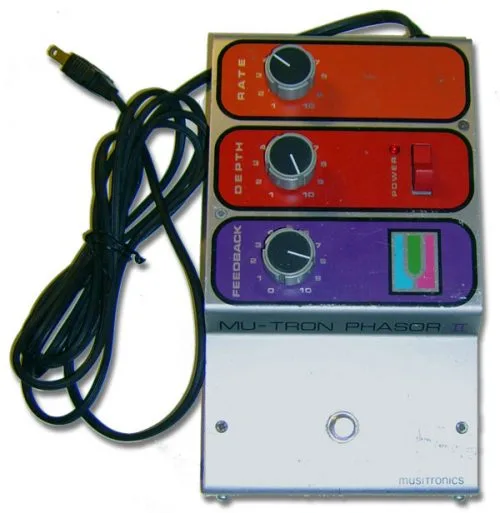


The Mu-Tron Phasor II is a phaser pedal released by Musitronics in 1977, a second-generation model built from the technology the company developed for the Mu-Tron Bi-Phase12. It is an LDR-based optical phaser: a low-frequency oscillator drives LEDs whose light falls on light-dependent resistors, sweeping notches through the signal to create the effect known as phasing23. Six phase-shift stages provide a maximum of 1080 degrees of phase-shift, and the pedal can be switched between 4 and 6 stage operation14.
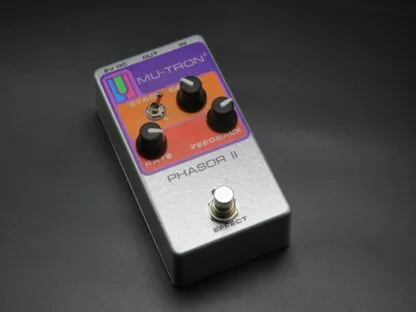
The vintage Phasor II is discontinued and now sells for over $500 on the used market5. Musitronics today sells a reissue, listed at $199.00 as of October 2026, and Warm Audio sells a recreation, the Warm Audio Mutation Phasor II46.
What the Phasor II does
Musitronics positioned the Phasor II as a phase-shifting device that adapted the advanced electronic technology developed for the Bi-Phase into a single-pedal format1. It carries the feedback circuitry first introduced on the Bi-Phase, which feeds part of the effected signal back into the effect for a stronger, more pronounced sweep1. The company says the circuitry has extremely low noise and signal-handling capability that keeps distortion out of the signal, with unity gain and less than 1db of insertion loss1.
Aion FX's technical write-up traces the circuit's lineage further back: the designers drew inspiration from the Uni-Vibe and replicated its LDR and lamp setup, but with six phase stages instead of four, op-amps instead of transistors, an LED instead of an incandescent lamp, and a redesigned LFO2. The 6-stage mode is what Musitronics calls the creamy and classic Mu-Tron sound4.
The signal path is straightforward: one 1/4" input jack and one 1/4" output jack, with an input impedance of 390K ohms unbalanced and an output impedance of 600 ohms unbalanced14. Signal-to-noise ratio is better than 86 db below a 2V input, and the phasing rate sweeps from 1Hz to 18Hz1.
The controls
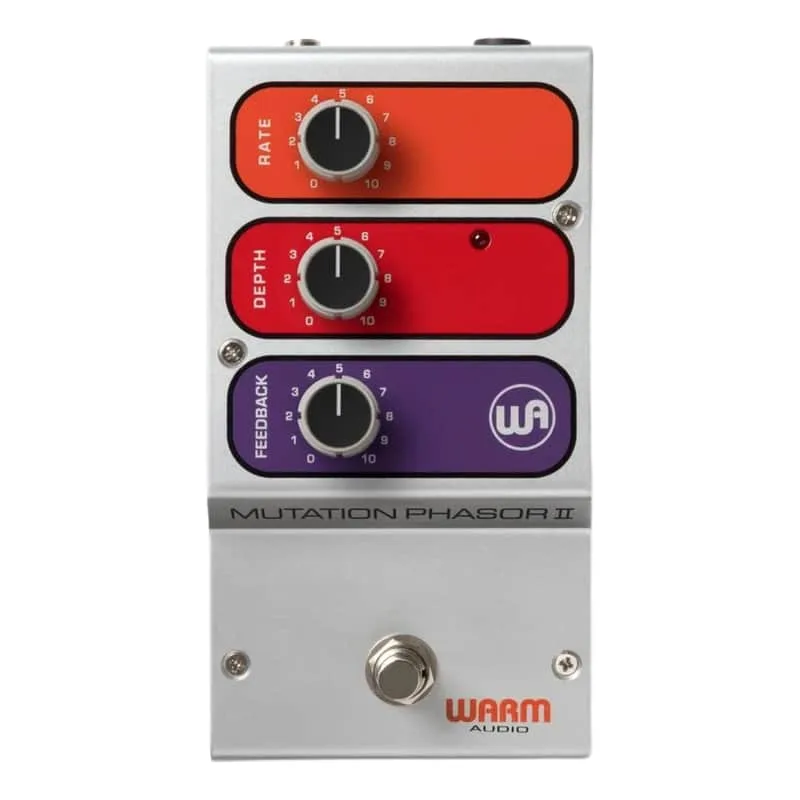
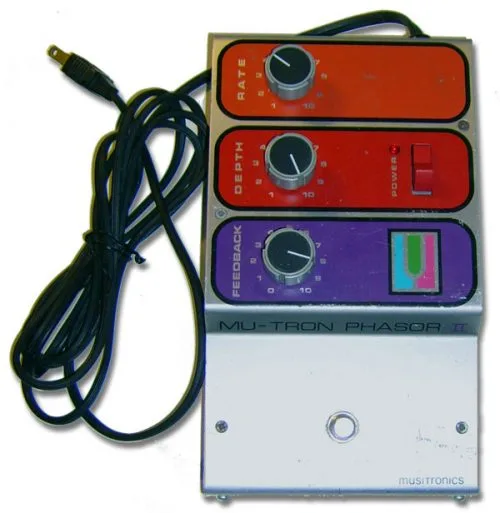
The Phasor II gives the player three continuously variable controls plus a stage switch14:
| Control | What it does |
|---|---|
| Rate | Controls the speed of the LFO wave that drives the effect, in both 4 and 6 stage modes14 |
| Depth | Controls the depth and amplitude of the modulation, the size of the range in which the effect sweeps14 |
| Feedback | Sets the amount of effected signal fed back into the effect for a stronger effect1 |
| Stage (4/6) | Selects 4 or 6 stages of phasing4 |
This control set is a step up from the original Mu-Tron Phasor, which used a Depth switch with L, M and H positions rather than a continuously variable knob7. The Bi-Phase's feedback and depth controls work the same way, which reflects how much circuitry the two pedals share8.
Power and connections: 115V AC, no battery
The vintage Phasor II runs on AC mains power, not a battery or a standard 9V pedal supply. It requires 115V AC at 50 to 60Hz and draws 5 watts, with a 230V AC version available on special order1. Players powering one today need to confirm their unit's voltage before plugging it in.
Musitronics advertised AC power as a feature, describing the Phasor II as "AC powered for quiet, reliable operation without the annoyance of frequent battery changes"1. That sets the vintage unit apart from most pedals of its era and from the current reissue, which runs on 9V DC in a rugged Mu-Tron enclosure4.
The housing is made of heavy gauge steel and thick, rugged epoxy-finished aluminum, weighing 3½ pounds and measuring 8¾ inches long by 3⅛ inches high1. The pedal handles 4V RMS (11.2V peak-to-peak) at minimum feedback and 2V RMS (5.6V peak-to-peak) at maximum feedback1.
The Phasor II and the Bi-Phase
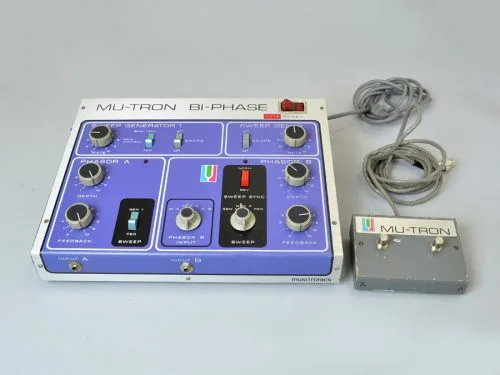
Aion FX sums up the relationship plainly: the Phasor II is essentially one-half of a Bi-Phase, with a nearly identical LFO and phase-shift topology, but without the second phaser2. The Bi-Phase runs two phasers, A and B, with a selector that feeds Phasor B from input A, from Phasor A's output, or from its own input B, and a sweep switch that puts Phasor A under pedal control or LFO control8. The Phasor II offers none of that routing, just one phaser with its stage switch.
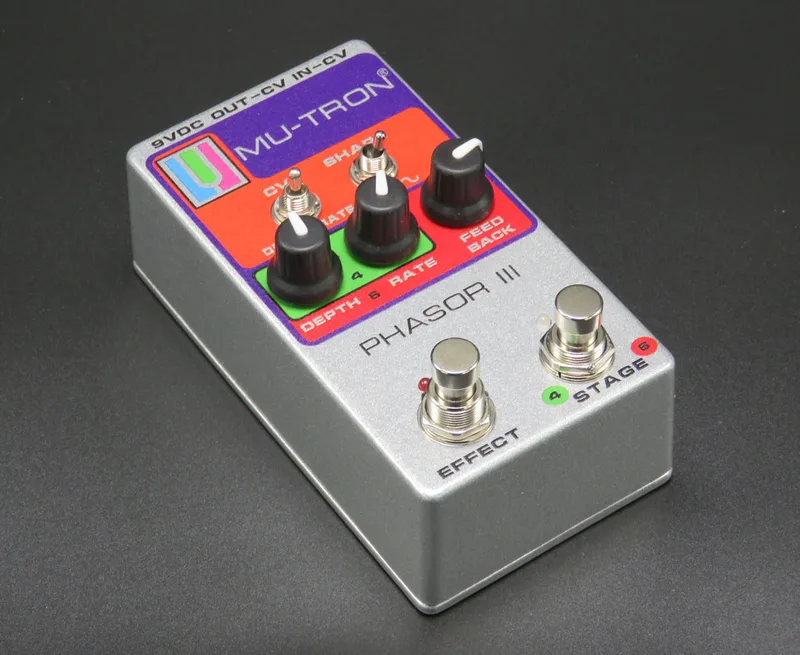
Guitar.com's reviewer notes that Mu-Tron currently produces the Phasor III, which combines the Phasor II and the Bi-Phase in one unit9. Musitronics describes the Phasor III as a compact, modernized and affordable version of the classic Phasor II, adding square and sine wave operation, priced at $279.00 as of October 202610.
Designers, builders and the Phasor II today
The Phasor II came from Mike Beigel and his team at Musitronics. Premier Guitar's reviewer, writing about the Warm Audio recreation, credits Beigel's team directly111:
"creator Mike Beigel and his team always made certain their products offered unique, deeper, and different sounds and functionality"11
The DIY community has kept the circuit alive. IvIark's Guitar FX Layouts project documents the phasing circuit with its LFO-driven LEDs and LDRs, and notes that ticking, a common artifact in LDR phasers, can be reduced by proper lead dress, shielded wire for input and output, cables crossing at 90 degrees, short input and output runs, and an enclosure larger than a 1590BB3. He also suggests that with two of these one could build a bi-phase3.
For players who want the design new, there are two routes: the Musitronics reissue at $199.00, and the Warm Audio Mutation Phasor II, a recreation whose knobs and control color fields are identical to the original's6. Guitar.com's Andy Grant rated Warm Audio's version 8 out of 10 and called its price "half the cost of a Mu-Tron III and barely a quarter of what an original" costs91.
Videos
gearmanndude
Pedal of the Day
Joe Perkins
Questions
Does the Mu-Tron Phasor II need a battery?
The vintage Phasor II does not take a battery at all. It runs on AC mains power, 115V AC at 50 to 60Hz drawing 5 watts, with a 230V AC version available on special order. The current Musitronics reissue instead runs on 9V DC in a standard pedal enclosure.
Who designed the Mu-Tron Phasor II?
The Phasor II came from Mike Beigel and his team at Musitronics. Premier Guitar's reviewer credits Beigel's team with making certain their products offered unique, deeper and different sounds. Beigel's company also created the Mu-Tron Bi-Phase, whose circuitry the Phasor II adapted.
What is the difference between the Mu-Tron Phasor II and the Bi-Phase?
Aion FX describes the Phasor II as essentially one-half of a Bi-Phase, with a nearly identical LFO and phase-shift topology but without the Bi-Phase's second phaser. The Phasor II offers 4 or 6 stages of phasing, while the Bi-Phase runs two phasers that can be chained and controlled by pedal or LFO.
How much is a used Mu-Tron Phasor II worth?
Delicious Audio reported in 2026 that the vintage Phasor II is discontinued and now sells for over $500 on the used market. The current Musitronics reissue, listed at $199.00 as of October 2026, is the affordable way to get the same design.
Is the Mu-Tron Phasor II optical?
Yes. The Phasor II uses an optical phasing circuit in which LFO-driven LEDs and light-dependent resistors do the phase shifting, a modular optical design Musitronics says allows for consistency across units. Aion FX notes the LDR and lamp setup was replicated from the Uni-Vibe.
Sources (11)
- Mu-Tron Phasor II, Musitronics Mu-Tron (mu-tron.com), 1970
- Hexatron Optical Phaser / Mu-tron Phasor II, Aion FX, 2026-07-03
- Guitar FX Layouts: Mutron Phasor II, Guitar FX Layouts (tagboardeffects.blogspot.com), 2014-06-25
- Phasor II, Musitronics Mu-Tron
- Warm Audio Mutation Phasor II, Delicious Audio, 2026-08-04
- Boostron II Black Limited Edition, Musitronics Mu-Tron (mu-tron.com)
- Mu-Tron Phasor, Musitronics Mu-Tron (mu-tron.com)
- Mu-Tron Bi-Phase by Musitronics Corp, RockBoard (www.rockboard.de), 2026
- Warm Audio’s Mutation Phasor II, Guitar.com, 2023-08-07
- Phasor III Vintage Silver, Musitronics Mu-Tron
- Warm Audio Mutation Phasor II Review, Premier Guitar, 2023-09-09