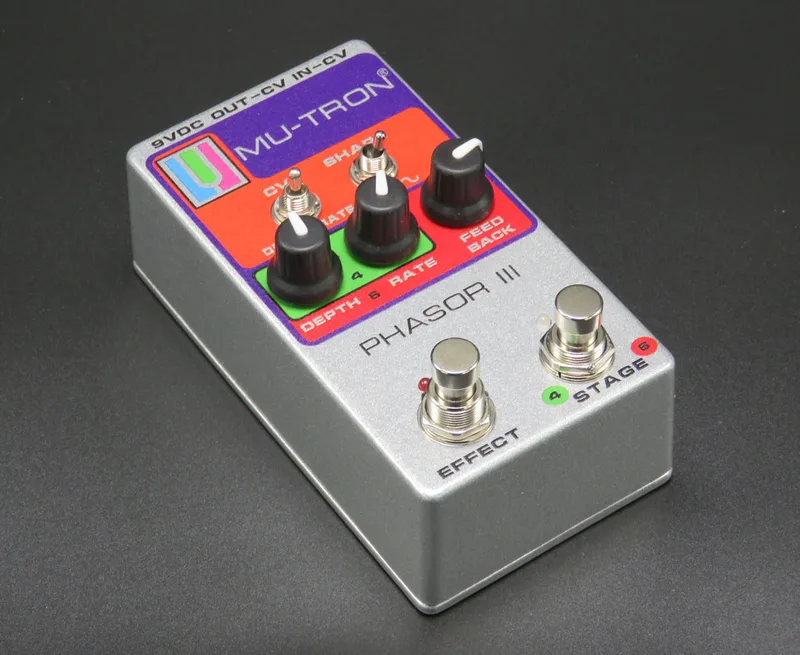


The Mu-Tron Phasor III is a compact phaser pedal from Mu-Tron that puts the optical circuitry of the vintage Phasor II and Bi-Phase pedals into a small, pedalboard-friendly enclosure. Mu-Tron describes it as "a compact, modernized and affordable version of the classic Mu-Tron Phasor II" that re-creates the creamy phase of the original while adding 4 and 6 stage modes and a control voltage input1.
The pedal is all analog and made in the USA, and it packs into a compact 9 volt enclosure akin to Mu-Tron's Micro-Tron III and Octavider pedals1. Pedal of the Day found that it "packs all the sounds from the original phaser pedals into a small, pedalboard-friendly enclosure" and that Mu-Tron was "not cutting any corners to ensure it sounds right on par with the vintage units…if not better"2.
The controls
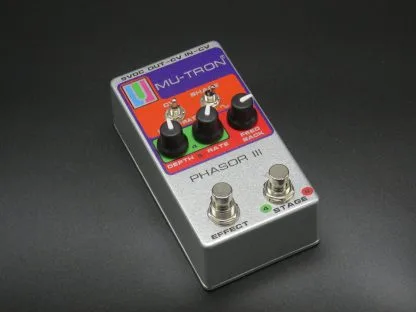
The Phasor III's front panel is built around two modes, selected by a Stage switch that determines 4 or 6 stages of phasing. A secondary footswitch next to the Effect Bypass switch selects between the modes2. The knobs and switches do the following, per Mu-Tron's product pages15:
| Control | What it does |
|---|---|
| Rate | Controls the speed of the phase in 4 and 6 stage modes |
| Depth | Controls the intensity of the phase effect |
| Feedback | Controls the level of phase feedback in 6 stage mode |
| Shape | Selects a square or sine wave for the LFO |
| Stage (4/6) | Determines 4 or 6 stages of phasing |
The two modes behave differently. In 4 stage mode the feedback is fixed, which Mu-Tron says gives "the classic rock tones that work well with overdrive and distortion harmonics"1. MusicRadar's Alex Lynham noted the practical result: "in four-step mode the feedback is fixed, so the effect is generally a bit more subtle"4. In 6 stage mode you get the Feedback knob, so the effect can be pushed harder2.
The Shape control is worth a moment for players new to phasers. A sine wave sweeps smoothly up and down, like the classic studio phaser sound, while a square wave jumps between fixed points, which produces a more stepped, rhythmic sweep. Choosing between them changes the character of the effect as much as the Rate setting does15.
CV input: rate or depth control for Leslie and Uni-Vibe sounds
The feature that most separates the Phasor III from a basic phaser is its control voltage input. Mu-Tron's product page explains that "there is a control voltage input that will allow for real-time control of Rate or Depth to give the musician utmost expr[ession]" and that it can produce "Leslie Speaker" type sounds1. The CV input can be assigned to rate, depth or none, so a player can choose which parameter the incoming signal moves, or switch the input off entirely5.
MusicRadar's Alex Lynham pointed at one use in particular: "as there's a CV-in that can be used to change the rate, it means that the Phasor III can create Uni-Vibe style" effects4. Driving the rate from an expression pedal or another CV source lets the sweep speed follow your foot rather than a fixed knob setting, which is how players get the slow, vocal swirl associated with Leslie rotary speakers and the Uni-Vibe.
The CV input is assignable, not automatic. It does nothing until you set it to control rate or depth, so a player who plugs in an expression pedal and hears no change should check the CV assignment first5.
History: the Phasor II and Bi-Phase optical circuit
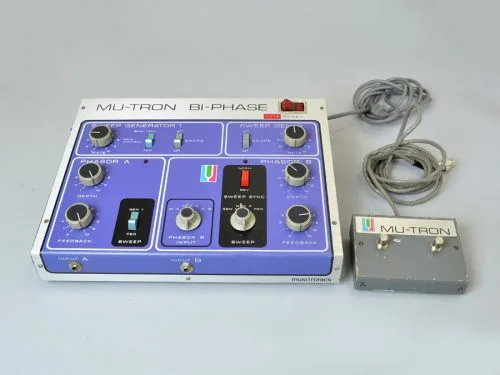
The Phasor III's circuit has a direct lineage. Mu-Tron says the all-analog pedal "takes the legendary opts-circuitry of the vintage Phasor II and Bi-Phase pedals"1. Function f(x)'s technical analysis of phaser types groups the "Mutron Phasor III" with optical-based phase shifting designs6, and Aion FX's circuit research fills in the family tree: the original Phasor I used CA3080 operational transconductance amplifiers (OTAs), which were relatively new technology at the time, while the Phasor II is "essentially one-half of a Bi-Phase, with a nearly identical LFO and phase-shift topology"7.
That lineage matters for how the pedal sounds. Optical phasers use a light-dependent element to sweep the notches, which gives a different sweep character than the OTA-based designs that followed, and it is the same approach Mu-Tron carried into its modern Bi-Phase II re-creation. The Phasor III is effectively the compact, single-channel descendant of that line, sitting between the vintage Phasor II and the full Bi-Phase in Mu-Tron's current range125.
How the Phasor III compares to the Phasor II
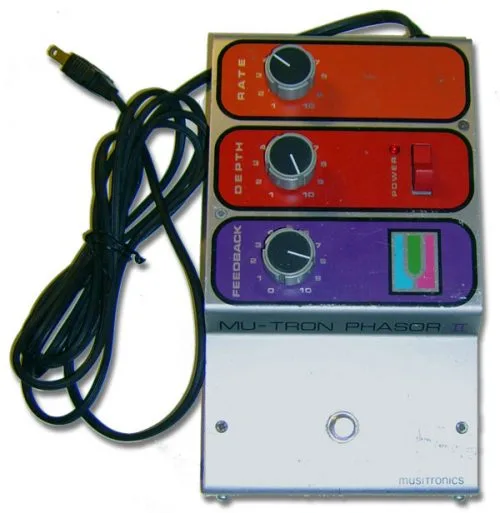
The vintage Phasor II was a simpler pedal. Its three continuously variable controls covered Rate, Depth and Feedback, with Rate controlling the speed of the LFO wave that drives the effect8. The Phasor III keeps those core controls but adds the Stage switch for 4 or 6 stages of phasing, the Shape control for square or sine waves, and the CV input15.
| Phasor II (vintage) | Phasor III | |
|---|---|---|
| Controls | Rate, Depth, Feedback15 | Rate, Depth, Feedback (6 stage), Shape, Stage switch1 |
| Stages | Fixed design | 4 or 6, switchable1 |
| Feedback | Continuously variable | Variable in 6 stage mode, fixed in 4 stage mode1 |
| CV input | No | Yes, assignable to rate, depth or none5 |
| Circuit | Optical, one-half of a Bi-Phase7 | Optical, all analog1 |
Mu-Tron's own positioning is that the Phasor III re-creates "the creamy phase of the Phasor II" in a compact, modernized and affordable package1. For players weighing vintage against modern, the Phasor II's appeal is its simplicity, while the Phasor III's is its flexibility: two stage counts, two LFO shapes and external control.
What reviewers said
Published reviews of the Phasor III have been positive. Pedal of the Day's 2019 review praised the mode switching and concluded that Mu-Tron was "not cutting any corners to ensure it sounds right on par with the vintage units…if not better"2. MusicRadar's Alex Lynham, writing in 2021, summed up the pedal as offering "unique vintage phaser sounds" while listing "complexity" as its downside, a fair trade for the CV input and dual modes that create that complexity4.
Videos
Pedal of the Day
mikesgigtv
Dinesh Lekhraj
Questions
Is the Mu-Tron Phasor III analog?
Yes. Mu-Tron describes the Phasor III as an all-analog pedal that takes the optical circuitry of the vintage Phasor II and Bi-Phase pedals. The phase shifting is done with light-dependent components rather than digital modeling, which is the same approach as the 1970s originals.
Is the Mu-Tron Phasor III made in the USA?
Yes. Mu-Tron states on its product page that the Phasor III is made in the USA. The pedal is built by the revived Musitronics company, which also makes the Micro-Tron III, Octavider and Bi-Phase II.
What power supply does the Mu-Tron Phasor III need?
The Phasor III runs on 9V DC and draws 115 mA, according to Mu-Tron's product page. That current draw is high enough that a standard 100 mA output on a multi-output power supply may not be enough, so check your supply's rating per output.
How does the Phasor III compare to the Phasor II?
Mu-Tron calls the Phasor III a compact, modernized and affordable version of the classic Phasor II, re-creating its creamy phase. The Phasor II has three controls for Rate, Depth and Feedback, while the Phasor III adds 4 and 6 stage modes, a Shape control and a CV input.
Sources (8)
- Phasor III, Musitronics Mu-Tron
- Mu-Tron Phasor III Optical Analog Phaser, Pedal of the Day, 2019-08-26
- Warm Audio Mutation Phasor ll review, MusicRadar, 2023-09-08
- 5 great phaser pedals guitar players need to try, MusicRadar, 2021-05-17
- Phasor III Vintage Silver, Musitronics Mu-Tron
- Guitar Phaser Pedal Types: JFET, Optical, OTA, and Others, Function f(x), 2022-03-18
- Hexatron Optical Phaser / Mu-tron Phasor II, Aion FX, 2026-07-03
- Mu-Tron Phasor II, Musitronics Mu-Tron (mu-tron.com)