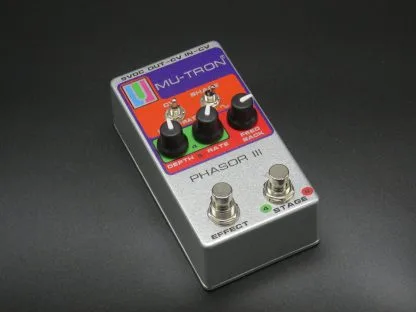


The Musitronics Mu-Tron Phasor III is a compact phaser pedal that puts the optical circuitry of the vintage Mu-Tron Phasor II and Bi-Phase into a modern, affordable box. Musitronics describes it as "a compact, modernized and affordable version of the classic Mu-Tron Phasor II," built on the same all-analog optical design that made the 1970s originals sought after1. It is made in the USA, carries a one-year limited warranty, and sells for $279.00 as of October 20261.
The Phasor III is an optical phaser: instead of using transistor or op-amp stages to shift the phase of your signal, it uses light-dependent elements, the approach Musitronics pioneered in the 1970s. The maker says its modular optical design "allows for consistency across units," a nod to the fact that vintage optical pedals could vary from unit to unit1. Pedal of the Day classifies it simply as an "Optical Analog Phaser"2.
An all-analog optical phaser
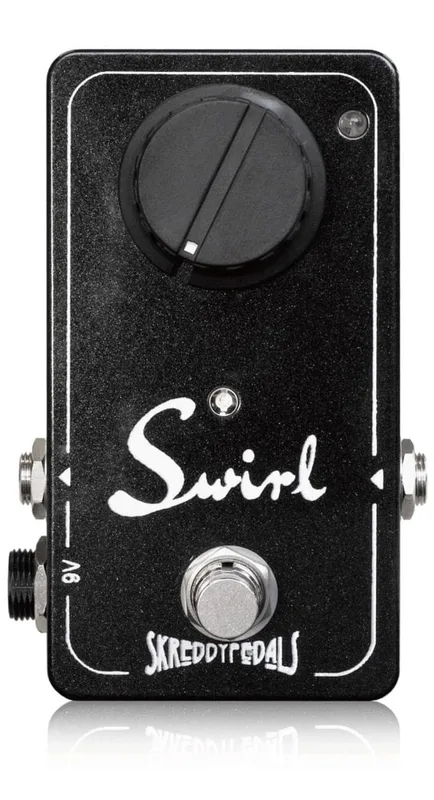
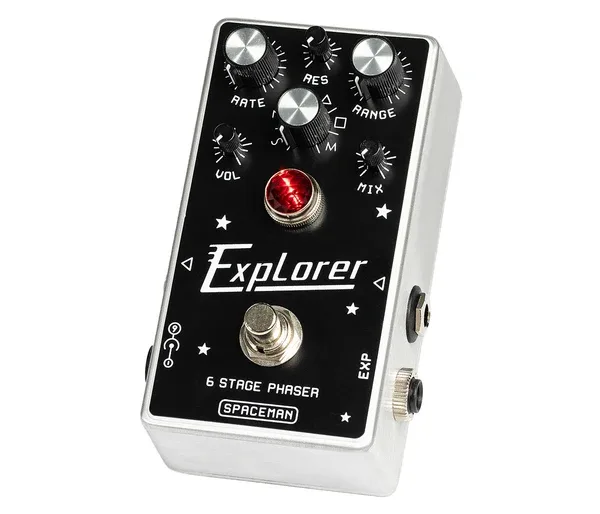
Most phasers on the market shift phase with op-amp or transistor stages swept by a low-frequency oscillator. The Phasor III instead uses optical phase shifting, the same approach as the vintage Phasor II and Bi-Phase. Function f(x), in its analysis of phaser pedal types, groups the Mutron Phasor III with other optical-based phase shifters such as the Skreddy Pedals Swirl and Spaceman Explorer4. Musitronics says the all-analog Phasor III "takes the legendary opts-circuitry of the vintage Phasor II and Bi-Phase pedals"1.
The practical difference for a player is in the character of the sweep. Optical phasers are known for a smooth, rounded modulation, and Musitronics leans on that heritage, saying the Phasor III re-creates "the creamy phase of the Phasor II"1. The modular optical design also means two Phasor III units should sound alike, where vintage optical pedals could differ noticeably from one serial number to the next1.
The controls
The Phasor III's front panel is built around two modes, 4-stage and 6-stage, with controls shared between them. Pedal of the Day notes the pedal offers "Depth and Rate controls for each mode of the Phasor III"21.
| Control | What it does |
|---|---|
| Rate | Controls speed of phase in 4 and 6 stage modes1 |
| Depth | Controls intensity of phase effect1 |
| Stage (4/6) | Determines 4 or 6 stages of phasing1 |
| Shape | Selects square or sine wave1 |
| Feedback | Controls the level of phase feedback in 6 stage mode1 |
| CV | May be assigned to rate, depth or none1 |
The Stage switch is the heart of the pedal. In 6-stage mode you get the Phasor II's sound, with a Feedback knob to set how much of the phased signal is recycled back into the sweep, which intensifies the effect. In 4-stage mode the feedback is fixed, and Musitronics says this mode delivers "classic rock tones that work well with overdrive and distortion harmonics"1. The Shape switch chooses between a sine wave, for a smooth continuous sweep, and a square wave, for a more abrupt, stepped modulation1.
The CV control sets the Phasor III apart from most compact phasers. MusicRadar's Alex Lynham notes the pedal "has the same circuitry as one of the two stages of the Bi Phase, as well as a control voltage (CV) in and out"5. With CV assigned to rate or depth, an external control voltage can modulate the speed or intensity of the phasing; assigned to none, the jacks sit idle. The CV output can also drive other voltage-controlled gear from the pedal's own oscillator.
Power: 9V DC, 115 mA
The Phasor III runs on 9V DC and draws 115 mA1.
At 115 mA, the Phasor III draws more current than many compact analog pedals. If you run a multi-pedal power supply, check that the isolated output feeding it has enough headroom, and avoid underpowered daisy-chain supplies.
The pedal has a single 1/4" input jack and a single 1/4" output jack, so it is a mono effect with no stereo operation1. Musitronics ships internationally, with the buyer responsible for taxes, import charges and onward shipping outside the shipping fee1.
From the Phasor II and Bi-Phase to the Phasor III
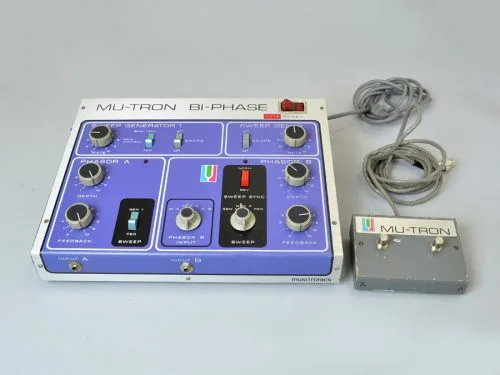
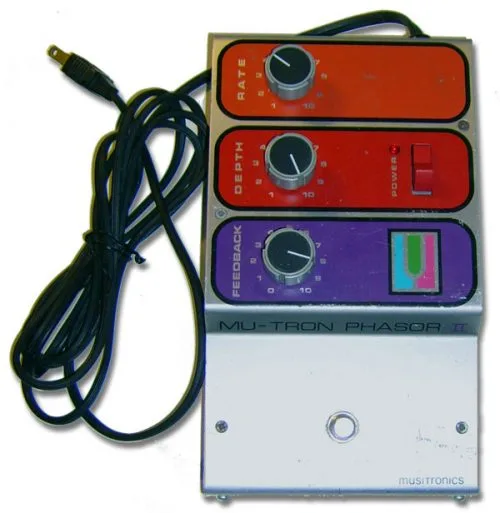
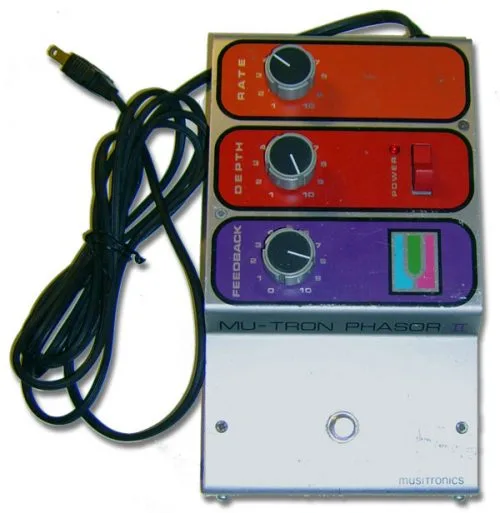
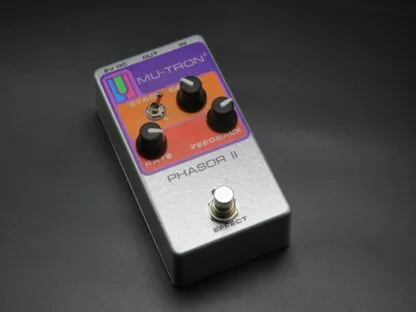
The Phasor III's lineage runs straight back to 1970s Musitronics. The original Mu-Tron Phasor used CA3080 operational transconductance amplifiers, which Aion FX notes were relatively new technology at the time6. In the 1970s Musitronics released the Phasor II as a second-generation phaser, adapting technology from the Bi-Phase, adding six phase-shift stages and exclusive feedback circuitry76. Aion FX's circuit analysis finds the Phasor II "is essentially one-half of a Bi-Phase, with a nearly identical LFO and phase-shift topology"6.
The vintage Phasor II had three continuously variable controls for Rate, Depth and Feedback, plus the ability to externally select between 4 and 6 stages of optical phasing78. The Phasor III carries that same 4/6-stage selection forward with its Stage switch, and adds the Shape and CV controls the original never had.
Musitronics sums up the Phasor III's place in the line: it re-creates the Phasor II's six-stage phase while adding a 4-stage mode with fixed feedback for classic rock tones1. MusicRadar confirms the circuit connection, noting the pedal shares its circuitry with one of the Bi-Phase's two stages5. For players weighing the two, the Phasor III is the compact, modern route to the Phasor II's optical sound, at $279.00 versus hunting a 1970s original1.
Videos
Pedal of the Day
Dinesh Lekhraj
Nicolas Melis
Questions
What does the Shape knob do on the Phasor III?
Shape selects the waveform of the low-frequency oscillator that drives the phasing: either a square wave or a sine wave. A sine wave gives a smooth, even sweep, while a square wave steps between extremes for a more abrupt, stepped phase effect.
Is the Mu-Tron Phasor III analog?
Yes. Musitronics describes the Phasor III as all analog, taking the optical circuitry of the vintage Phasor II and Bi-Phase pedals. Its phase shifting is optical-based, using light-dependent elements rather than digital processing.
What power supply does the Mu-Tron Phasor III need?
The Phasor III runs on 9V DC and draws 115 mA. That current draw is well above what a typical compact analog pedal uses, so a dedicated 9V DC supply with adequate headroom is the practical choice.
How does the Phasor III relate to the original Phasor II?
Musitronics positions the Phasor III as a compact, modernized and affordable version of the classic Phasor II. It re-creates the Phasor II's six-stage phase and adds a four-stage mode with fixed feedback aimed at classic rock tones.
What does the CV control do on the Phasor III?
The Phasor III has a control voltage (CV) input and output, and the CV can be assigned to rate, depth or none. This lets an external control voltage modulate the speed or intensity of the phasing, or lets the pedal's own LFO drive other gear.
Sources (8)
- Phasor III Vintage Silver, Musitronics Mu-Tron
- Mu-Tron Phasor III Optical Analog Phaser, Pedal of the Day, 2019-08-26
- Warm Audio Mutation Phasor ll review, MusicRadar, 2023-09-08
- Guitar Phaser Pedal Types: JFET, Optical, OTA, and Others, Function f(x), 2022-03-18
- 5 great phaser pedals guitar players need to try, MusicRadar, 2021-05-17
- Hexatron Optical Phaser / Mu-tron Phasor II, Aion FX, 2026-07-03
- Phasor II, Musitronics Mu-Tron
- Mu-Tron Phasor II, Musitronics Mu-Tron (mu-tron.com)