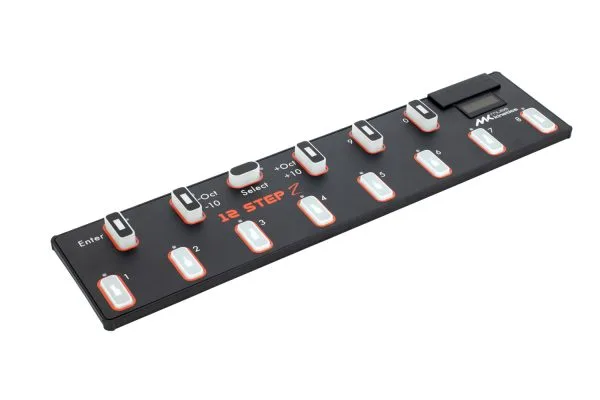

The Muse Kinetics 12 Step2 is a MIDI keyboard controller pedal played with the feet: 12 keys laid out like a keyboard, each with its own red LED, that you step on to output notes and other MIDI messages. Muse Kinetics describes it as the latest MIDI Keyboard controller pedal from Muse Kinetics Music, and it sits in the maker's Steps category1. For a guitarist or bassist, it is a way to play synths, trigger loops, or drive effects hands-free, and it belongs to the wider family of MIDI pedals.
Keys, chords and note modes
Each key has an accompanying red LED for visual feedback, and stepping on a key outputs notes and other MIDI messages2. Every key can play a single note or up to a 5 note chord: the manual explains that each key contains five slots, and each slot can hold a single MIDI note anywhere from 0 (C-2) to 127 (G8)12.
The 12 Step2 offers four note modes, listed in the manual2:
- Normal: notes turn on when a key is pressed, and turn off when the key is released.
- Legato: notes are held, in the maker's words one of the modes that hold notes to create pads and backing harmonies1.
- Toggle: the other holding mode for pads and backing harmonies1.
- Hold: the fourth note mode listed in the manual2.
Connections: MIDI, USB-C and CV
The 12 Step2 connects to external hardware via TRS MIDI Out, 2 CV outputs, and MIDI over USB-C1. The TRS MIDI output is Type A, for connecting to 5 pin MIDI hardware and synths1. The manual likewise describes sending MIDI over USB to a computer or tablet, or connecting to a power supply when using the 12 Step without a computer2.
The two CV outputs send Pitch and Gate CV messages to Eurorack and modular synth rigs, so the same foot performance can drive both MIDI gear and analog modular1.
Expression pedal and MIDI control
A pedal input accepts an external expression pedal, which sends MIDI CC messages from the pedal1. Beyond the keys themselves, pressure and tilt can be mapped to MIDI CC#s to expressively control effects parameters, which makes the 12 Step2 a controller for expression duties as well as note playing1.
Programming and presets
Presets are programmed with the included 12 Step Editor software1, and the 12 Step2 hardware can store up to 64 presets2.
Videos
Muse Kinetics
Questions
Can the 12 Step2 play chords?
Yes. Each of the 12 keys can play a single note or up to a 5 note chord. The maker's manual explains that each key contains five slots, and each slot can hold a single MIDI note anywhere from 0 (C-2) to 127 (G8), so a key can be programmed with a full chord under one step.
Does the 12 Step2 work with Eurorack?
Yes. The 12 Step2 has CV outputs that send Pitch and Gate CV messages, which the maker says lets it drive Eurorack and modular synth rigs alongside its MIDI outputs.
Does the 12 Step2 connect over USB-C?
Yes. The 12 Step2 sends MIDI over USB-C to a computer or tablet, and it also has a TRS MIDI Out (Type A) for connecting to 5 pin MIDI hardware and synths.
What are Legato and Toggle modes?
Legato and Toggle are note modes that hold notes, which the maker says lets you create pads and backing harmonies. The manual lists four note modes: Normal, where notes turn on when a key is pressed and off when released, plus Legato, Toggle, and Hold.
Can I plug an expression pedal into the 12 Step2?
Yes. The 12 Step2 has a pedal input for an external expression pedal, which sends MIDI CC messages and can be mapped for additional control.
How do I program presets on the 12 Step2?
Presets are programmed with the included 12 Step Editor software. The hardware can store up to 64 presets, according to the maker's manual.
Sources (2)
- 12 Step2, Muse Kinetics (keithmcmillen.com)
- 12 Step Manual v3.0.1, Keith McMillen Instruments, 2024