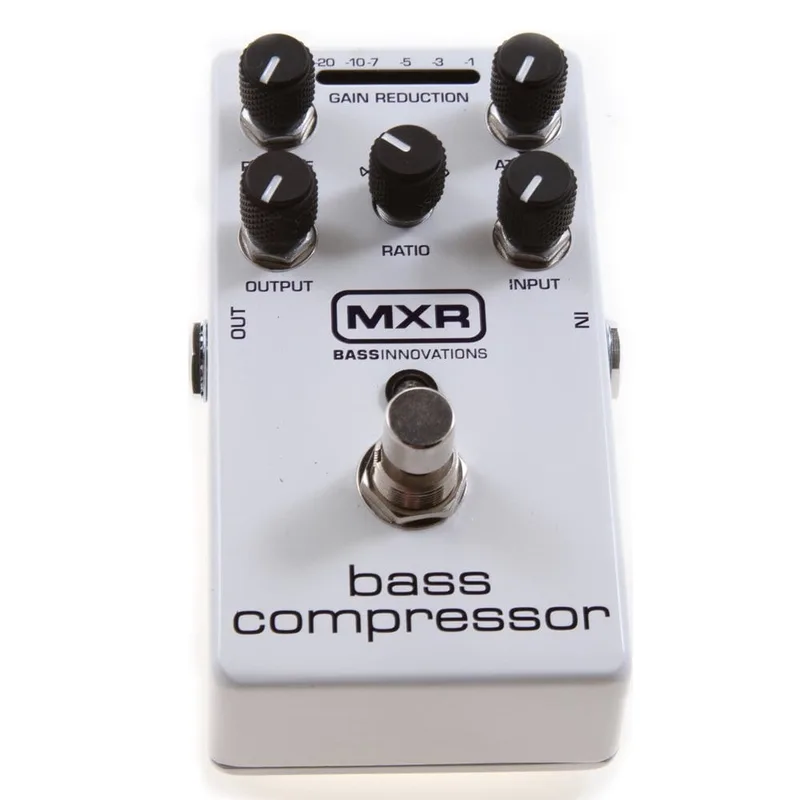


The MXR Bass Compressor (M87) is a studio-style compressor pedal built for bass, made by MXR and first made available in February 2011 as part of the MXR Bass Innovations line1. MXR describes it as delivering recording-quality compression with Constant Headroom Technology (CHT) and true bypass switching, all packed into a durable, lightweight aluminum housing the size of a Phase 902. The maker calls it a totally transparent compressor that lets your full dynamic range through until the signal reaches the compression threshold2.
A studio-style compressor in a Phase 90-sized box
The M87's own manual sums up the concept: "Classic studio compressor in a Phase 90-sized pedal"3. Where most bass compressor pedals of its era offered two or three knobs, the M87 gives you the five controls a rack compressor would, plus a meter, in a box small enough to sit on a crowded pedalboard. Premier Guitar's reviewer noted that "its compact size makes it a handy tool for real-estate-conscious bassists"5.
The circuit is based on a classic studio compressor, as Dunlop's 2011 launch announcement put it6, and MXR says its CHT Constant Headroom Technology gives plenty of headroom and clear performance2. That headroom matters on bass: the pedal accepts a maximum input level of +14 dBV and puts out up to +8.5 dBV, with gain of 31 dB available3.
The controls: Attack, Release, Ratio, Input and Output
MXR says the complete control array makes it easy to fine-tune your sound, from subtle peak limiting to hard squashed compression2. Each knob does what its name suggests, per the manual3:
| Control | What it does |
|---|---|
| Input | Controls the gain level of the input signal, setting where the compressor starts working |
| Attack | Controls the reaction time of the compression |
| Release | Sets how fast the compressor lets go, 50 ms to 1.1 s |
| Ratio | Sets the degree of compression, from mild 4 (4:1) to extreme 20 (20:1) |
| Output | Controls overall effect volume |
The METER display shows gain reduction level and compressor response time, backed by ten gain reduction status LEDs3. Dunlop's own history of the line highlights this: "With knobs for Attack, Release, Ratio, Input, and Output, plus a bright LED meter to monitor gain reduction, these are s"7 the features that set the pedal apart from simpler designs.
Ratios from 4:1 to 20:1 and the gain reduction LEDs
The RATIO knob offers four fixed settings: 4:1, 8:1, 12:1 and 20:13. The manual explains how to read them: the 4 setting selects a 4:1 ratio, the 8 setting selects an 8:1 compression ratio, 12 selects 12:1, and 20 selects 20:13. RATIO sets the degree of compression, from mild 4 (4:1) to extreme 20 (20:1)3.
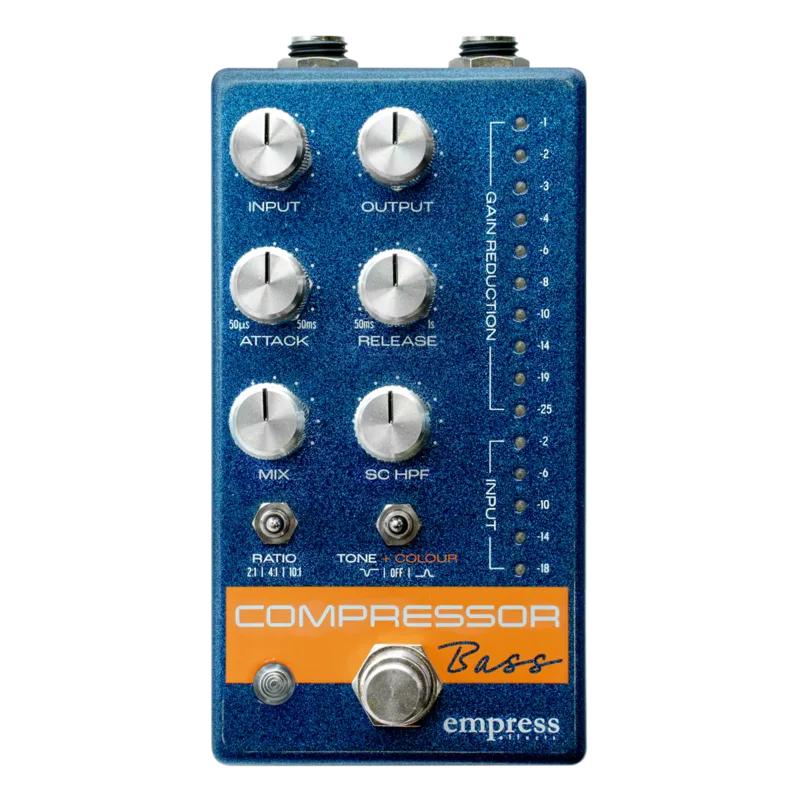
At the top of that range the pedal doubles as a limiter. Premier Guitar's reviewer noted that most adjustable compressors can serve as a limiter by setting the ratio to 20:1 or higher with fast attack and release, and that the M87's 20:1 is more than enough for most limiting purposes, though some bassists might prefer a compressor with variable or higher ratio options5. For comparison, the Empress Bass Compressor offers selectable 2:1, 4:1 and 10:1 ratios89, a different spread aimed more at transparency than hard limiting.
The ten LEDs give you visual feedback on how hard the compressor is working, which is the practical difference between the M87 and one-knob designs: you can see the gain reduction in real time rather than guessing by ear3.
History and versions
There have been two main versions:
| Version | What it is | Status |
|---|---|---|
| M87 Bass Compressor | The original, in MXR's standard aluminum housing | In production, $209.994 |
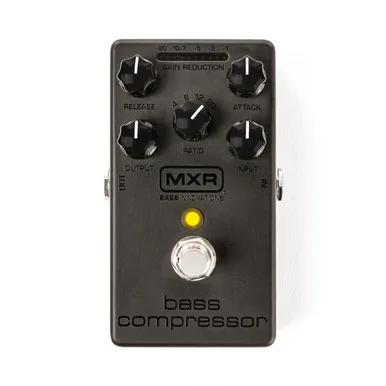
| M87B Blackout Series Bass Compressor | Special edition of 1,500 pieces marking 15 years of MXR Bass Innovations, matte black housing with gloss black text and a bright yellow meter | Legacy product, no longer in production10 |
The Blackout Series M87B is discontinued. If you see one for sale, it is from the limited run of 1,500 pieces; the standard M87 remains in the MXR lineup10.
The M87B is electronically the same pedal: its manual lists the same controls, the same 4:1 to 20:1 ratios, the same 50 ms to 1.1 s release time and true bypass11.
How it differs from the Dyna Comp Bass
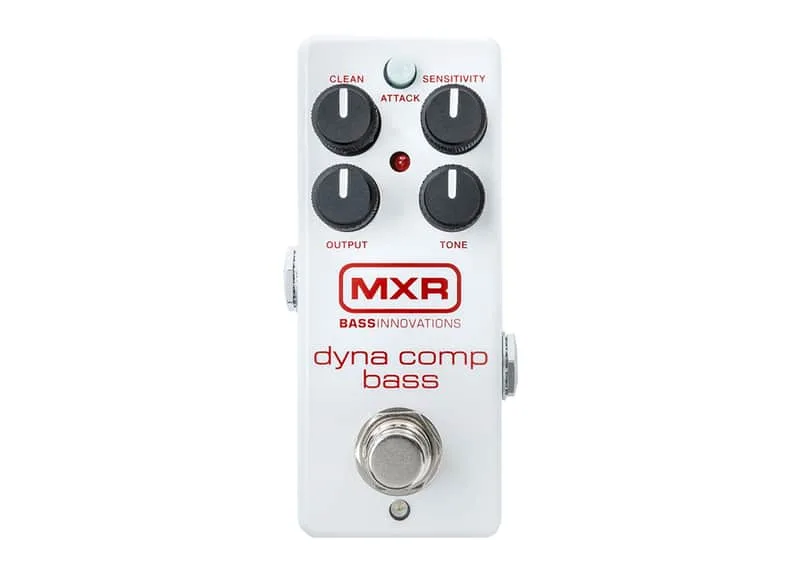
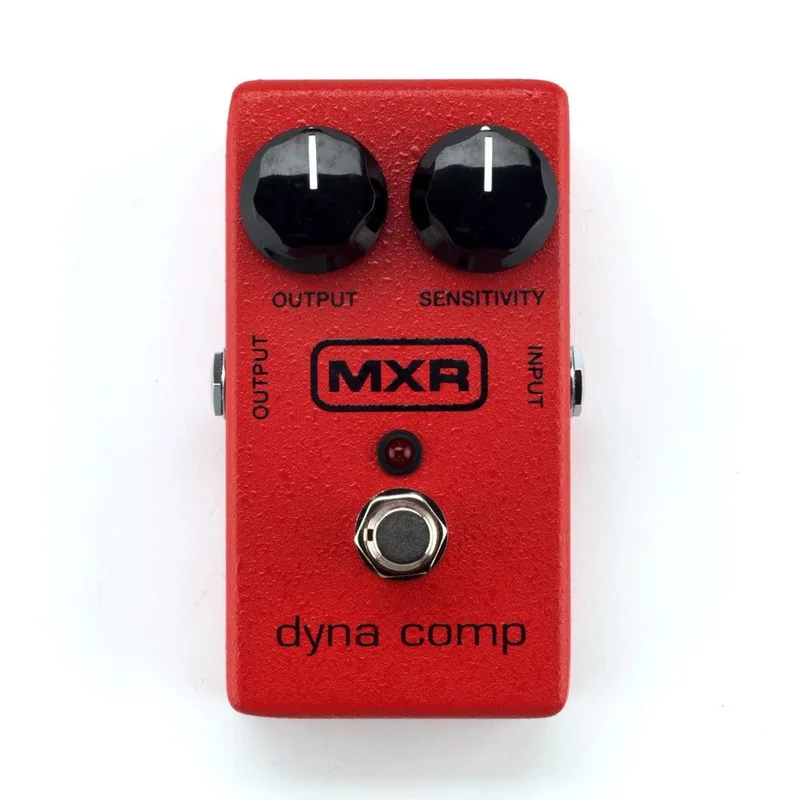
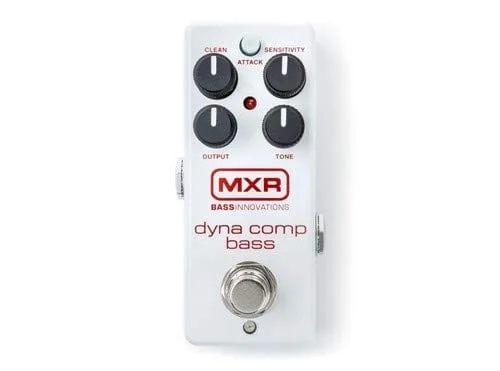
MXR also makes the MXR Dyna Comp Bass Compressor (M282), and the two pedals take opposite approaches. The M282 is a mini pedal based on the MXR Dyna Comp circuit, first produced in the 1970s, with the circuitry tailored to bass frequencies and the nuances of electric bass1213. Where the M87 gives you five knobs and a meter, the M282 keeps the familiar Output and Sensitivity controls for volume and sustain, plus a Tone control, a Clean blend and an Attack switch that toggles between slow and fast attack times12143.
| MXR M87 Bass Compressor | MXR M282 Dyna Comp Bass | |
|---|---|---|
| Format | Phase 90-sized standard pedal3 | Mini housing pedal13 |
| Controls | Attack, Release, Ratio, Input, Output2 | Sensitivity, Output, Tone, Clean, Attack switch21516 |
| Ratios | 4:1, 8:1, 12:1, 20:13 | Fixed compression, max 36 dB14 |
| Metering | Ten gain reduction LEDs3 | None |
| Bypass | True hardwire3 | Not stated |
The M282 is the simpler, smaller and cheaper route, in the spirit of the original Dyna Comp; the M87 is the full studio-style tool. Bass Magazine's review of the M282 found it evened out volume and sustain well behind the artist and performed well on funk and rock133, while MXR promises quiet operation, superior transparency and increased dynamic range from the bass-tuned circuit17.
What reviewers said
Premier Guitar's 2021 review is the most substantive published assessment of the M87. Its reviewer found that pedal compressors often have too few controls for top-quality compression, but the M87 has its own version of a rack compressor's five most potent controls plus a gain-reduction meter7. The same review flagged the fixed ratio steps as the one thing some bassists might want more from, while judging 20:1 sufficient for most limiting5.
MXR's own positioning, that the pedal is totally transparent until the signal reaches the threshold2, is the claim the control set is built to deliver: with Input and Output you set the threshold and make up the lost level, and with the meter you can see exactly what the compressor is doing3.
Videos
BassTheWorld.com
Tsunami Red
GAK
Questions
Is the MXR M87 true bypass?
Yes. MXR's product page lists true bypass switching for the Bass Compressor, and the M87 manual specifies a true hardwire bypass, so the pedal passes your signal untouched when switched off.
Does the MXR Bass Compressor take a 9V battery?
Yes. The M87 runs on one 9-volt battery, installed by removing the bottom plate, or on a Dunlop ECB003 9-volt adapter or an MXR Brick Series power supply.
What is the difference between the MXR M87 and the Dyna Comp Bass?
The M87 is a full-size studio-style compressor with Attack, Release, Ratio, Input and Output controls and a gain reduction meter. The Dyna Comp Bass (M282) is a mini pedal based on the 1970s Dyna Comp circuit, with Sensitivity, Output, Tone, a Clean control and a two-position Attack switch.
Is the Blackout Series M87 still made?
No. MXR lists the Blackout Series Bass Compressor (M87B) as a legacy product no longer in production. It was a special edition run of 1,500 pieces marking 15 years of MXR Bass Innovations.
Can you use the MXR M87 on guitar?
The M87 is voiced for bass, with a frequency response of plus or minus 1 dB from 20 Hz to 20 kHz, which covers the full guitar range too. MXR also makes the M76 Studio Compressor, a Phase 90-sized studio compressor with the same control set aimed at guitar players.
Sources (17)
- Dunlop Announces MXR M87 Bass Compressor Pedal, No Treble, 2011-02-06
- MXR® BASS COMPRESSOR, Dunlop (jimdunlop.com)
- M87.pdf, Jim Dunlop, 2019
- MXR® BASS DI+ SPECIAL EDITION YELLOW, Jim Dunlop (jimdunlop.com)
- MXR M87 Bass Compressor Pedal Review, Premier Guitar, 2011-09-20
- NAMM 2011: Dunlop unveils five MXR stompboxes, MusicRadar, 2011-01-17
- A Dyna Comp-rehensive History, Dunlop (lifestyle.jimdunlop.com), 2018-10-25
- Bass Compressor, Empress Effects Inc.
- Review: Empress Bass Compressor, Bass Musician Magazine, 2025-04-14
- MXR® BLACKOUT™ SERIES BASS COMPRESSOR, Jim Dunlop (jimdunlop.com)
- M87B.pdf, Jim Dunlop (jimdunlop.com), 2023
- MXR® DYNA COMP® BASS COMPRESSOR, Dunlop (jimdunlop.com)
- Review: MXR M282 Dyna Comp Bass Compressor, Bass Magazine, 2019-07-23
- M282.pdf, Jim Dunlop, 2025
- MXR® STUDIO COMPRESSOR, Jim Dunlop (jimdunlop.com)
- MXR Sub Octave Bass Fuzz, Vintage Bass Octave and Dyna Comp Bass review, Guitar World, 2021-08-26
- MXR releases Dyna Comp Bass Compressor pedal, MusicRadar, 2019-02-27