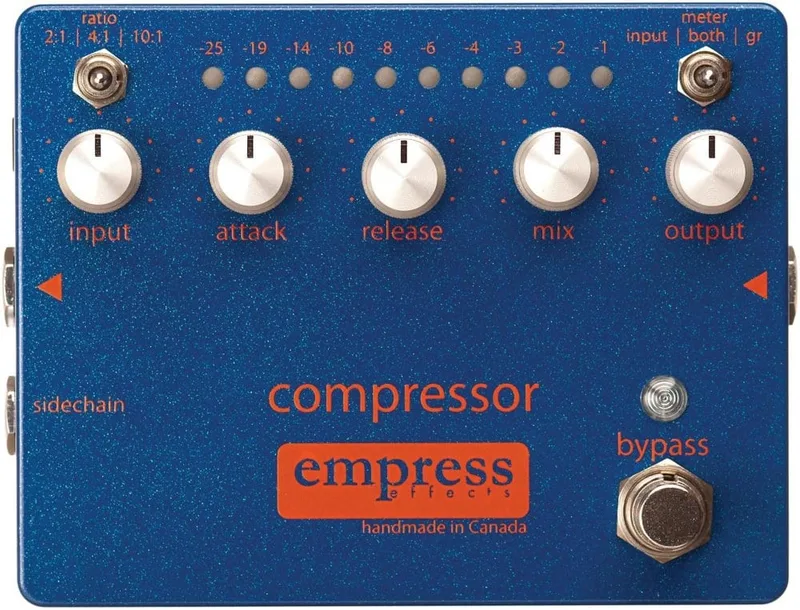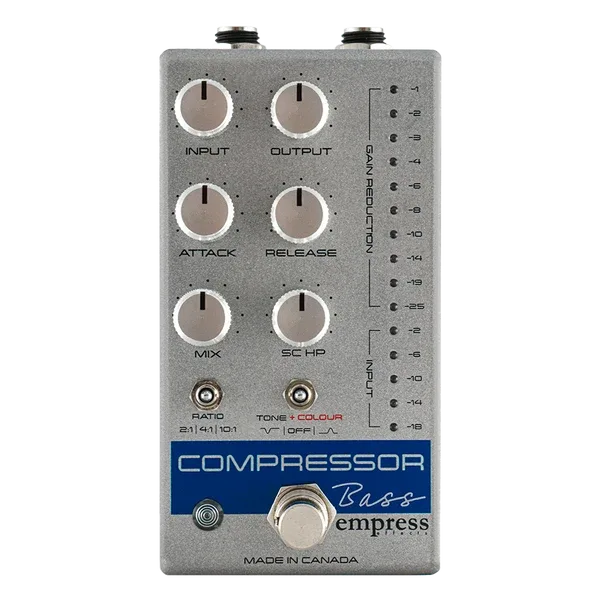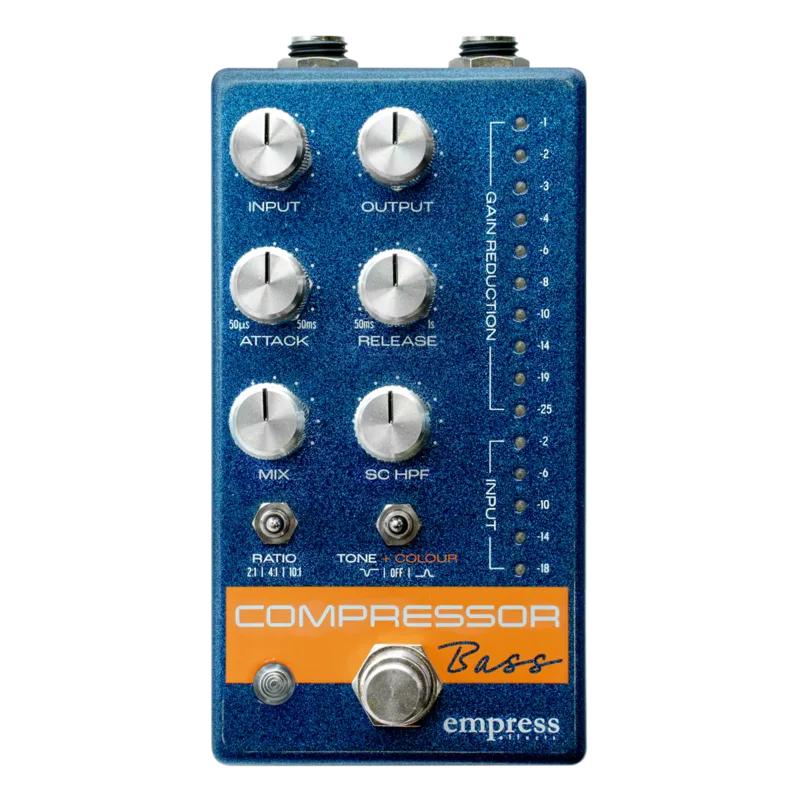
The Empress Bass Compressor is a compressor pedal built specifically for bass guitar, made by Empress Effects. It uses FET compression in an all-analog signal path, which Empress says preserves your instrument's original tone while adding dynamic control1. Released on November 25, 2020 alongside the guitar-oriented Compressor MKII, it grew out of the original 2011 Empress Compressor, which the maker says "sounded great on bass (and still does!)" but which they "set out to do even better" with a dedicated bass design123.
For a bassist, the point of this pedal is studio-style control on a pedalboard: selectable compression ratios, a sidechain high-pass filter so your low frequencies do not trigger pumping, separate gain reduction and input metering, and a Mix control for parallel compression. Bass Musician Magazine's Cláudio Ribeiro called it "a precision tool for serious players," delivering "studio-grade functionality in a compact pedal format"4.
Analog FET compression for bass
The pedal is built around FET compression, the same circuit family as the Compressor MKII, which Empress describes as a "FET compressor with transparent, all-analog signal path"3. Empress pitches the Bass Compressor as "pure analog compression without any digital interference," preserving the instrument's original tone while adding dynamic control1.
The measured performance backs up the transparency claim on paper: distortion is specified at less than 0.1%, noise at 101dB, and frequency response at 10Hz to 20kHz at -3dB, which comfortably covers the full range of a bass1. Input impedance is 1MΩ and output impedance 2.2kΩ1.
Guitar World's 2026 bass compressor guide made the Empress Effects Bass Compressor its pick for transparency, citing "ultra transparent tones, excellent metering, lots of options"5.
The controls
Guitar World lists the full control set as Input, Output, Attack, Release, Mix, SC HP, Ratio and Tone+Color5.
| Control | What it does |
|---|---|
| Input | Sets how much signal hits the compression circuit4 |
| Output | Sets how much signal comes out the other side4 |
| Attack | Shapes how quickly compression engages |
| Release | Shapes how quickly compression lets go |
| Ratio | Selects 2:1, 4:1 or 10:11 |
| Mix | Blends uncompressed and compressed signals for New York-style parallel compression1 |
| SC HP | Variable sidechain high-pass filter, 20Hz to 400Hz1 |
| Tone + Color | 3-position switch: flat, mid cut at 500Hz, or upper-mid boost at 2kHz, optionally adding harmonic distortion1 |
The three ratio settings cover the practical range for bass: 2:1 for gentle leveling, 4:1 for firmer control and 10:1 for hard limiting. The same three ratios have been on Empress compressors since the original 2011 Compressor3. In his 2025 review, Cláudio Ribeiro flagged this as the pedal's main limitation: "While practical, some may prefer finer control (e.g., 6:1, 8:1)"4.
The Mix control is what makes heavy settings usable. Empress describes it as blending "uncompressed and compressed signals using the Mix control for New York-style parallel compression"1, the technique of running clean and compressed signals together so you keep attack and character while gaining sustain and evenness.
The Tone + Color circuit is unique to the bass version. Empress calls it "a two position 'tone + colour' circuit which adds gentle tone sculpting and harmonic distortion, giving your bass some d[imension]"1. In practice it is a 3-position switch: flat, a mid cut at 500Hz, or an upper-mid boost at 2kHz, with the option of adding harmonic distortion1.
Sidechain and metering
The sidechain is where the Bass Compressor most differs from a generic compressor pedal. The SC HP control adjusts a variable high-pass filter from 20Hz to 400Hz for what Empress calls "precise control over low-frequency compression"1. In plain terms, the filter sits in the detection path, not the audio path: the lower you set it, the more your low E and B strings drive the compression, and the more the pedal pumps. Raising it lets the deep fundamentals through untouched while the compressor works on the mids and highs.
There is also a physical sidechain connection: a 3.5mm TRS jack send and return for sidechain compression1. Ribeiro explained the use case: "The external sidechain input (1/8″) allows the compressor to react to an entirely different source, for instance, a kic[k]"4. A recording or live player could, for example, key the bass compression from a kick drum so the two lock together.
For metering, the pedal meters both gain reduction and input on separate meters2, so you can see how hard you are driving the circuit and how much it is compressing at the same time.
Power and connections
Power comes from a 9V DC center-negative supply through a 2.1mm barrel connector, drawing roughly 100mA1. Guitar World's guide lists the same figures, 9V DC 100mA5. That current draw is on the higher side for an analog pedal, so a shared supply would need enough headroom to cover it.
Audio connections are a 1/4" jack input and a 1/4" jack output, plus the 3.5mm sidechain jack1. The enclosure is die cast aluminum, 2.5" high by 4.8" long by 2.6" wide, weighing 1lb1. When it launched, Premier Guitar noted the new enclosure was "approximately half the size of the original compressor"2.
History: from the original Empress Compressor
Empress Effects released its original Compressor in 2011, and it "quickly became a favourite among guitar and bass players alike"3. That pedal offered the same three ratios (2:1, 4:1 and 10:1) and a pro-style control set of Attack, Release and Ratio67, and Empress noted it "works great on bass, keys or even vocals"7.
In November 2020 the company split the line in two. On November 4, Guitar World reported that Empress was "reboots[ing] one of the top compressor pedals on the market" with the Compressor MKII and launching a new bass version, both available to preorder for $249 and shipping November 258. Premier Guitar's announcement confirmed the November 25 release date and the $249 US price for both pedals2.
The original Compressor has since been discontinued and replaced by the Compressor MKII and the Bass Compressor9. The MKII carries the same circuit and sound as the original with a new tone knob and top-mounted jacks, while the Bass Compressor is the bass-specific design with the variable sidechain filter, the Tone + Color switch and the external sidechain jack101. By 2025, Bass Musician Magazine described the Bass Compressor as one of Empress's "best-reviewed and top-sellin[g]" products11.
The pedal has shipped in a royal blue sparkle paint job, also available in silver sparkle12, and Empress also lists S&D Compressor Bass editions in both finishes.
What reviewers said
Bass Musician Magazine has reviewed the pedal twice. Jake Wolf's 2022 review walked through the control set, noting that "Like the original Empress Compressor, the Empress Bass Compressor has an Input knob"12. Cláudio Ribeiro's 2025 review judged it a precision tool with full metering, sidechain filtering and parallel compression, at a premium price, with the limited ratio settings as the main caveat4.
Guitar World's 2026 bass compressor guide made it its pick for transparency, citing it for jazz and blues players who want "a nice, even playing performan[ce]"5.
"The external sidechain input (1/8″) allows the compressor to react to an entirely different source, for instance..."
Empress lists Brian Kobayakawa among the artists who use the Bass Compressor1.
Questions
What compression ratios does the Empress Bass Compressor have?
It offers three selectable ratios: 2:1, 4:1 and 10:1. That covers gentle leveling at 2:1, firmer control at 4:1 and hard limiting at 10:1. Some reviewers noted that players who want intermediate settings such as 6:1 or 8:1 may find the three choices limiting.
Is the Empress Bass Compressor true bypass?
Yes. Empress specifies an all-analog signal path with true bypass switching, so the pedal does not affect your signal when it is disengaged. It runs on 9V DC center negative at roughly 100mA through a 2.1mm barrel connector.
What is the difference between the Empress Compressor MKII and the Bass Compressor?
Both were released on November 25, 2020 and share the same FET compression approach, but the Bass Compressor is voiced and equipped for bass: a variable sidechain high-pass filter from 20Hz to 400Hz, a Tone + Colour switch with bass-focused settings, and an external sidechain input. The MKII is the guitar-oriented update of the original 2011 Compressor.
How do you use the sidechain on the Empress Bass Compressor?
Two ways. The SC HP control sets a variable high-pass filter from 20Hz to 400Hz so low frequencies trigger less compression, which keeps the low end from pumping. There is also a 3.5mm TRS send and return jack that lets the compressor react to an entirely different source, such as a kick drum.
Is the Empress Bass Compressor analog?
Yes. Empress describes an all-analog signal path with FET compression, preserving the instrument's original tone while adding dynamic control, with no digital processing in the audio path. Distortion is specified at less than 0.1%.
Who uses the Empress Bass Compressor?
Empress lists Brian Kobayakawa among the artists who use the Bass Compressor. Guitar World's bass compressor guide cites it for jazz and blues players who want transparent, studio-style compression, and made it its pick for transparency in its 2026 update.
Sources (12)
- Bass Compressor, Empress Effects Inc.
- Empress Effects Launches Compressor MkII & Bass Model, Premier Guitar, 2020-11-12
- Compressor MKII, Empress Effects Inc.
- Review: Empress Bass Compressor, Bass Musician Magazine, 2025-04-14
- Best bass compressor pedals 2026: ultimate low-end control, Guitar World, 2022-05-11
- Empress Effects Introduces Compressor Pedal, No Treble, 2011-07-29
- Empress Effects Launches Compressor Pedal, Premier Guitar, 2011-07-27
- Empress reboots one of the top compressor pedals on the market, and launches new bass version, Guitar World, 2020-11-04
- Compressor, Empress Effects Inc.
- Empress Effects Compressor MKII, Delicious Audio, 2022-08-31
- Gear News: Empress Effects Releases Dedicated EQ Pedal for Bass Instruments, Bass Musician Magazine, 2025-05-21
- Review: Empress Bass Compressor, Bass Musician Magazine, 2022-02-28