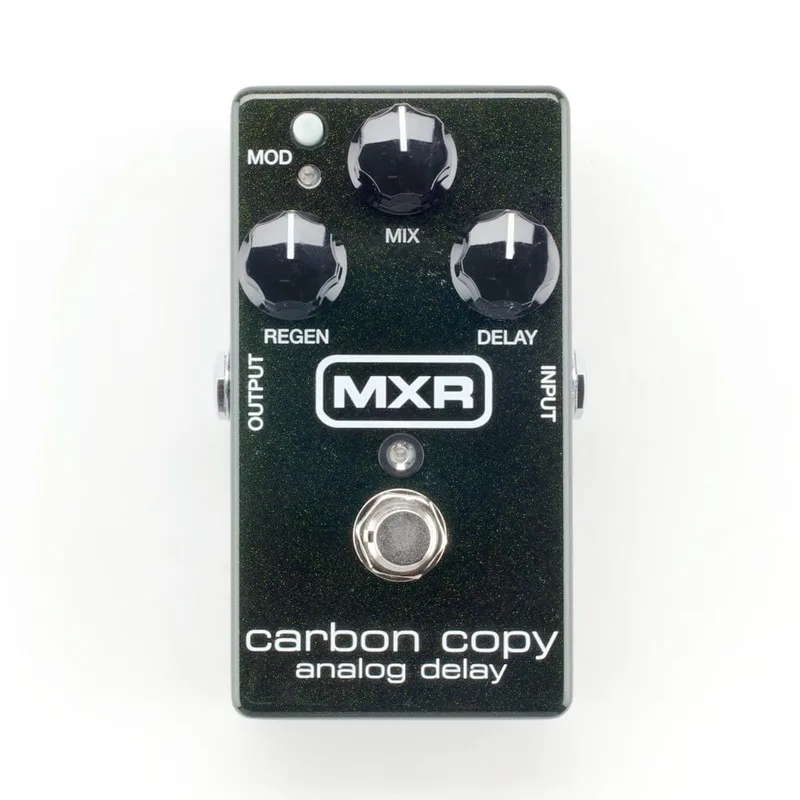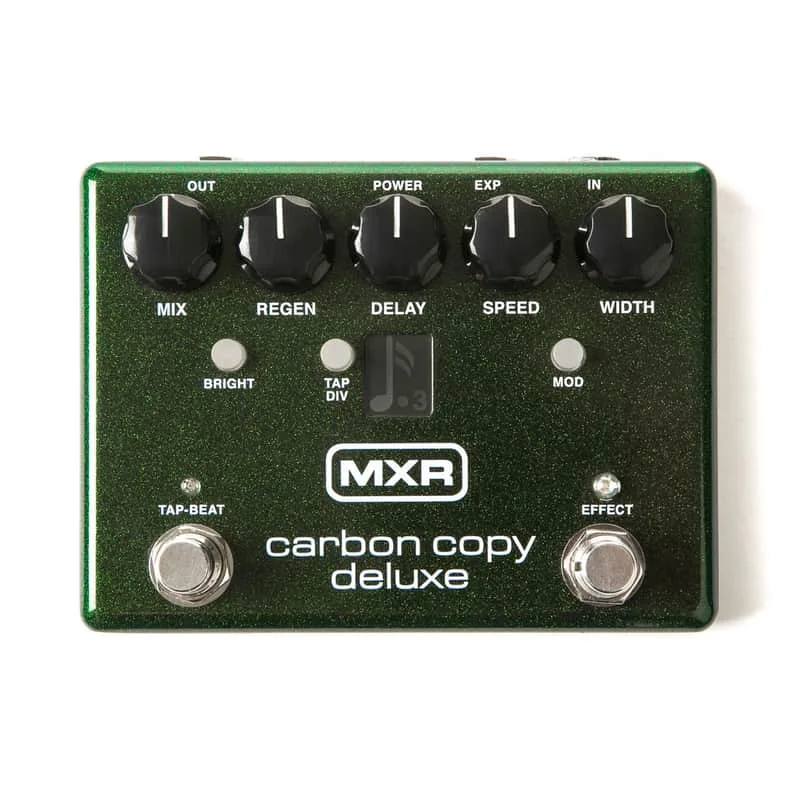


The MXR Carbon Copy Deluxe Analog Delay (M292) is an analog delay pedal from MXR, first released in 2017 as an expanded version of the company's Carbon Copy Analog Delay1. Where the original Carbon Copy gives you 600ms of delay time, the Deluxe doubles that to a full 1.2 seconds and adds the tap tempo facility players had been asking for since the original launched21. Under the hood it keeps the analog bucket-brigade design the Carbon Copy line is known for: Guitar World's review counts eight bucket-brigade chips inside3.
The controls
The Deluxe keeps the three core knobs familiar from the original Carbon Copy and adds top-panel control over the modulation that was buried inside the M1692.
| Control | What it does |
|---|---|
| DELAY knob | Sets delay time4 |
| REGEN knob | Sets number of repeats4 |
| SPEED knob | Controls rate of the modulation effect4 |
| TAP-BEAT footswitch | Sets tempo of repeats, indicated by an orange LED4 |
| EFFECT footswitch | Toggles effect on/bypass4 |
| TAP DIV switch | Engages and selects one of four tap tempo subdivisions: dotted 8ths, 8ths, Triplets, and 16ths4 |
| EXP jack | Allows external control of various functions4 |
The pedal comes in MXR's compact wide housing to accommodate the multiple controls on its top panel3. There are footswitches for Tap-Beat (tap tempo) and Effect (on/off), with an orange LED above the Tap-Beat that flashes the current tempo3.
The modulation is a big practical difference from the original. On the M169, modulation is optional and adjusted with internal trim pots for width and rate6; on the Deluxe, the Speed knob sits on the top panel alongside the delay controls, so you can dial in modulation on the fly rather than opening the box.
Tap tempo up to 1.2 seconds
The headline feature is tap tempo. The M292's tap tempo switch unlocks a full 1.2 seconds of delay potential, with delay time spanning 40ms to 1200ms41. Pedal of the Day called tap tempo "probably the main thing everyone wanted that was missing about the original"5.
The Tap Division switch, accompanied by an easy-to-read status display, gives four subdivisions: dotted 8ths, 8ths, triplets, and 16ths1. That covers the rhythmic settings most players use for tempo-synced delays, from straight eighths to the dotted-eighth pattern common in ambient and rock playing.
The pedal also holds two preset slots7. Combined with the expression jack, this gives you more flexibility than the single-knob original: you can program two different configurations of the Delay, Speed, and Width knobs and the Bright, Tap Div, and Mod switches, then blend or switch between them1.
Expression and external control
The EXP jack accepts an expression pedal or an external footswitch4. An expression pedal sweeps between the two programmable "A" and "B" setting configurations; the MIX and REGEN knobs cannot be controlled with an expression pedal4. An external tap switch can act as a tap tempo control, toggle between A and B configurations, or control the Bright, Tap Div, or Mod buttons when programmed at power-up4.
History and versions
The Carbon Copy family starts with the MXR Carbon Copy Analog Delay (M169), released in 2008, which MXR describes as delivering rich, warm bucket-brigade delay with up to 600ms of delay time and modulation68. Dunlop notes that in the 10 years since its 2008 release, the Carbon Copy became a rock 'n' roll staple8.
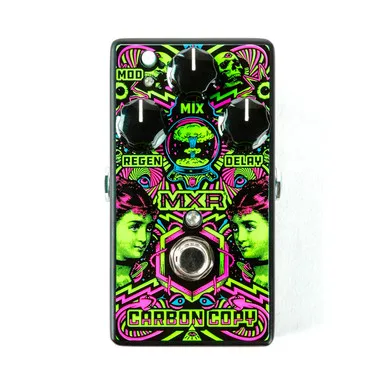
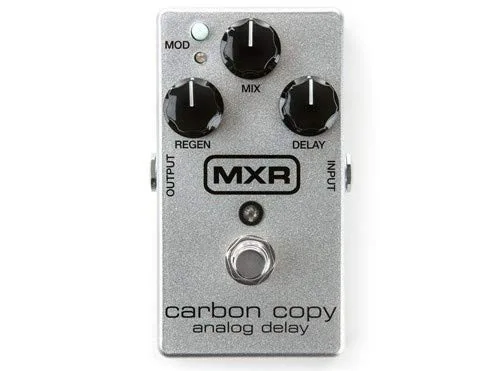
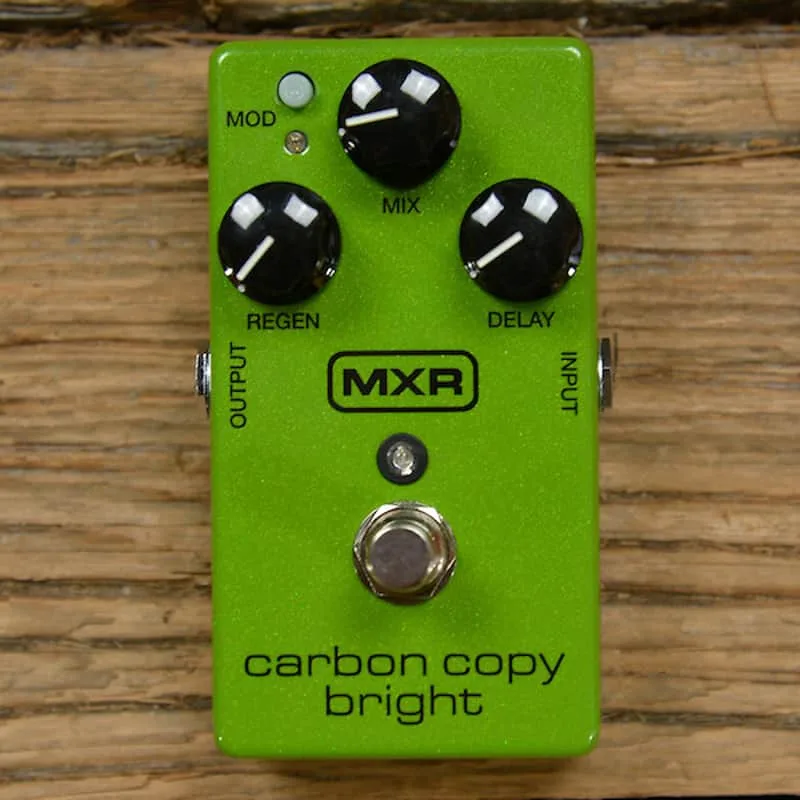
The Carbon Copy family has since grown to include the Carbon Copy Deluxe Analog Delay, announced with availability due that October91011, and the Carbon Copy Mini Analog Delay (M299), a compact version with 600ms of delay time1012, and a 10th Anniversary Edition of the original with the same circuit and features91011.
| Version | Delay time | Notable differences |
|---|---|---|
| Carbon Copy (M169) | 20ms to 600ms21 | Internal modulation trim pots2 |
| Carbon Copy Deluxe (M292) | 40ms to 1200ms4 | Tap tempo, subdivisions, two presets, top-panel modulation, expression jack41 |
| Carbon Copy Mini (M299) | 600ms1012 | Compact size, no battery power10 |
What reviewers said
Guitar World's Paul Riario reviewed the Deluxe in March 2018 and was positive about both its flexibility and its sound:
"For its ace versatility and authentic echo, the Carbon Copy Deluxe is a benchmark among analog delays3."
Paul Riario, Guitar World3
Delicious Audio's best-analog-delays guide describes the Deluxe as an expanded version of the classic Carbon Copy with more delay time (1200ms), two preset slots, tap tempo and subdivisions7. Pedal of the Day's write-up says the Deluxe "takes the original and makes it better," all while retaining the warm sounds the original is famous for5.
For context on the family as a whole, MusicRadar's buying guide lists "authentic analogue delay tones" among the Carbon Copy's strengths13, and gearnews' delay buying guide reports that user feedback consistently praises the Carbon Copy for how naturally it sits in a mix, especially with overdrive and fuzz where cleaner digital delays can feel too sharp14.
Videos
ProGuitarShopDemos
Sweetwater
Reverb
Questions
Can the Carbon Copy Deluxe run on a battery?
Yes. The manual lists a 9-volt battery, a Dunlop ECB003 9-volt adapter, or the DC Brick and Iso-Brick power supplies. Note that the smaller Carbon Copy Mini cannot run on a battery at all, so the Deluxe is the battery-friendly option in the family.
Can I use the Carbon Copy Deluxe in an effects loop?
Yes. Pedal of the Day reports the pedal has selectable Line Level or Instrument functionality, so it can run in front of your amp or in an amp's FX loop. The internal switch lets you match the level of wherever you place it.
Is the MXR Carbon Copy Deluxe true analog?
Yes. Guitar World's review notes the Deluxe features eight bucket-brigade chips, the same class of analog delay circuit as the original Carbon Copy, which MXR describes as 100% analog bucket-brigade technology. The repeats are analog, not digital emulations.
What is the difference between the Carbon Copy and the Carbon Copy Deluxe?
The original Carbon Copy (M169) offers 600ms of delay time with internal modulation trim pots. The Deluxe (M292) doubles delay time to 1200ms, adds tap tempo with four subdivisions, two preset slots, top-panel modulation knobs, and an expression jack.
Does the Carbon Copy Deluxe take an expression pedal?
Yes. The EXP jack accepts an expression pedal or an external footswitch. An expression pedal sweeps between two programmable A and B configurations of the Delay, Speed and Width knobs and the Bright, Tap Div and Mod switches. The Mix and Regen knobs cannot be expression controlled.
Sources (14)
- MXR® Carbon Copy® Mini Analog Delay, Dunlop (lifestyle.jimdunlop.com), 2019-05-15
- M169.pdf, Dunlop Manufacturing, Inc., 2019
- Review: MXR Carbon Copy Deluxe Analog Delay, Guitar World, 2018-03-01
- M292.pdf, Jim Dunlop (jimdunlop.com/mxr), 2019
- MXR Carbon Copy Deluxe Analog Delay, Pedal of the Day, 2020-08-30
- MXR® CARBON COPY® ANALOG DELAY, Dunlop (jimdunlop.com)
- 2023 UPDATE: The Best Analog Delay Pedals (Mono & Stereo), Delicious Audio, 2024-01-04
- MXR® CARBON COPY® ANALOG DELAY 10TH ANNIVERSARY EDITION, Dunlop (www.jimdunlop.com)
- Summer NAMM 2017, gearnews.com, 2017-07-14
- Review: MXR's Carbon Copy Mini is a sonic beast of an analog delay, Guitar World, 2019-11-15
- MXR® TREMOLO, Jim Dunlop (jimdunlop.com)
- M299.pdf, Jim Dunlop, 2019
- Best delay pedals: add extra dimension to your tone, MusicRadar, 2022-05-17
- The 7 Best Delay Pedals for any Budget: Endless Depth and Lush Vibes, gearnews.com, 2026-01-19