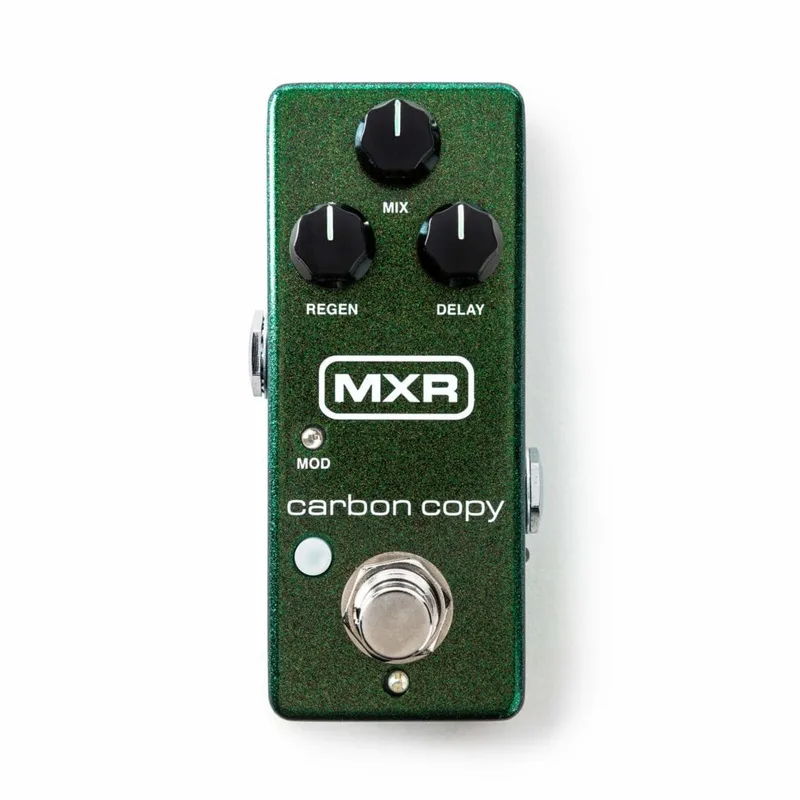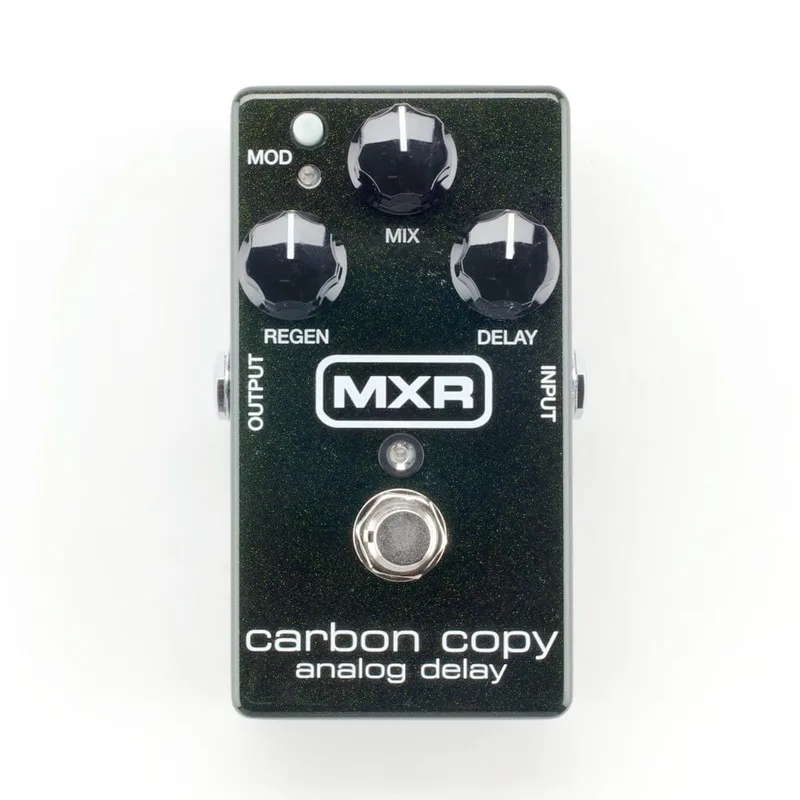


The MXR Carbon Copy Analog Delay (model M169) is a compact delay pedal built entirely on analog bucket-brigade technology, the same approach as the vintage tape and BBD units it takes its cues from. It offers up to 600ms of delay time with optional modulation, controlled from a three-knob faceplate of Delay, Mix and Regen12. MXR released it in 2008, and the maker describes it as the world's bestselling analog delay pedal3.
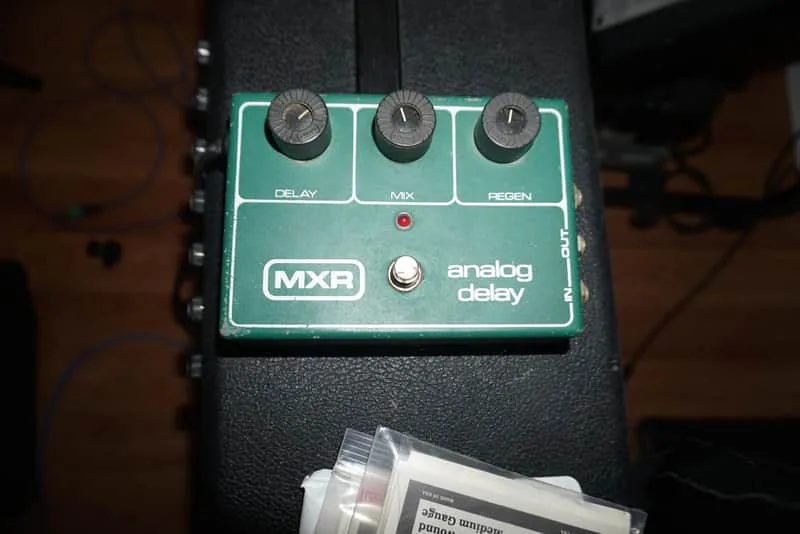
Where a digital delay samples and replays your signal, a bucket-brigade device passes it along a chain of capacitors, one small step at a time, which rolls off high end and thickens the repeats. MXR promises the result is "rich, warm delay - made possible only by old-school bucket brigade technology"4. The pedal traces its lineage to the old MXR Analog Delay discontinued in the eighties, sharing its three-knob layout and greenish coloring, in what MusicRadar's reviewer called "a much spanglier metallic shade this time around"5.
What it does to your sound
The Carbon Copy is a true analog bucket-brigade device, which GuitarPlayer's buying guide says lets it emulate the best qualities of vintage tape echoes7. Delay time runs from 20 ms to 600 ms2, an impressive span for an analog unit; MusicRadar noted that much vintage and some new-build delay tops out around 300 ms5.
MusicRadar's reviewer described the range of sounds available: "The sounds range from springy metallic reverb at very short delay times through Elvis-style slapback and on to all types of rhythmic and ambient delay - revisiting Edge and Gilmour up to the maximum 600ms"5. The repeats have the dark, mellow character the pedal became known for; MXR's own page for the Mini version says its default mode yields "the dark, mellow wash that made the Carbon Copy Analog Delay famous"8.
A Mod switch adds modulation to the repeats only, which Premier Guitar's reviewers said "replicates the tape warble found in older tape units"9. The pedal also includes a 2:1 noise reduction ratio2.
The controls
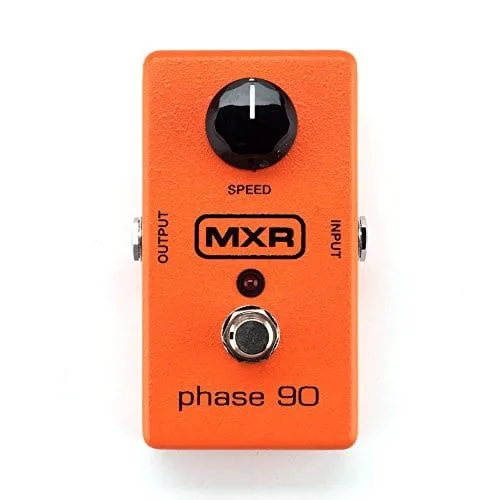
The faceplate keeps things simple: three knobs and two switches, the same size as other MXR pedals such as the Phase 90, with a triangular knob configuration5.
| Control | What it does |
|---|---|
| DELAY knob | Sets delay time, 20 ms to 600 ms2 |
| REGEN knob | Sets the number of repeats2 |
| MIX knob | Blends wet and dry signals; fully clockwise is 100% wet, fully counterclockwise is 100% dry2 |
| MOD switch | Toggles modulation on/off, blue LED indicates on2 |
| FOOTSWITCH | Toggles effect on/bypass, blue LED indicates on2 |
MusicRadar counted it as five controls in total, since the modulation rate and width sit on two internal trim pots4. Inside the case you will find a Width trimpot and a Rate trimpot for dialing the modulation to taste31. The modulation speed range is 0.2 Hz to 2.2 Hz2. MXR describes the effect as adding "wow and flutter a la vintage tape echo units or to simply give your repeats extra richness and depth"3.
To change the modulation character you have to remove the bottom plate and turn the trim pots with a small screwdriver. MusicRadar's buying guide listed "internal trim pots are tiny" among its reasons to avoid the pedal10.
Power and specifications
The Carbon Copy runs on one 9-volt battery (installed by removing the bottom plate), a Dunlop ECB003 9-volt adapter, or the DC Brick, Iso-Brick and Mini Iso-Brick power supplies1. Current draw is 26 mA at 9 volts DC2.
| Specification | Value |
|---|---|
| Delay time | 20 ms to 600 ms2 |
| Modulation speed | 0.2 Hz to 2.2 Hz2 |
| Noise reduction | 2:1 ratio2 |
| Input impedance | 1 MΩ2 |
| Output impedance | 1 kΩ2 |
| Max input level | +5 dBV at 500 Hz2 |
| Max output level | +8 dBV2 |
| Delay distortion | <1% at 1 kHz, -5 dBV input2 |
| Bypass | True hardwire2 |
History and versions
MXR released the Carbon Copy in April 20084. In the years since, the family has grown into several versions:
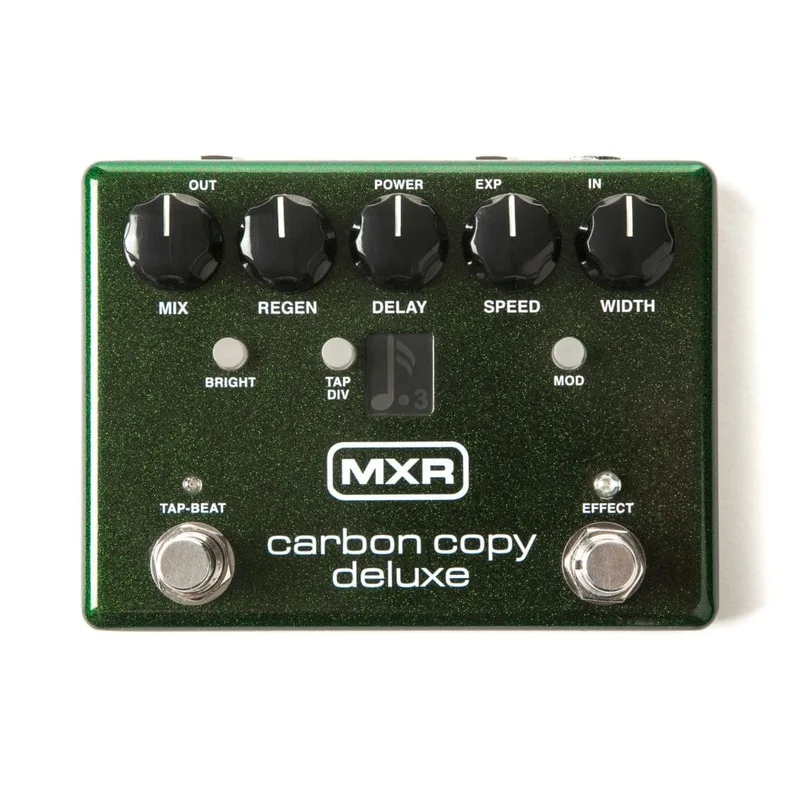
- Carbon Copy Deluxe (M292), 2017. An expanded version with 1200ms of delay time, tap tempo, subdivisions and programmable presets1112. See the MXR Carbon Copy Deluxe.
- Carbon Copy Mini (M299). The same bucket-brigade circuit in an MXR mini housing, with a Bright switch for extra high-end presence; it cannot run on a battery1314. See the MXR Carbon Copy Mini Analog Delay.
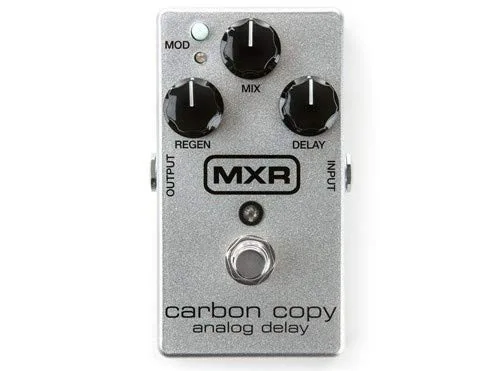
- 10th Anniversary Edition (M169A), 2018. A limited edition in a lightweight aluminum housing with a metallic silver finish, with innards identical to the normal green version; now a legacy product no longer in production315. See the MXR Carbon Copy 10th Anniversary Analog Delay.
- ILOVEDUST Carbon Copy (ILD169), 2018. A limited edition with artwork by the UK design collective ilovedust, functionally identical to the standard model; also no longer in production16176. See the MXR ILOVEDUST Carbon Copy Analog Delay.
The original green sparkle chassis is the finish most players know; the 2018 anniversary edition swapped it for silver18.
What reviewers said
MusicRadar's review verdict was short and positive: "Great sounds in a compact box - brilliant"5. The same review praised how much control fits into the Phase 90-sized enclosure5. Premier Guitar's reviewers were equally taken, with one writing that "The MXR Carbon Copy is one of the most musical analog delays I've ever tried," and noting that the repeats setting "provided a naturally occurring trail of echos that was never apparent on most older units - never too much or too little"9.
Gearnews' 2026 buying guide called it "a reference point for what 'analog delay' is supposed to sound like," built like a tank, and said user feedback consistently praises how naturally it sits in a mix, especially with overdrive and fuzz where cleaner digital delays can feel too sharp19. GuitarPlayer's guide recommended it for players who like dark, moody delay, listing its small footprint and useful modulation option as strengths and difficult battery access as the main drawback7.
Not every take was glowing. Gearnews' coverage of the 10th Anniversary Edition shrugged that "it is still the same old delay just in a new silver case. Not exactly a huge deal"15.
Who uses it
Dunlop's artist pages list Tosin Abasi and Javier Reyes of Animals as Leaders among users of the Carbon Copy Analog Delay20.
Videos
ProGuitarShopDemos
Sweetwater
Reverb
Questions
Is the MXR Carbon Copy true bypass?
Yes. The M169 manual lists the bypass as true hardwire, and MusicRadar's coverage of the pedal also describes it as true bypass24. The footswitch toggles the effect on and off, with a blue LED showing when it is engaged2.
How do you adjust the modulation on the Carbon Copy?
Push the Mod switch to add modulation to the repeats, then remove the bottom plate and set the two internal trim pots: one for width, one for rate21. The modulation speed range is 0.2 Hz to 2.2 Hz2. MusicRadar's one complaint was that the trim pots are tiny10.
What is the difference between the Carbon Copy and the Carbon Copy Deluxe?
The Deluxe (M292) extends delay time from 600ms to 1200ms and adds tap tempo with subdivisions, programmable presets, and Speed and Width knobs on the surface instead of internal trim pots1221. It also draws more current, up to 44 mA with its LEDs on, versus 26 mA for the original212.
What was the original Carbon Copy's enclosure color?
Green sparkle. The 10th Anniversary Edition of 2018 replaced the green sparkle chassis with a lightweight aluminum frame in a metallic silver finish, but the circuit inside was identical to the standard green version1815.
Does the MXR Carbon Copy take a battery?
Yes. The M169 runs on one 9-volt battery, installed by removing the bottom plate, or on a Dunlop ECB003 9-volt adapter or a DC Brick, Iso-Brick or Mini Iso-Brick power supply1. GuitarPlayer's buying guide noted that battery access is difficult7.
Sources (21)
- MXR® CARBON COPY® ANALOG DELAY, Dunlop (jimdunlop.com)
- M169.pdf, Dunlop Manufacturing, Inc., 2019
- MXR® CARBON COPY® ANALOG DELAY 10TH ANNIVERSARY EDITION, Dunlop (www.jimdunlop.com)
- New analogue delay and tremolo pedals from MXR, MusicRadar, 2008-02-01
- MXR Carbon Copy review, MusicRadar, 2008-05-23
- MXR® CARBON COPY® ANALOG DELAY, Jim Dunlop (www.jimdunlop.com)
- Best delay pedals 2026: from slapback to space age, GuitarPlayer (www.guitarplayer.com), 2023-07-26
- MXR® CARBON COPY® MINI ANALOG DELAY, Dunlop (jimdunlop.com)
- Stomp on This! 28 Stompboxes Reviewed, Premier Guitar, 2008-10-15
- Best delay pedals: add extra dimension to your tone, MusicRadar, 2022-05-17
- MXR® Carbon Copy® Mini Analog Delay, Dunlop (lifestyle.jimdunlop.com), 2019-05-15
- 2023 UPDATE: The Best Analog Delay Pedals (Mono & Stereo), Delicious Audio, 2024-01-04
- Review: MXR's Carbon Copy Mini is a sonic beast of an analog delay, Guitar World, 2019-11-15
- M299.pdf, Jim Dunlop, 2019
- MXR Carbon Copy 10th Anniversary Edition: The 'silver fox' of delay pedals?, gearnews.com, 2018-10-22
- MXR® ILOVEDUST CARBON COPY® ANALOG DELAY, Dunlop (jimdunlop.com)
- MXR introduces Dyna Comp Deluxe, limited edition Carbon Copy & Phase 90, gearnews.com, 2018-07-03
- MXR releases the Tenth Anniversary Carbon Copy Analog Delay, Guitar.com, 2018-10-19
- The 7 Best Delay Pedals for any Budget: Endless Depth and Lush Vibes, gearnews.com, 2026-01-19
- Animals As Leaders is a Dunlop Artist., Jim Dunlop (jimdunlop.com)
- M292.pdf, Jim Dunlop (jimdunlop.com/mxr), 2019
 Joe Perry
 J Mascis