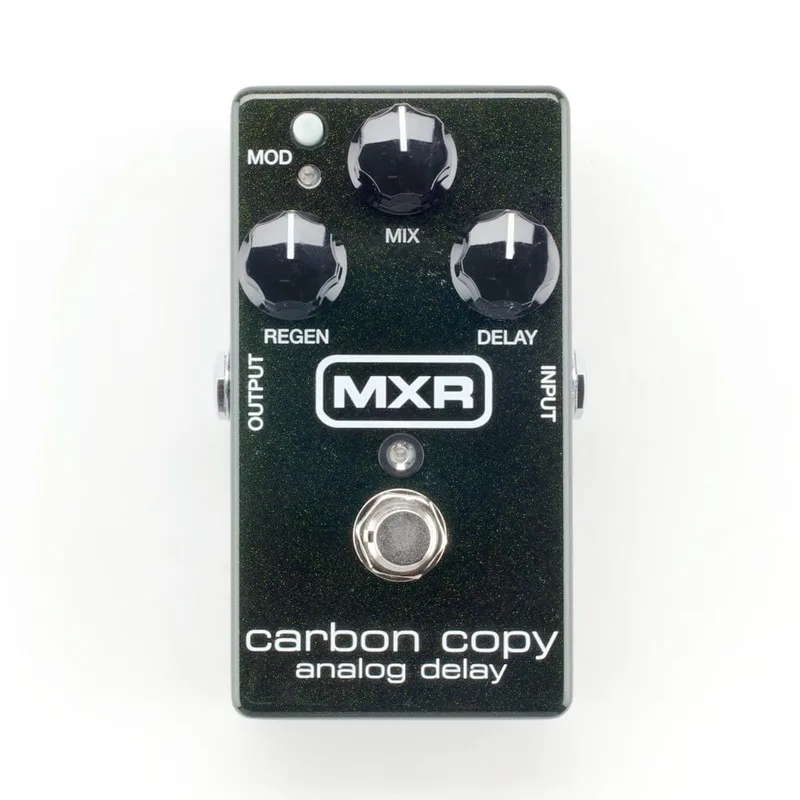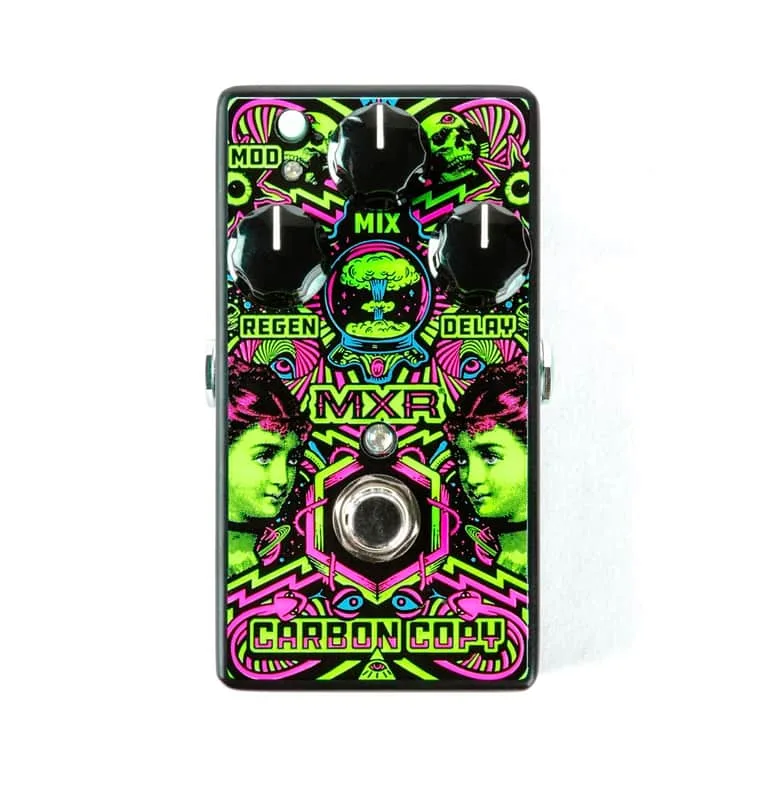
The MXR ILOVEDUST Carbon Copy Analog Delay is a limited edition of the MXR Carbon Copy Analog Delay, the analog delay pedal made by MXR, part of the Jim Dunlop family of brands. It carries the same delay circuit as the standard Carbon Copy but arrives in a special finish: Dunlop describes it as "decked out in the bold, brazen art" of the ILOVEDUST design studio, an award-winning graphic outfit whose work covers the pedal's enclosure1.
Under the artwork it is a straightforward analog delay. Dunlop specifies 600ms of delay time with optional modulation, a completely analog audio path built on old-school bucket brigade technology, and true bypass switching1. Dunlop also calls the Carbon Copy "the world's bestselling analog delay," which is the company's own framing for the pedal this edition is based on1.
Dunlop lists the ILOVEDUST Carbon Copy as a legacy product that is no longer in production1. It appears on the used market rather than in current dealer catalogs.
What it does
As a delay pedal, it takes the note you play and repeats it, from what Dunlop describes as "crisp bathroom slap echoes" up to long, spacious repeats, with the company pointing to "epic, Gilmouresque delays" as the upper end of its range1. The modulation, engaged with the pedal's modulation controls, adds movement to the repeats in the manner of an old tape or analog echo unit.
The controls follow the standard Carbon Copy layout: a three-knob arrangement covering Delay, Mix, and Regen1.
| Control | What it does |
|---|---|
| Delay | Sets the delay time, up to 600ms1 |
| Mix | Blends the delayed signal with your dry tone1 |
| Regen | Sets how many times the repeats carry on before fading1 |
The signal path is entirely analog. Dunlop's product page describes "a completely analog audio path for authentic rich, warm analog delay," made possible by old-school analog bucket brigade chips, the same technology used in vintage delay units1. True bypass means that when the pedal is off, your guitar's signal passes through without the pedal's circuitry in the way1.
Where it sits in the Carbon Copy family
The ILOVEDUST edition is one of several versions of the Carbon Copy circuit. The standard MXR Carbon Copy Analog Delay is the core pedal, and MXR has issued it in other limited and revised finishes and formats, including the MXR Carbon Copy 10th Anniversary Analog Delay and the compact MXR Carbon Copy Mini Analog Delay. The parts and service page for the Carbon Copy line on Dunlop's site covers the shared hardware across these editions2.
What sets the ILOVEDUST version apart is purely visual: the ILOVEDUST studio's artwork on the enclosure, applied to a limited run of the pedal1. Sonically and functionally it is the Carbon Copy that players know, with the same 600ms analog delay, optional modulation, and true bypass1.
Questions
Is the MXR ILOVEDUST Carbon Copy Analog Delay still available new?
No. Dunlop lists it as a legacy product that is no longer in production, so it only turns up secondhand or in leftover dealer stock. Players who want the same circuit in a current finish can look at the standard Carbon Copy or its other editions.
What is the difference between the ILOVEDUST Carbon Copy and the regular Carbon Copy?
The circuit is the same: 600ms of analog delay with optional modulation, a Delay, Mix and Regen knob layout, and true bypass. The ILOVEDUST version is a limited edition of the standard pedal, distinguished by the bold artwork of the ILOVEDUST design studio on its enclosure.
Is the Carbon Copy a true analog delay?
Yes. Dunlop describes the audio path as completely analog, built on old-school bucket brigade technology, which is what gives the pedal its rich, warm repeats. True bypass keeps the dry signal untouched when the effect is off.
Sources (2)
- MXR® ILOVEDUST CARBON COPY® ANALOG DELAY, Dunlop (jimdunlop.com)
- MXR® CARBON COPY® ANALOG DELAY, Jim Dunlop (www.jimdunlop.com)