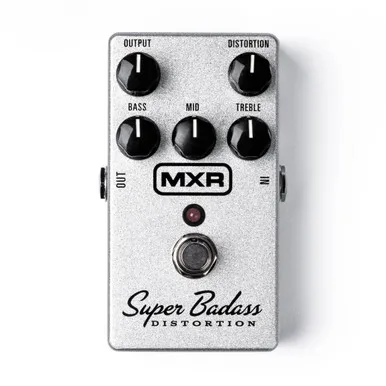


The MXR M75 Super Badass '75 is an analog distortion pedal from MXR, released in 20131. Its aim is British amp crunch: Delicious Audio calls it "a pedal inspired by the British tone associated with the EL34 tube (read: Marshall and Orange amps)"1, and Guitar World says "the M75 has a default voice that speaks in British EL34 tube crunch"2. Where many distortion pedals give you a single tone knob, the M75 carries a full three-band EQ, which is the feature reviewers returned to most.
A British-style crunch from an analog distortion
The M75 is a fully analog design. At launch, Guitar Interactive Magazine reported that the pedal "puts decades of 100% analog distortion at your feet"6, and Guitar World's 2026 distortion buying guide likewise lists it among pedals that "produce versatile analog distortion"2.
Its character, as reviewers describe it, sits firmly in the British camp. MusicRadar's Michael Astley-Brown found that "with everything set to 12 o'clock, the Super Badass's basic voicing is tight and crunchy - firmly in the British distortion" camp7. The pedal ships in MXR's familiar compact enclosure, which Guitar Interactive described at launch as coming "ready for the road with the sturdy housing and durable components that MXR is known for"6, and Delicious Audio cites its "rugged metal housing"1.
The manual includes a set of sample settings that hint at the range MXR intended3:
| Sample setting | Use |
|---|---|
| CHUNKY | Heavy rhythm tones |
| METAL | High-gain styles |
| CLASSIC OD | Overdrive-flavored crunch |
| DIRTY BOOST | Low-gain boost duties |
These four names come straight from the manual's suggested settings section3.
The controls: Output, Distortion, Bass, Mid and Treble
The M75 has five knobs: Output, Distortion, Bass, Mid and Treble25. Two set the gain structure and three shape the tone, which is what separates it from most single-tone-knob distortions.
| Control | What it does | EQ center and range |
|---|---|---|
| Output | Controls overall effect volume | |
| Distortion | Controls amount of distortion | |
| Bass | Cuts or boosts low frequencies | 150 Hz, +/-11 dB |
| Mid | Cuts or boosts midrange frequencies | 500 Hz, +/-12 dB |
| Treble | Cuts or boosts high frequencies | 10 kHz, +/-10 dB |
All control functions and EQ figures come from MXR's manual3. The manual calls the EQ "highly tweakable," and Premier Guitar's reviewer agreed, writing that "the separate bass, mid, and treble knobs are powerful and enable control over a very wide frequency spectrum"8.
The Mid knob deserves special mention because it is the control that lets the pedal cover two very different eras. Delicious Audio notes that "the dedicated Mid knob allows for scooped tones (good for metal) or the more mid-rangey distortion in vogue in the '70s"1. With 12 dB of cut or boost available at 500 Hz3, a player can pull the mids down for a modern scooped metal rhythm, or push them up for the mid-forward crunch of 1970s British stacks.
The pedal is also quiet for a high-gain design. The manual specifies a signal-to-noise ratio of 93 dBV, A-weighted, with all controls at their mid positions3, and Guitar World's guide lists "low noise, large output" among its pluses2.
How it compares to the M78 Custom Badass '78
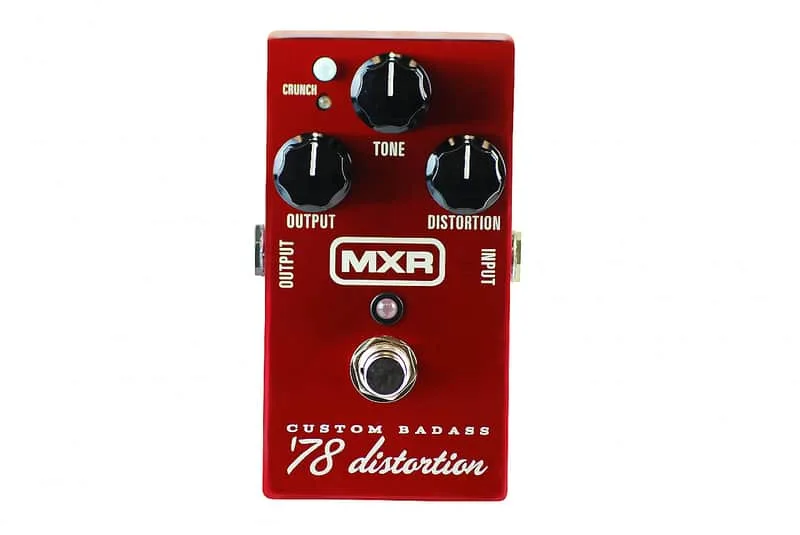
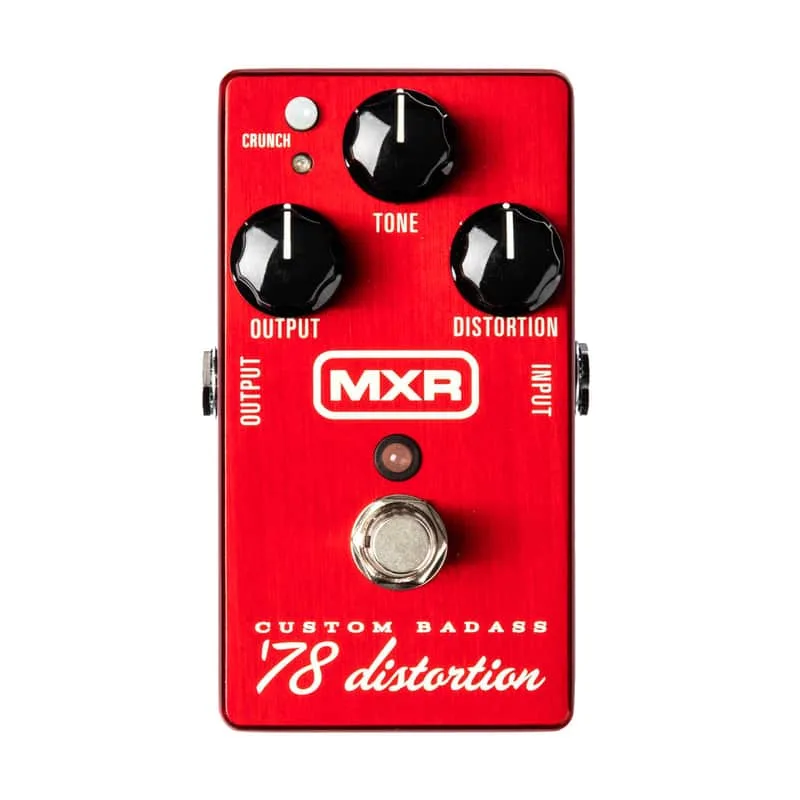
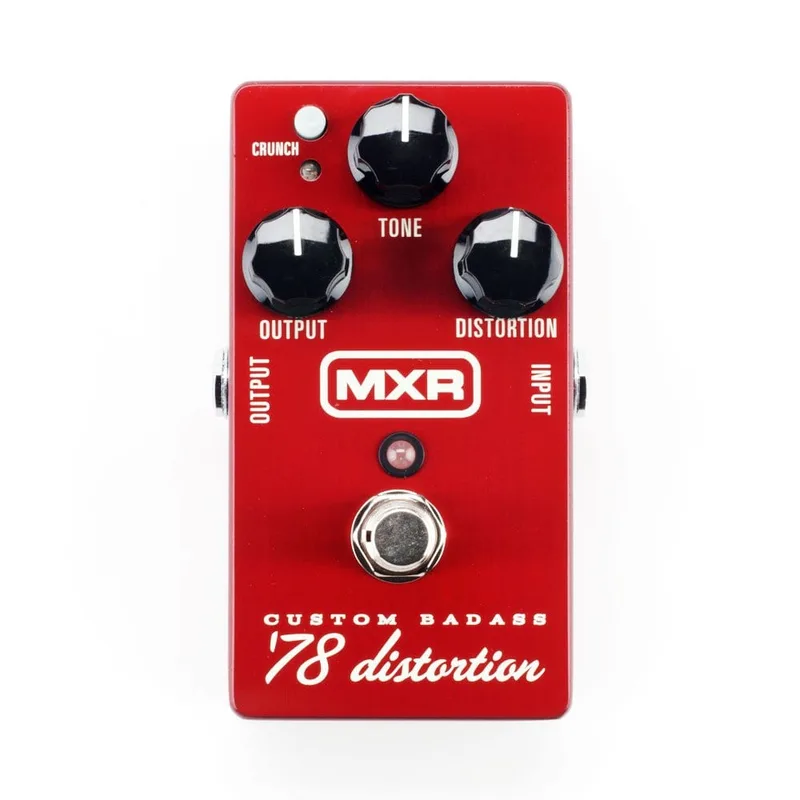
The M75 is a follow-up to the MXR M78 Custom Badass '78 Distortion. MusicRadar notes that MXR, "not content with one Badass (the M78 Custom Badass '78 Distortion), they've one-upped it with the M75 Super Badass Distortion"7. The M78, reviewed by MusicRadar's Trevor Curwen, is built around "a classic distortion circuit"9 and, like the M75, is an all-analog, true bypass design according to Pedal of the Day10.
The practical difference for a player is the EQ. The M78 takes the simpler classic-circuit approach, while the M75 adds the separate bass, mid and treble section with a wide frequency spectrum of control87. Current list prices also differ: Jim Dunlop lists the M75 at $139.99 and the M78 at $125.994.
What reviewers said
Published reviewers were broadly positive, with some caveats at the gain extremes.
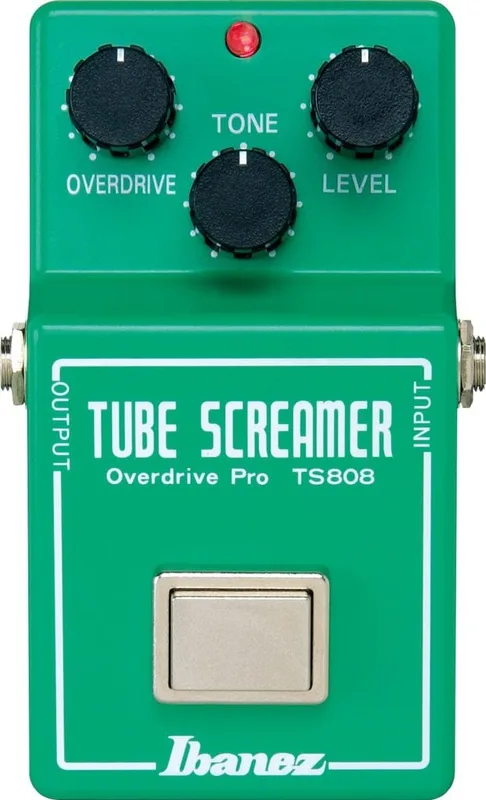
- Premier Guitar (2021) listed as pros: "Powerful, flexible 3-band EQ. Touch-sensitive responsiveness. Can go from modern metal leads to simple lead boosts." Its main con: "Most available tones have a trace of modern distortion color." The reviewer also found that at lower gain settings "I got a brawny overdrive similar to the output from a TS9. However, unlike the Ibanez, which has a rather restrictive EQ," the M75's EQ is more flexible8.
- MusicRadar concluded that "MXR now has a Best Buy Badass on its hands"7.
- Guitar World's buying guide credits it with low noise and large output, but found it "unconvincing at low and high gain extremes"2.
- Delicious Audio flagged it as "rather weak in the low gain range"1.
The low-gain criticism is the one that recurs: as a boost or light overdrive, reviewers found it less convincing than it is as a mid-to-high gain distortion. At its core setting, though, the British crunch voicing is what the pedal is for128.
Videos
Sweetwater
Bax-shop | Bax Music Goes
Chicago Music Exchange
Questions
Is the MXR M75 Super Badass '75 analog or digital?
It is fully analog. Guitar Interactive reported at launch that the pedal puts decades of 100% analog distortion at your feet, and Guitar World's buying guide likewise describes it as a versatile analog distortion. There is no digital processing in the signal path.
What does the Mid knob do on the Super Badass '75?
The Mid knob cuts or boosts midrange frequencies, centered at 500 Hz with a range of plus or minus 12 dB according to MXR's manual. Delicious Audio notes it allows scooped tones suited to metal, or the more mid-forward distortion sound in vogue in the 1970s.
Is the Super Badass '75 meant to sound like an EL34 amp?
Yes, that is its stated inspiration. Delicious Audio describes it as a pedal inspired by the British tone associated with the EL34 tube, meaning the Marshall and Orange camp, and Guitar World says its default voice speaks in British EL34 tube crunch.
How is the M75 different from the M78 Custom Badass '78?
The M75 is a follow-up to the M78 Custom Badass '78 Distortion, which MusicRadar says MXR one-upped with the M75. The M75 adds a full three-band EQ with separate bass, mid and treble knobs, where the M78 takes a simpler classic distortion circuit approach. The M75 lists at $139.99 and the M78 at $125.99.
What is the list price of the MXR M75 Super Badass '75?
Jim Dunlop's product page lists the M75 Super Badass Distortion at $139.99 USD as of October 2026. Earlier press figures were lower: Premier Guitar cited a $99 street price in 2021 and Delicious Audio listed $99 in May 2024, so the current list price is the newer figure.
Sources (10)
- 2024 UPDATE! The Best Distortion Pedals, Delicious Audio, 2024-05-03
- Best distortion pedals: Our top high-gain stompboxes, Guitar World, 2022-06-09
- M75.pdf, Dunlop Manufacturing, Inc., 2019
- MXR® SUPER BADASS® DISTORTION, Jim Dunlop (www.jimdunlop.com)
- Best distortion pedals: top gain stages for guitar, MusicRadar, 2023-01-20
- MXR Introduces the M75 Super Badass Distortion, Guitar Interactive Magazine, 2013-06-19
- MXR M75 Super Badass Distortion review, MusicRadar, 2013-09-23
- MXR Super Badass Distortion Pedal Review, Premier Guitar, 2013-07-26
- MXR M78 Custom Badass '78 Distortion review, MusicRadar, 2011-11-11
- Dunlop MXR M78 Custom Badass '78 Distortion, Pedal of the Day, 2014-07-17