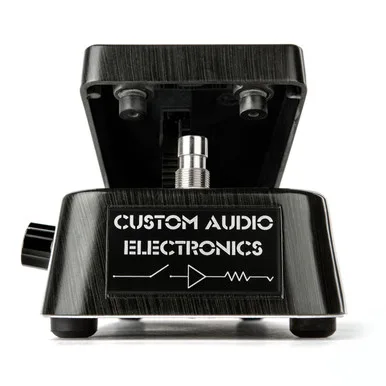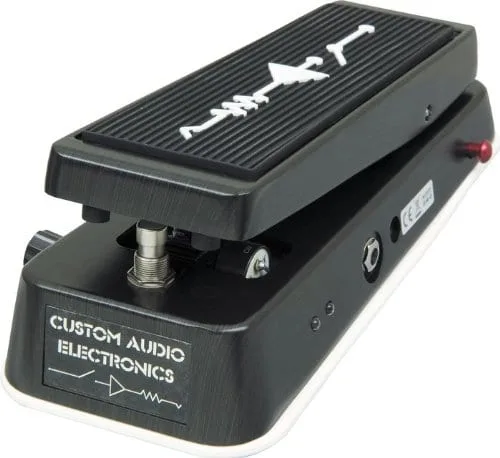


The MXR MC404 CAE is a wah pedal from MXR, developed with Bob Bradshaw of Custom Audio Electronics and the Cry Baby design team and released in 200912. Its defining feature is a pair of switchable Fasel inductors, giving the player two distinct wah voices in one housing: one with high-end emphasis, the other with low to mid resonance1.
Alongside the two inductors, the pedal carries a built-in boost circuit borrowed from the CAE MC401, internal Q and gain trimmers, and true hardwire bypass3. .
A wah with two Fasel inductors
The inductor is the component at the heart of a wah's voice, and the MC404 CAE carries two Fasel inductors that the player can switch between. Dunlop describes the two voices as high-end emphasis on one side and low to mid resonance on the other1. The company's buying guide frames the same choice as "two switchable inductors for a warm, vintage vibe or bright transparency"5.
For a player, that means one pedal covers ground that would otherwise take two. The high-end voice cuts through a busy mix, while the low-to-mid voice sits rounder and thicker underneath a riff. Pedal of the Day's reviewer found the switching itself to be the pedal's standout feature631:
"Being able to switch back and forth between the two Fasel inductors is a really unique and cool feature, as you can adjust it on the fly with a kick of your foot."
The controls: two kickswitches and internal trimmers
The MC404 CAE is operated from the top and the sides. The treadle sweeps the wah as on any Cry Baby-style pedal, while two small kickswitches mounted on the sides of the housing handle everything else, and both are reachable with your foot mid-performance61.
| Control | Where | What it does |
|---|---|---|
| Treadle | Top | Sweeps the wah filter |
| Inductor kickswitch | Side-mounted | Chooses between the two Fasel inductors1 |
| Boost kickswitch | Side-mounted | Turns the boost on or off1 |
| Q pot | Internal | Adjusts the wah's Q, the sharpness of the filter peak1 |
| Gain pot | Internal | Adjusts the gain4 |
The internal pots are set with a screwdriver rather than on the fly, which suits the Q and gain adjustments they control: those are voicing decisions a player tends to make once and leave alone. Premier Guitar's review also notes a custom-designed CTS extended-life low-noise potentiometer for the treadle among the pedal's top-grade components6.
The boost
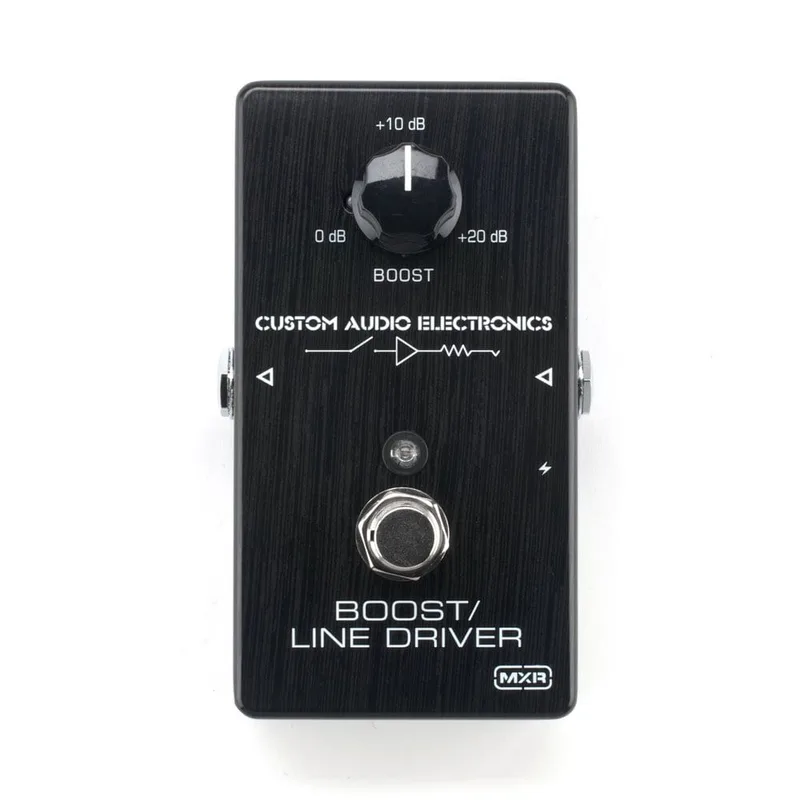
One of the two kickswitches engages a built-in MXR MC-401 Boost/LineDriver, a clean boost circuit that delivers up to 18 dB of extra level36. Premier Guitar's reviewer put its purpose plainly: "A built-in MXR MC-401 Boost/LineDriver gives you an extra kick in your tone if you need one"6.
Because the boost is inside the wah rather than on the board as a separate boost pedal, a player can stomp it in during a solo without moving to another pedal, and it can also push the front end of an amp harder when the wah is engaged63.
Designed by Bob Bradshaw and the Cry Baby team
The MC404 CAE came out of a collaboration between Dunlop and Custom Audio Electronics, the rig-design company founded by Bob Bradshaw. Dunlop credits the pedal to Bradshaw and the Cry Baby design team1, and JHS Pedals' account adds that the collaboration was initiated by Jimmy Dunlop, with head of engineering Sam McRae as lead engineer2. Bradshaw had already built a reputation before the project; JHS Pedals calls him "an industry legend"2.
The pedal was released in 2009 as the MXR MC4042, and Custom Audio Electronics announced it as "the MC404 CAE Wah developed in conjunction with Bob Bradshaw"3.
What reviewers said
Published reviews were positive. Premier Guitar's reviewer wrote that "Dunlop takes another big step forward with the MC-404 CAE, with more features and added versatility" over the 535 and GCB-95 Cry Baby models6. Pedal of the Day's review echoed the maker's own description of the dual inductors and highlighted the on-the-fly switching as a feature that "opens up twice as many soundscapes" as a single-inductor wah4.
Videos
ProGuitarShopDemos
Sweetwater
jimdunlopusa
Questions
Is the MXR MC404 CAE wah true bypass?
Yes. The MC404 CAE uses true hardwire bypass, so when the wah is off the signal passes through without the circuit coloring it. Premier Guitar's review also lists true bypass among its top-grade components, alongside a custom CTS extended-life low-noise potentiometer.
What does the boost on the MC404 do?
The MC404 CAE includes a built-in MXR MC-401 Boost/LineDriver circuit, delivering up to 18 dB of clean boost. A side-mounted kickswitch turns the boost on and off with your foot, giving the wah an extra push for solos or for driving the front of an amp harder.
What is the input impedance of the MC404 CAE?
The input impedance is 1 MΩ, with a nominal input level of -20 dBu. That high input impedance means the pedal presents a friendly load to guitar pickups, preserving high end when the guitar feeds the wah directly.
Sources (6)
- CAE WAH - Dunlop, Dunlop (jimdunlop.com)
- ARE MASS PRODUCED PEDALS GOOD?, JHS Pedals, 2009
- CAE News, Custom Audio Electronics, 2011-11-27
- MXR / Custom Audio Electronics MC404 Wah, Pedal of the Day, 2014-03-23
- RANGE OF EXPRESSION: FIND YOUR CRY BABY® WAH, Dunlop (lifestyle.jimdunlop.com), 2021-10-08
- Dunlop MC-404 CAE Wah Pedal Review, Premier Guitar, 2009-04-09