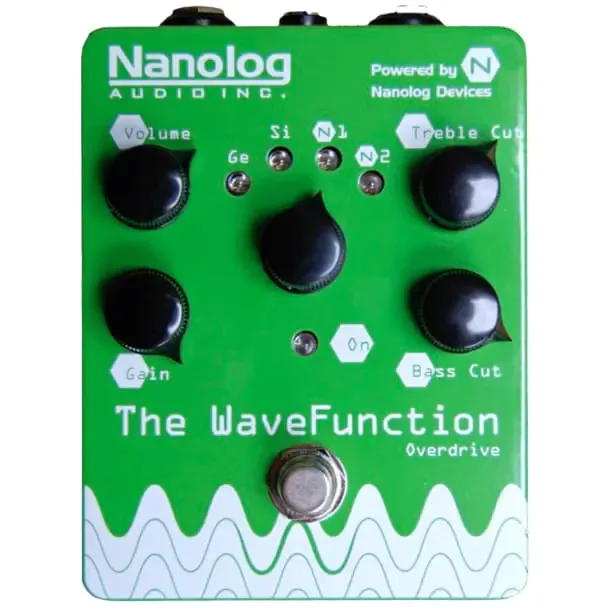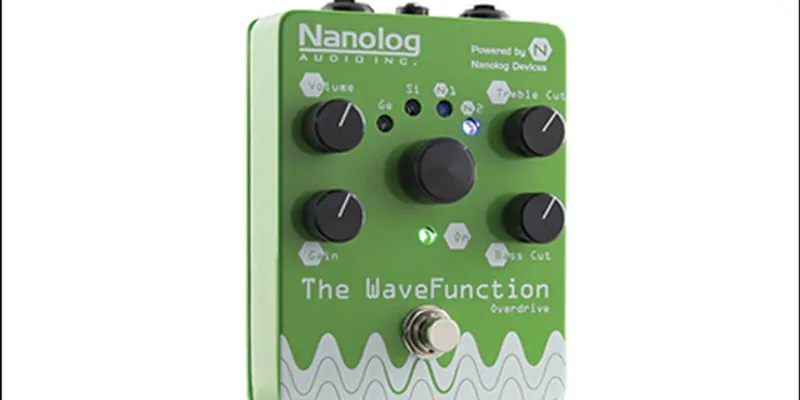


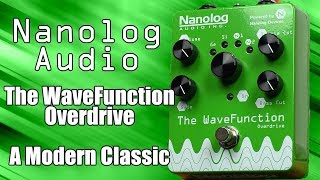
The WaveFunction is a diode-clipping overdrive pedal from Nanolog Audio, a maker based in Canada, and it takes a familiar circuit idea in an unfamiliar direction. Premier Guitar describes it as a pedal that "sounds and behaves much like a conventional IC-based overdrive," built around an LM1458 dual op amp, but its clipping stage is where things get unusual1. Two of its four settings use conventional germanium and silicon diodes; the other two use carbon molecular junctions, a nanotechnology approach Nanolog calls Nanolog Device Technology, which the maker says opens up "a new palette of sounds not available with silicon" diodes2.
The pedal was introduced in late 2017 and reviewed by Premier Guitar in 2018, with a street price of $299 at the time of the magazine's 2021 review132. It sits in a conventional BB-sized enclosure with metal knobs and board-mounted plastic jacks, and despite the high-tech diodes, it is a traditional through-hole build rather than surface-mount1.
Four diode settings: germanium, silicon, N1 and N2
The WaveFunction's central control is its Clip Toggle, a four-position selector. Two positions are the classic options players already know: germanium clipping using 1N34A diodes and silicon clipping using 1N4148s12. The other two positions, N1 and N2, are where Nanolog Device Technology comes in. This is a clipping approach built on carbon molecular junctions rather than silicon diodes, and Nanolog says it allows fine-tuning of the achievable sounds "in a way not possible before"2.
| Setting | Clipping element | Character |
|---|---|---|
| Germanium | 1N34A diode pair | Conventional germanium clipping12 |
| Silicon | 1N4148 diode pair | Conventional silicon clipping12 |
| N1 | Carbon molecular junction | Similar to silicon, but a touch fatter12 |
| N2 | Carbon molecular junction | Considerably more aggressive2 |
A quartet of LEDs on the pedal indicates which diode setting is currently active1.
In practice, the two molecular settings cover different ground. Premier Guitar's reviewer found the N1 setting "similar to silicon, but a touch fatter"1, and Delicious Audio's write-up agrees, describing N1 as sounding "like a slightly fatter silicon diode" while N2 is "considerably more aggressive"2. For a player, that means the toggle effectively spans from warm, soft clipping to a harder-edged drive without touching the gain knob.
Controls and how it works
Alongside the Clip Toggle, the WaveFunction has the expected gain and volume controls. More unusual are its dual passive tone controls, one of which is a bass-cut control that acts as both a tone and a gain control, letting you shape how loose or tight the low end feels while also affecting the drive character1.
The circuit topology will be familiar to anyone who knows the overdrive family. The clipping diodes sit in the feedback loop's downstream path, Screamer-style, meaning the WaveFunction shares its general signal layout with Tube Screamer-type pedals rather than with DOD 250-style units that clip differently. The chip doing the work is an LM1458 dual op amp, not the JRC4558 associated with Tube Screamer clones1.
Where the molecular junction idea came from
The technology behind the N1 and N2 settings is the product of years of research and patents, and Nanolog describes it as the first commercialized example of molecular electronics in a guitar pedal3. The molecular junction work comes from Nanolog's Adam J. Bergren, who has published a scientific paper on the underlying technology1.
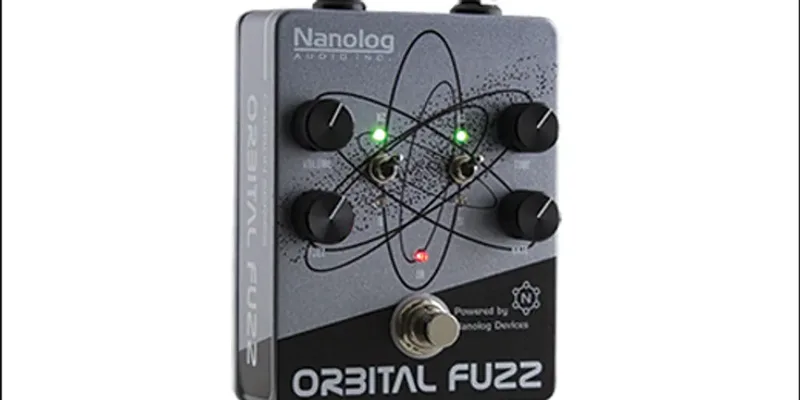
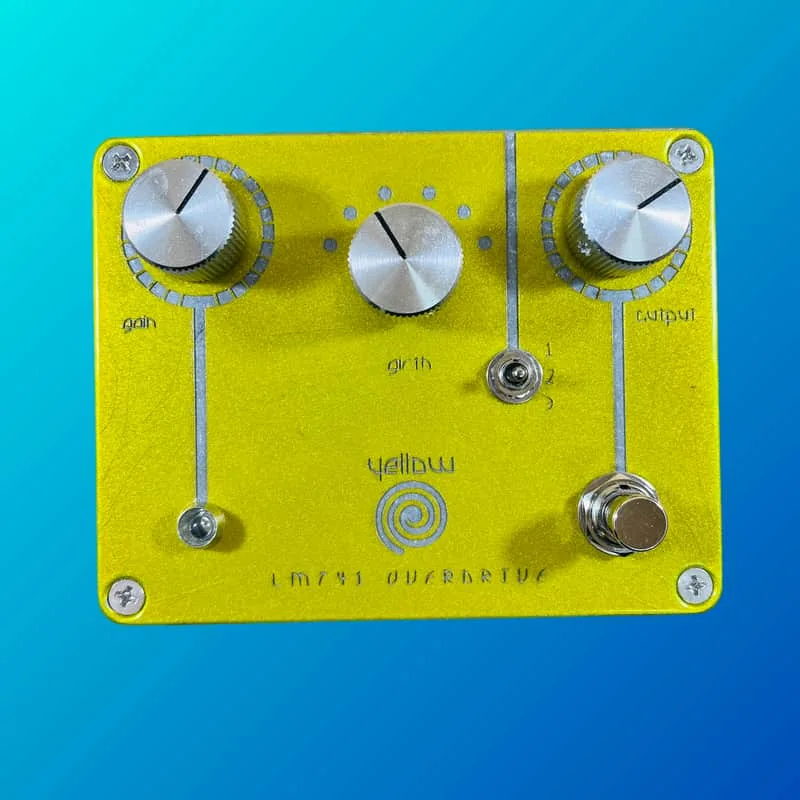
The WaveFunction was not the only pedal to carry the molecular junction sound. Premier Guitar's later review of the Nanolog Orbital Fuzz recalled that the WaveFunction "distinguished itself via proprietary 'molecular junction' or 'nano-molecular sandwich' diodes," and the same clipping approach appeared in other makers' pedals, including Spiral Electric FX's Yellow Spiral Drive, a DOD 250-based overdrive with a Nanolog N2 Quantum Junction option4.
What reviewers said
Premier Guitar's 2021 review was positive about the pedal's range and its handling of tricky harmony. The reviewer's pros list read14:
"Pros: Bold new diodes. Wide tonal range. Good with dissonant intervals and chords."
The same review noted that the pedal behaves much like a conventional IC-based overdrive despite its unconventional diodes, which is worth knowing for players deciding whether the molecular junction settings are a novelty or a genuinely usable tool1. Delicious Audio's coverage framed the pedal as a reinvention of distortion, emphasizing that the carbon molecular junctions allow sounds silicon diodes cannot produce23.
Videos
60 Cycle Hum
shnobel
Sean Pierce Johnson
Questions
What are the N1 and N2 settings on the WaveFunction?
N1 and N2 are the two positions that use Nanolog Device Technology, a clipping approach built on carbon molecular junctions instead of silicon diodes. N1 sounds like a slightly fatter silicon diode, while N2 is considerably more aggressive. Both are selected with the same four-position Clip Toggle that also covers the germanium and silicon settings231.
Does the Nanolog WaveFunction take a battery?
No. The pedal runs on standard 9V power and has no battery compartment, so it needs a 9V DC supply from the start. There is no battery option to fall back on1.
Who designed the Nanolog WaveFunction?
The molecular junction technology behind the pedal comes from Nanolog's Adam J. Bergren, who has published a scientific paper on the subject. Nanolog Audio is based in Canada, and the WaveFunction was introduced as a new pedal in late 201714.
Is the WaveFunction a Tube Screamer circuit?
Not a clone, but it follows the same family layout. The clipping diodes sit downstream of the op amp, Screamer-style, and the chip is an LM1458 dual op amp. The diodes themselves, including the molecular junctions, are what set it apart14.
Sources (4)
- Nanolog Audio The WaveFunction Review, Premier Guitar, 2018-02-19
- Nanolog Audio Reinvents Distortion With The WaveFunction Overdrive, Delicious Audio, 2018-02-21
- Nanolog Audio The WaveFunction Overdrive, Delicious Audio, 2017-12-26
- Quick Hit: Nanolog Orbital Fuzz Review, Premier Guitar, 2019-10-20