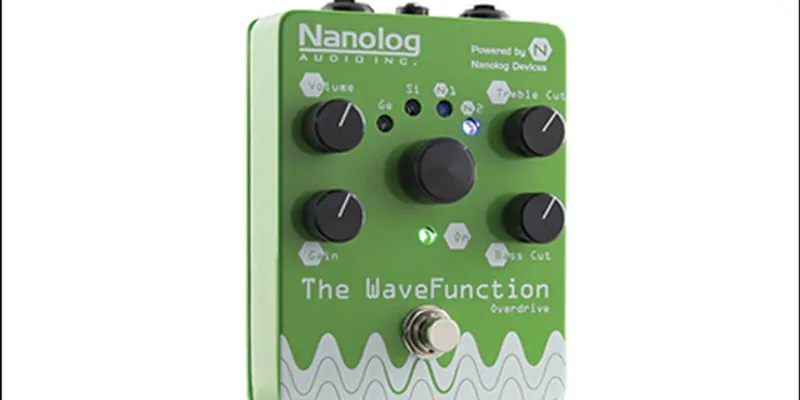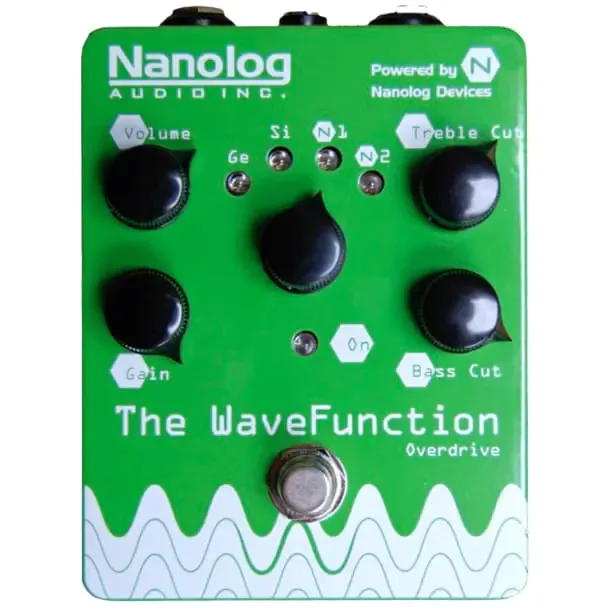



The Nanolog WaveFunction is an overdrive pedal from Nanolog Audio, a Canadian company, built around what the maker calls Nanolog Device Technology12. What sets it apart from most overdrives is its clipping stage: alongside conventional germanium and silicon diodes, it uses proprietary "molecular junction" diodes built on carbon molecular junctions, a technology Nanolog describes as nanotechnology12.
In circuit terms it is otherwise familiar territory. Premier Guitar's review found a Screamer-style topology, with the clipping diodes placed downstream of an LM1458 dual op amp, and a traditional through-hole build rather than surface-mount1. The interesting part is what sits in the diode positions.
Overdrive with molecular junction clipping
Most overdrive and distortion pedals shape their sound by clipping the signal with diodes, and the choice of diode is a big part of the voice: germanium and silicon pairs are the two classic options. The WaveFunction adds a third option. Its N1 and N2 settings use Nanolog Device Technology, a clipping approach built on carbon molecular junctions rather than silicon diodes4.
Nanolog says the carbon molecular junctions allow a new palette of sounds not available with silicon diodes, fine-tuned in a way not possible before2. The company frames the pedal as the first commercialized example of molecular electronics in a guitar effect, the product of years of research and patents2.
The rest of the circuit is deliberately conventional. Premier Guitar's reviewer noted that despite the high-tech diodes, the WaveFunction is a traditional through-hole build, not surface-mount, with the diodes sitting downstream of the op amp in the arrangement popularized by the Tube Screamer1.
The controls and four-position clip selector
The WaveFunction's controls are Volume, Gain, Treble Cut and Bass Cut, plus a four-position Clip Toggle that selects the clipping diodes4.
| Control | What it does |
|---|---|
| Clip Toggle | Four-position selector: germanium (1N34A), silicon (1N4148), N1 and N2 molecular junction settings14 |
| Gain | Sets the amount of drive4 |
| Volume | Sets the output level4 |
| Treble Cut | Rolls off high end4 |
| Bass Cut | Rolls off low end4 |
The two tone controls are cut controls rather than boost, which shapes how the pedal sits in a mix: you trim frequencies rather than add them4.
What the four settings sound like
The four clip settings give the pedal four distinct voices, and the press coverage described each142:
- Germanium (1N34A): conventional germanium diode clipping1
- Silicon (1N4148): conventional silicon diode clipping1
- N1: the first molecular junction setting, similar to silicon but a touch fatter14
- N2: the second molecular junction setting, considerably more aggressive4
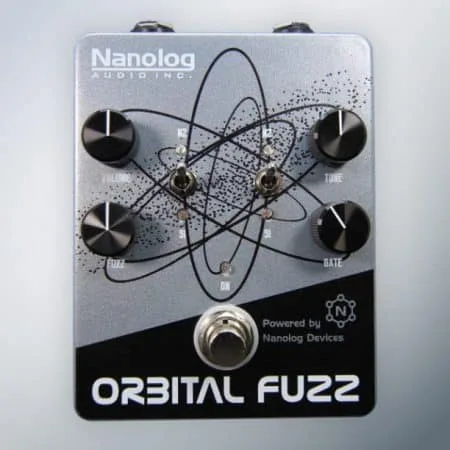
In a later Premier Guitar review of the related Orbital Fuzz, the reviewer recalled the WaveFunction's nano-molecular diodes as comparatively bold, fat, hot, and aggressive3.
Who makes it, and where it came from
Nanolog Audio is a young Canadian company, based in Edmonton, Alberta24. The molecular junction technology behind the pedal is associated with Nanolog's Adam J. Bergren, who has published a scientific paper on the subject1. The WaveFunction was the company's first pedal, introduced in December 2017 and launched in February 2018 at $21924; by Premier Guitar's 2021 review its street price was $2991.
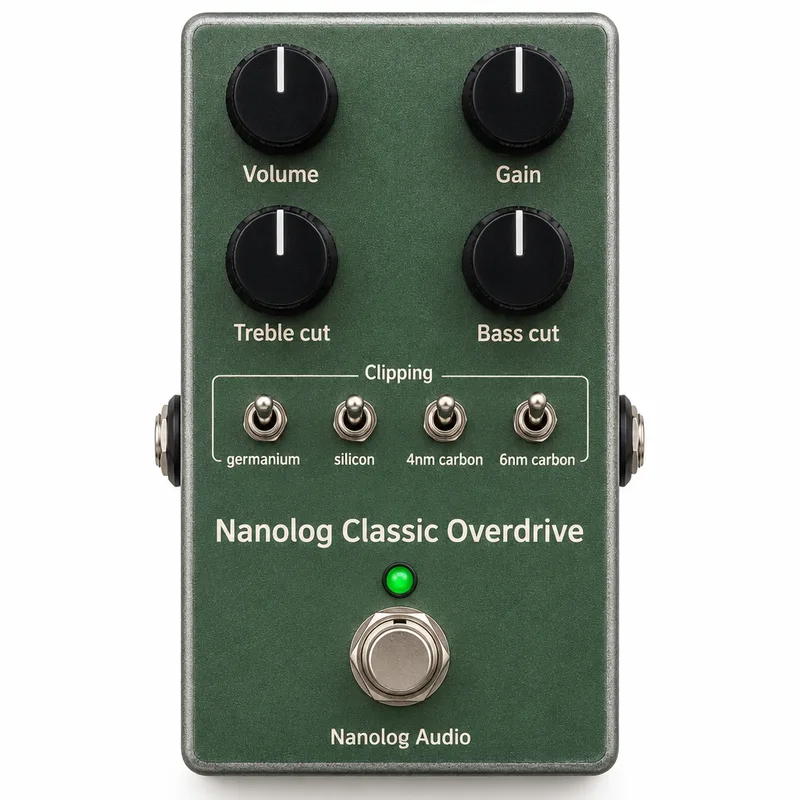
Nanolog later brought the molecular clipping technology to further pedals under its own name, including the Nanolog Classic Overdrive, and the technology also appeared in collaboration pedals from other makers3.
What reviewers said
Premier Guitar reviewed the WaveFunction in 2021 and came away positive:
"This is a good-sounding overdrive in its own right, and perhaps a foretaste of cool things to come1."
Premier Guitar review, August 20213
The same review noted that while two of the four settings provide conventional germanium and silicon diode clipping, the other two employ the newer molecular junction approach, which was the pedal's reason for being1. Delicious Audio called it a versatile pedal that uses both traditional and innovative techniques to produce a range of overdrive sounds4.
Videos
60 Cycle Hum
shnobel
Sean Pierce Johnson
Questions
What are Nanolog molecular junction diodes?
They are clipping devices built on carbon molecular junctions rather than silicon, the product of years of research and patents by Nanolog Device Technology. Nanolog describes them as nanotechnology and the first commercialized example of molecular electronics in a guitar pedal, offering a palette of sounds not available with silicon diodes.
Does the WaveFunction have germanium and silicon clipping?
Yes. Two of its four clip settings use conventional germanium (1N34A) and silicon (1N4148) diode pairs. The other two settings, N1 and N2, use Nanolog's molecular junction technology. N1 sounds like a slightly fatter silicon diode, while N2 is considerably more aggressive.
How much does the Nanolog WaveFunction cost?
Delicious Audio reported a list price of $219 when the pedal launched in 2018. Premier Guitar's 2021 review listed a street price of $299, so the price moved between those two points in the press coverage.
Who makes the Nanolog WaveFunction?
Nanolog Audio, a Canadian company based in Edmonton, Alberta. The molecular junction technology behind the pedal is associated with Nanolog's Adam J. Bergren, who has published a scientific paper on the subject.
Sources (4)
- Nanolog Audio The WaveFunction Review, Premier Guitar, 2018-02-19
- Nanolog Audio The WaveFunction Overdrive, Delicious Audio, 2017-12-26
- Quick Hit: Nanolog Orbital Fuzz Review, Premier Guitar, 2019-10-20
- Nanolog Audio Reinvents Distortion With The WaveFunction Overdrive, Delicious Audio, 2018-02-21