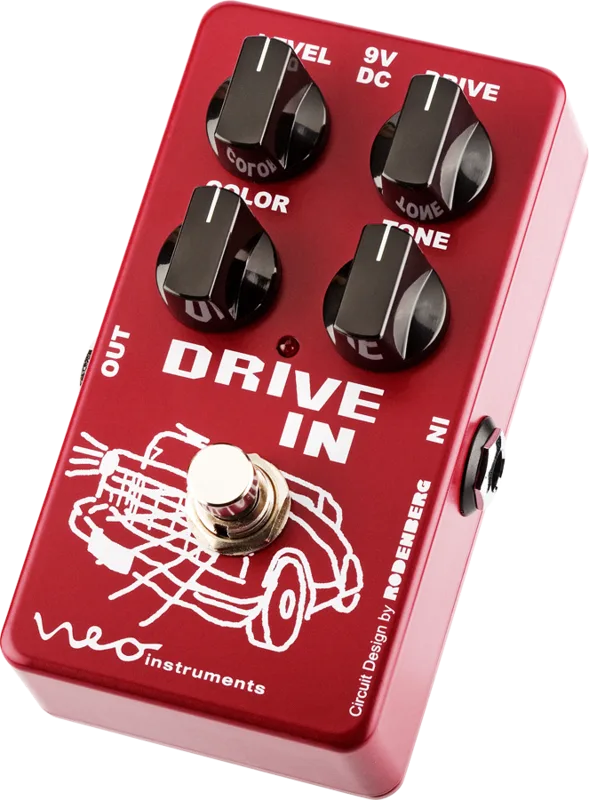


The Neo Instruments Drive In is an analog overdrive pedal from NEO Instruments, a red stompbox built to cover the classic overdrive territory and then some. Neo Instruments says it gives you all the typical overdrive sounds, and that it can sound like the green original, a reference to the vintage green overdrive circuit it draws from. The maker also claims more than that: "thanks to its sophisticated circuitry, it offers a more open sound, that is more defined with clearer high frequencies."1
Delicious Audio's review, with a demo by Mike Hermans, framed it as "a rich and nuanced medium gain drive for blues and rock players," and noted that it "masters the classic overdrive sounds, and is just as convincing at producing different distortion variations and a considerable variety of overdrive sounds."2 The review added that it "has been designed to appeal to the more discerning player who loves rich, deep smooth sounds that blend wonderfully" into a mix.2
Controls and the Color knob
The Drive In provides the usual level, drive and tone controls, plus a fourth control Neo Instruments calls Color. That extra knob is the pedal's main departure from the classic design. "Whilst a classic tone control dampens the treble range of a classic overdrive pedal, the COLOR control on the DRIVE IN mostly changes the frequencies in the bass and mid range," according to Delicious Audio's review.2
| Control | What it does |
|---|---|
| Level | Sets output level |
| Drive | Sets the amount of overdrive |
| Tone | Classic treble control |
| Color | Reduces the mid boost and the loss of bass components, working mostly on the bass and mid frequencies12 |
Neo Instruments describes the Color control as "perfect for even more powerful overdrive sound," since it addresses the mid boost and bass loss rather than simply rolling off highs.1
Using it on a board
The maker also suggests the pedal works as a boost into an already pushed amp: "By placing the DRIVE IN before amp distortion, you can easily change the sound spectrum and adjust DRIVE IN for different" amps.1 The housing is described as rugged, protecting the circuitry, with a footswitch designed for tens of thousands of stomps.1
The Drive In runs on 9V DC with negative to center pin or on a battery, at about 10mA of current demand, so it fits comfortably on most pedalboard power supplies.1
Where it came from
The pedal's PCB layout is credited to "a special PCB layout by boutique guru Uli Rodenberg (Rodenberg Amplification)," according to Neo Instruments.1 The name reaches back further than the circuit: Delicious Audio's review ties it to the drive in restaurant era, when, as the review puts it, "the sounds that a guitar could produce changed radically too," with amplifiers first overdriven and the first effects pedals introduced.2
For how the Drive In sits among its neighbors, see the site's pages on Overdrive Pedals, Distortion Pedals and Boost Pedals, or the comparison of the Boss SD-1 vs Ibanez TS9 Tube Screamer.
Videos
Mike Hermans
Brett Kingman
Chris Buck
Sources (3)
- Drive In, neo-instruments.com
- NEO Instruments Drive In Overdrive, Delicious Audio, 2019-03-15
- Drive In by Neo Instruments, RockBoard PedalPedia, 2026