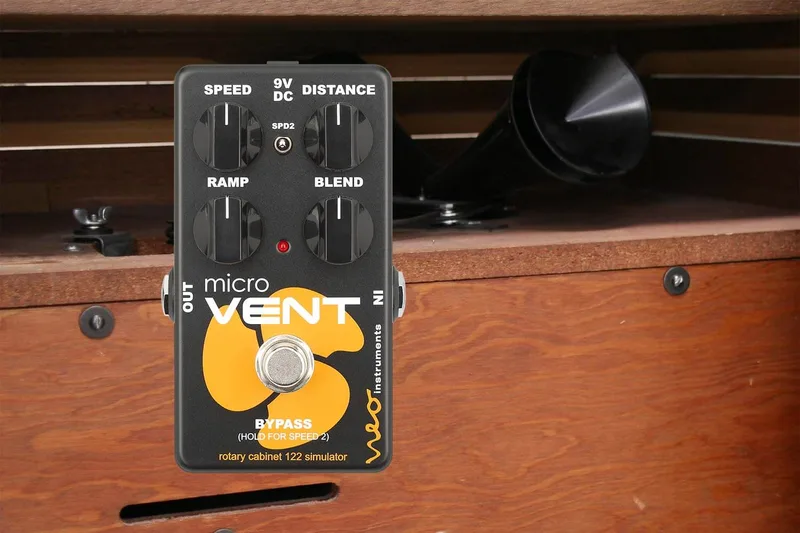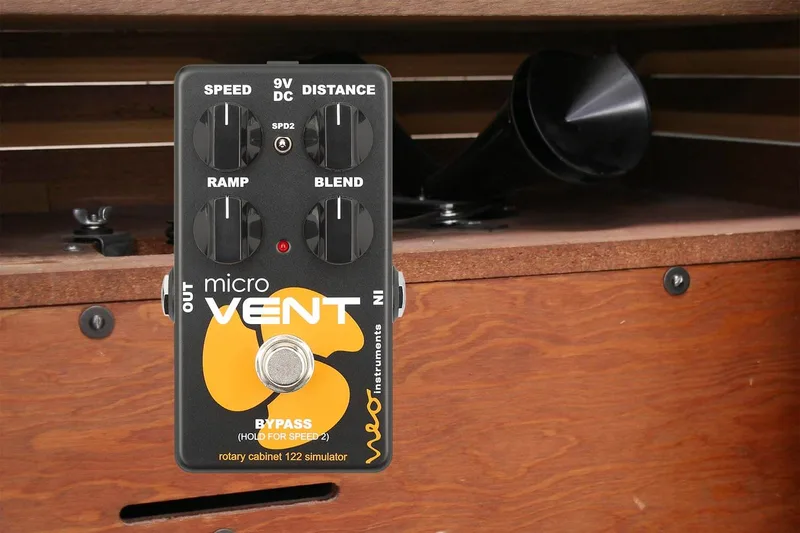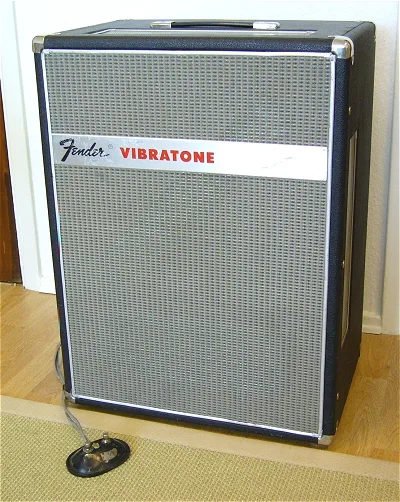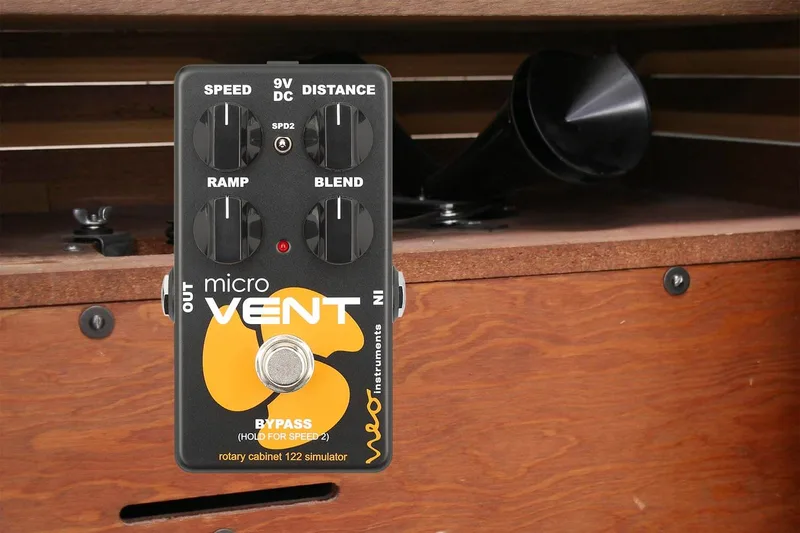


The Neo Instruments micro Vent 16 is a compact rotary speaker simulator pedal that recreates a specific Leslie cabinet: the Leslie 16, the single-drum rotor design Fender sold as the Vibratone1. Where most rotary pedals chase the two-rotor Leslie 122 with its spinning horn and drum, the micro Vent 16 models a later, simpler speaker with no horn at all, a 10-inch speaker firing into one drum rotor23. Neo Instruments describes it as "a newly designed simulation of a Vibratone guitar Leslie"1.
It was announced in November 2019 alongside its sibling, the micro Vent 122, as one of two mini-pedals from the German maker, and both reached shops in January 20204. Guitar.com reviewed the pair in March 2020 and found the 16 "an interesting softer-voiced alternative to the 122," scoring it 8/103.
What it simulates, and why that matters
The Leslie 16 is a different animal from the 122 that most rotary pedals copy. Guitar.com's reviewer, Richard Purvis, explains the distinction: the 16 is "a later, simpler rotary speaker with no horn," one whose sound is more subtle than the horn-and-drum swirl of a 1223. Gearnews described the target as "a Leslie with a 10-inch speaker into a single drum rotor, as found in an old Fender Vibratone"2.
That source cabinet has a notable player attached: Stevie Ray Vaughan used the Leslie 16, which Purvis notes is "the one Stevie Ray used"3. Players chasing that particular slow, vocal wobble rather than a full organ-style swirl are the audience for this pedal. You can read more about the original cabinet on the Fender Vibratone page, and about the wider category on the speaker simulation pedals page.
Neo Instruments says the algorithm "simulates capturing the Vibratone with one mic and the distance from the cabinet is variable"1. That single-mic approach contrasts with the micro Vent 122, whose algorithm models the classic two-mic technique, one virtual microphone on the horn and one on the drum rotor, with variable mic distance via a DISTANCE pot1.
Controls, connections and power
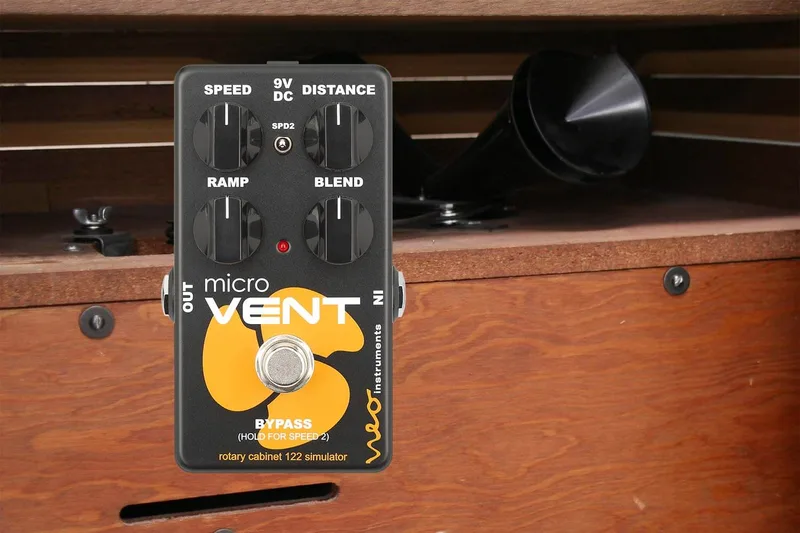
The controls are the same as the micro Vent 122's2. The pedal is mono in and mono out, with no drive option, a point Guitar.com raised against it13. Bypass is switchable between true and buffered, so it can sit anywhere in a signal chain14.
Power comes from a 9-volt mains supply only3. There is no battery option, so the pedal needs a mains-fed supply or a powered pedalboard output.
How it differs from the micro Vent 122
The two micro Vents share a platform: same footprint, same controls, same German construction, same power requirement34. The differences are the color and the algorithm.
| micro Vent 16 | micro Vent 122 | |
|---|---|---|
| Enclosure | White2 | Black1 |
| Models | Leslie 16 / Fender Vibratone, single drum rotor, no horn23 | Leslie 122, horn and drum32 |
| Algorithm | Newly designed, one virtual mic, variable distance1 | Derived from the Ventilator II, two virtual mics, DISTANCE pot1 |
| Character | Less complex and dominant, suited to rhythm work and lead touches1 | Deeper modulation, deeper movement4 |
Neo Instruments' own description of the split: "Compared to the micro Vent 122, the micro Vent 16 sounds less complex and dominant. It is perfect for rhythm work and for giving lead tones the final touch"1. Guitar World framed the 122 as aiming "for the more dramatic effect of a Leslie 122 rotary speaker. Expect deeper modulation, deeper movement"4.
Where it came from
The micro Vents are board-friendly descendants of Neo's larger rotary simulators. The company's flagship Ventilator II is modeled on the Leslie 122, complete with independent drum and horn circuits, onboard overdrive, adjustable fast/slow ramping and stereo outputs3. The micro Vent 122 carries that lineage directly, deriving its algorithm from the Ventilator II1; the micro Vent 16 instead got a new algorithm built around the single-drum Vibratone1. The line also includes the mini Vent II1.
At launch, prices had yet to be confirmed for either version2.
What reviewers said
Guitar.com's March 2020 review of both pedals gave the micro Vent 16 an 8/10 verdict, calling it "an interesting softer-voiced alternative to the 122"3. The same review raised two criticisms that apply to both: they are mono with no drive option, and the price.
In a 2025 Guitar.com review of the Boss RT-2 rotary pedal, the micro Vents were still in the comparison set: the reviewer judged that "one of the Neo Micro Vents, which sound better, but lose out on flexibility (mono outputs, no overdrive) and pricing" relative to the Boss5. The micro Vent 16 also appeared among the pedals used in a That Pedal Show episode on rotary speaker simulator pedals in December 20246.
Videos
Mike Hermans
Alberto Barrero
PJ and the Beard
Questions
What Leslie does the Neo Micro Vent 16 simulate?
It simulates the Leslie 16, the cabinet Fender sold as the Vibratone. That design is a later, simpler rotary speaker with no horn: a 10-inch speaker fires into a single drum rotor. Neo Instruments says the algorithm models capturing the Vibratone with one microphone, with variable distance from the cabinet.
Does the Micro Vent 16 run on a battery?
No. Guitar.com's review reports it is powered by a 9-volt mains supply only, so there is no battery option. Plan on a mains-fed power supply or a pedalboard power brick with a suitable mains-fed output.
Is the Micro Vent 16 true bypass?
It can be run either way. Neo Instruments lists true bypass or buffered bypass for the micro Vent line, and Guitar World reported the same at launch, so you can choose the bypass mode that suits your signal chain.
How does the Micro Vent 16 differ from the Micro Vent 122?
The 16 is white and models the single-drum Leslie 16 (Fender Vibratone); the 122 is black and models the Leslie 122, with an algorithm derived from the Ventilator II. Neo says the 16 sounds less complex and dominant, suited to rhythm work, while the 122 offers deeper modulation. Controls are otherwise the same.
What DSP does the Micro Vent use?
Neo Instruments lists signal processing via a 32-bit SHARC DSP for the micro Vent line. The 16's algorithm simulates capturing the Vibratone with one microphone, and the distance from the cabinet is variable.
Sources (6)
- micro Vent, neo-instruments.com
- New Leslie rotary speaker effect pedals for guitar: Neo Micro Vent 122 and 16 pedals, gearnews.com, 2019-11-27
- Review: Neo Instruments Micro Vent 122 & 16, Guitar.com, 2020-03-11
- Neo Instruments will make your tone spin with its micro Vent 122 and micro Vent 16 rotary effects pedals, Guitar World, 2019-11-26
- Boss RT-2 Rotary Ensemble review: doesn’t compromise on features, Guitar.com, 2025-10-01
- The Problem With Rotary Speaker Simulator Pedals And What We Can Do About It, That Pedal Show, 2024-12-13