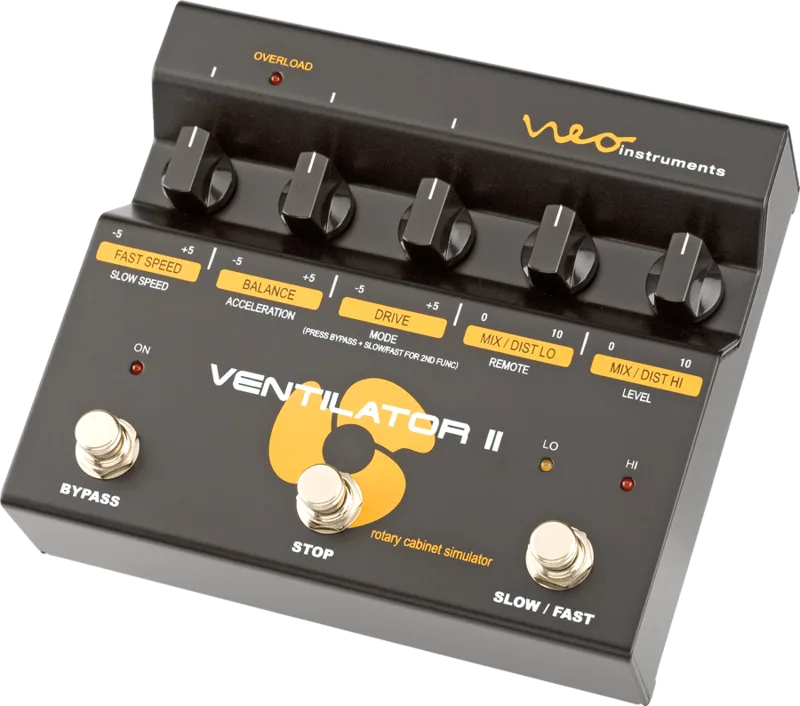


The mini VENT II is a rotary speaker emulation pedal from Neo Instruments' maker, neo-instruments. It puts the maker's Leslie 122 emulation into what the company calls "a compact and easy to use pedal format," carrying the sound of its larger Ventilator II into a box sized for a pedalboard1. Neo Instruments positions it for organ, keyboard and guitar players who want the depth of a classic rotary speaker without the cabinet itself.
At its core is a detailed emulation of a Leslie 122 rotary cabinet, representing a three microphone placement, with two microphones on the treble horn and one on the bass rotor1. A real Leslie splits the signal with a simple two-way crossover between its horn and drum rotors, letting each frequency band move independently, and the pedal models that whole moving system digitally2.
What the mini VENT II does
The pedal is a digital emulation of a Leslie 122, the classic rotary speaker cabinet associated with organ players and adopted by guitarists for its swirling, moving sound. Neo Instruments says the emulation "accurately represent[s] a three microphone (2x treble, 1x bass) placement," the way a real Leslie 122 would be recorded in a studio1.
The Leslie 122 itself works by spinning two rotors inside the cabinet: a high frequency horn and a low frequency drum. As the BOSS Articles history piece by Rod Brakes explains, "A simple two-way crossover splits the signal between the horn and drum rotors, letting each frequency band move independently"2. The mini VENT II models this behavior in a 32 Bit SHARC DSP, with 48kHz, 24 Bit conversion on the way in and out1.
Beyond the basic rotary effect, the pedal offers:
- Two different cabinet modes, which Neo Instruments says allow adjustment to suit the performance1
- A DRIVE control, which the maker describes as adding "the smokey hot magic of a tube saturated power amp," thickening the sound "from light to super juicy"1
- A Microphone Distance parameter, adjusting the simulated mic placement relative to the rotors1
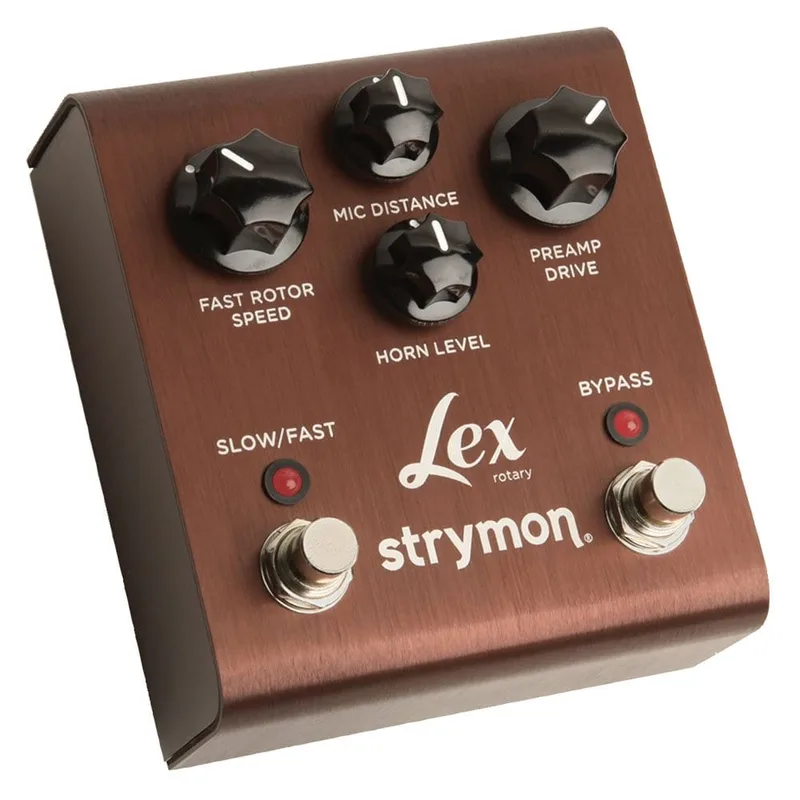
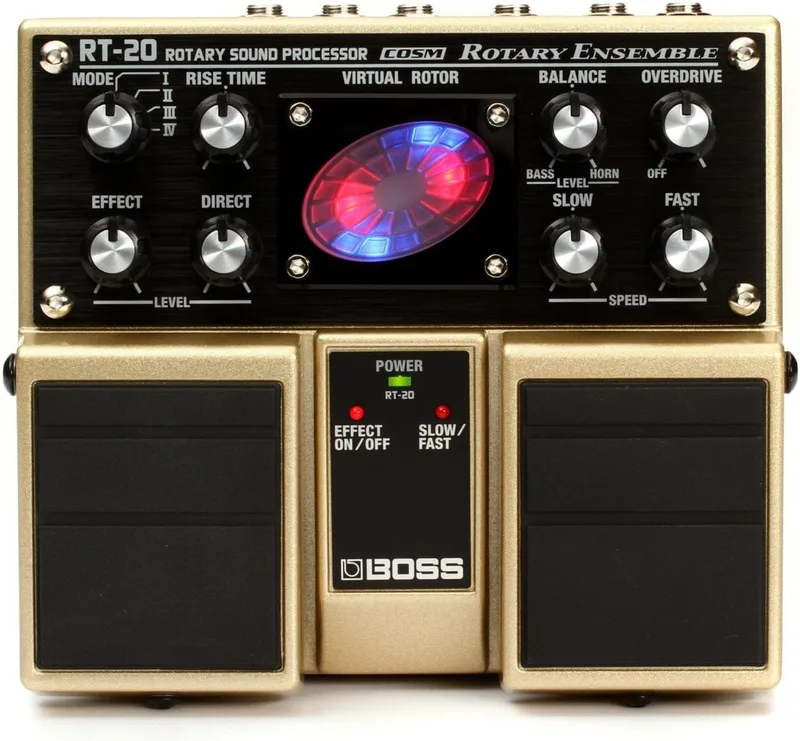
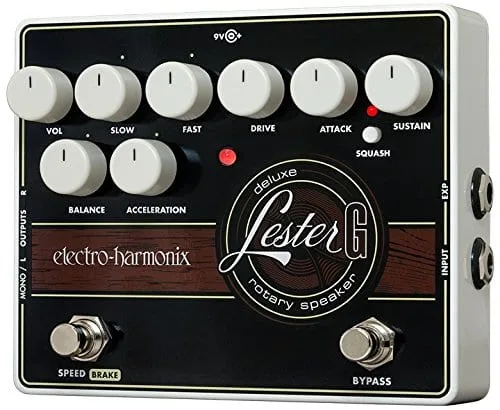
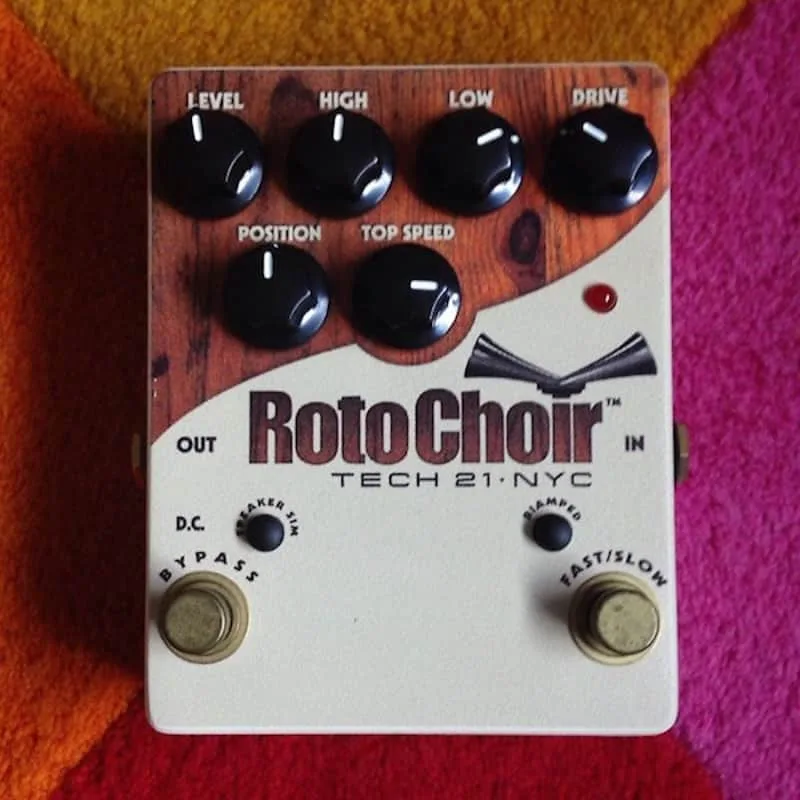
For players comparing rotary pedals, the mini VENT II sits in a category alongside units like the Strymon Lex, the Boss RT-20 Rotary Ensemble, the Electro-Harmonix Lester G Deluxe and the Tech 21 RotoChoir, all of which aim at the same Leslie-style effect in pedal form. See the speaker simulation pedals page for the wider field.
Controls, presets and footswitches
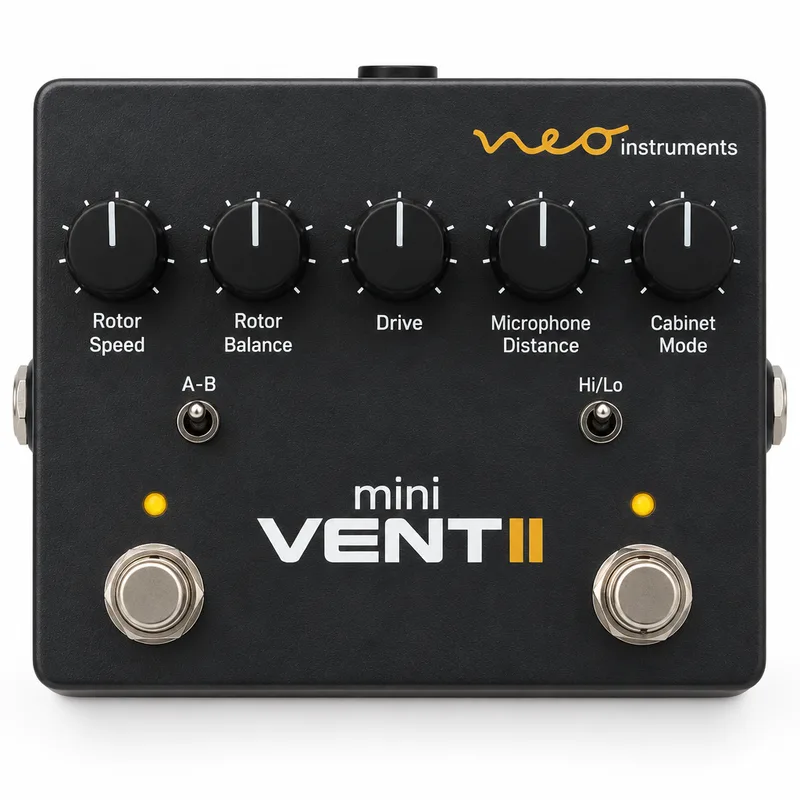
The mini VENT II keeps its editable parameters to a short list, and stores two of your setups in memory1:
| Control or switch | What it does |
|---|---|
| Rotor Speed | Sets the rotation speed of the emulated rotors1 |
| Rotor Balance | Balances the treble horn and bass rotor levels1 |
| Drive | Adds tube-power-amp-style saturation, from light to thick1 |
| Microphone Distance | Moves the simulated mic placement relative to the rotors1 |
| Cabinet Mode | Selects between two different cabinet behaviors1 |
| A-B switch | Recalls one of the two stored user presets1 |
| Bypass footswitch | Switches the effect on and off1 |
| Slow/Fast footswitch | Switches between the slow and fast rotor speeds1 |
Two user presets can be stored to memory and recalled via the A-B switch, so you can keep, for example, a slow chorus setting on one side and a fast, driven setting on the other, and jump between them mid-song1.
Power and connections
The pedal connects with a mono input and stereo outputs, plus a DC input for power. The connectors on the unit are Input Mono, Output L, Output R and DC In1.
| Specification | Value |
|---|---|
| Input impedance | 1MOhm1 |
| Output impedance | 100 Ohms1 |
| Recommended load impedance | 10 KOhms or more1 |
| Input sensitivity | -10 dBV (Hi), 0 dBV (Lo)1 |
| Output level | +6 dBV1 |
| Noise level | -80 dBA1 |
| Current draw | 200mA1 |
The Hi/Lo input gain select makes room for both guitar-level signals and hotter keyboard or organ outputs, which fits the maker's positioning of the pedal for organ, keyboard and guitar1.
The mini VENT II runs on 12 volts, not the 9V DC center-negative supply most guitar pedals use. A 12 volt universal power supply with four adaptors for use anywhere in the world is included1. If you run a shared pedalboard power supply, check that it can deliver 12V at 200mA on its own; the pedal cannot run from a standard 9V daisy chain.
How it differs from the micro Vent pedals
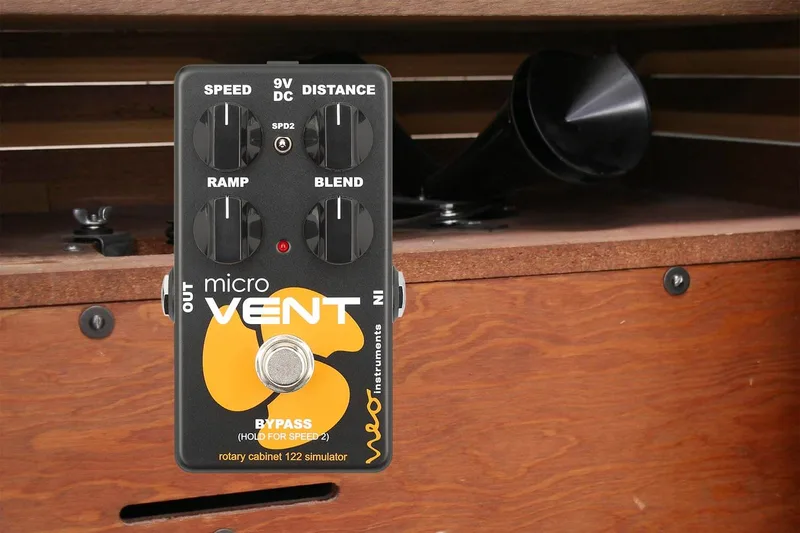
Neo Instruments also makes a smaller micro Vent line, and the differences matter when choosing between them. The micro Vent 122 derives its Leslie 122 algorithm from the Ventilator II, and the micro Vent 16 simulates a Fender Vibratone-style guitar Leslie, a 10 inch speaker firing into a single drum rotor3.
| mini VENT II | micro Vent line | |
|---|---|---|
| Emulation | Leslie 122, three-mic placement1 | Leslie 122 (micro Vent 122) or Vibratone (micro Vent 16)3 |
| Outputs | Stereo, Output L and R1 | Mono in / mono out3 |
| Power | 12V, 200mA, universal supply included1 | 9V DC standard negative polarity, 180mA3 |
| Presets | Two user presets, A-B recall1 | Speed switching via 3-way switch and BYPASS modes3 |
The micro Vent's Speed 1 control is a pot that ranges continuously from Slow to Fast with intermediate speeds, while Speed 2 is a three-way switch with Slow, Fast and Stop, and its BYPASS switch can be configured for momentary or latching operation, or to select speeds while the effect stays on3. The micro Vent line is also aimed at guitar, bass and keys3. The mini VENT II's advantages are its stereo outputs, its stored presets and its deeper parameter set, at the cost of a 12V power requirement rather than standard 9V pedalboard power.
Videos
Mike Hermans
Ondre J Pivec
Lance Keltner Music
Questions
Does the mini VENT II have stereo outputs?
Yes. It has a mono input and stereo outputs, Output L and Output R, so the two sides of the rotary emulation can be spread across a stereo rig. The input also has a Hi/Lo gain select to match the level of the source instrument.
What power supply does the mini VENT II need?
It runs on a 12 volt supply, and a universal 12V power supply with four adaptors for use anywhere in the world is included with the pedal. Current draw is 200mA. This is not a standard 9V center-negative pedalboard supply like some smaller rotary pedals use.
Can the mini VENT II be used with keyboards?
Yes. Neo Instruments describes it as a way to enhance organ, keyboard or guitar with rotary speaker emulation, and the Hi/Lo input gain select lets you match hotter keyboard or organ levels as well as guitar.
How many presets does the mini VENT II store?
Two user presets can be stored to memory and recalled via the A-B switch. Editable parameters include Rotor Speed, Rotor Balance, Drive, Microphone Distance and Cabinet Mode.
Sources (3)
- mini VENT II, neo-instruments.com
- Whirled Class: From Spinning Speaker Cabs to the RT-2 Rotary Ensemble, BOSS Articles (articles.boss.info), 2025-07-17
- micro Vent, neo-instruments.com