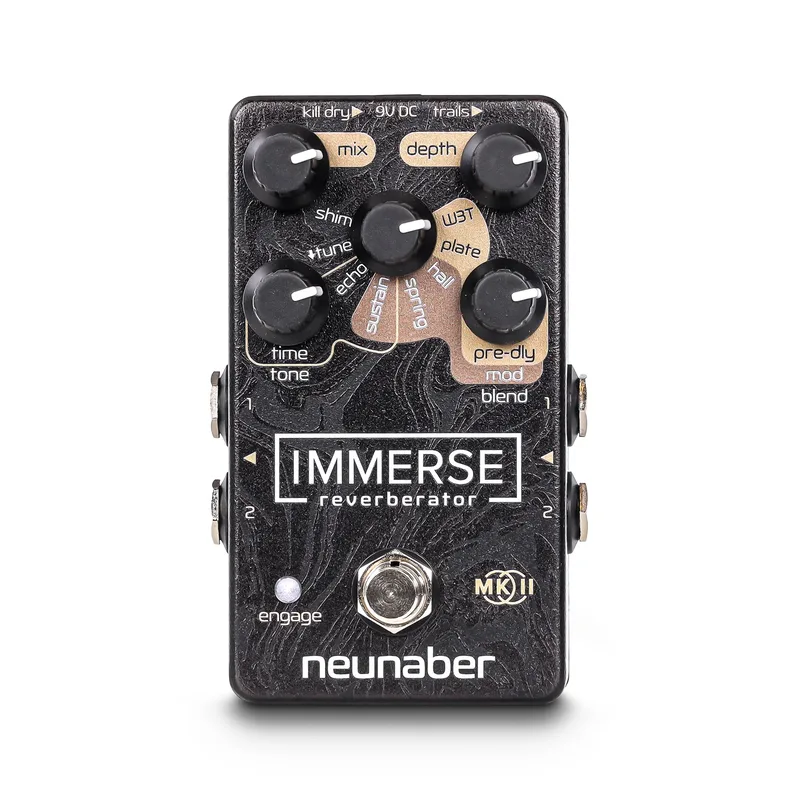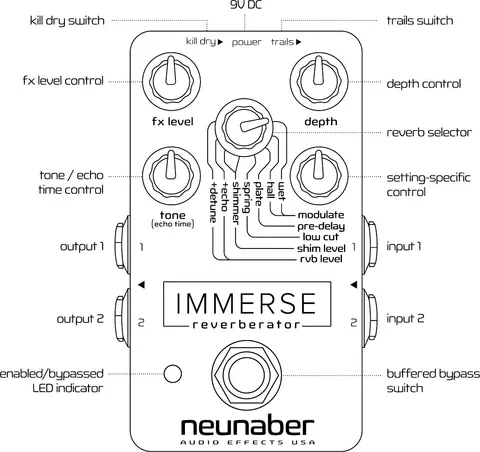
The Quilter Wet Reverb Pedal v1 is a mono reverb pedal made by Neunaber Technology. It is a compact, single-knob effect: a Mix knob sets the reverb level, from fully dry at full counter-clockwise to about a 50/50 dry and reverb blend at full clockwise1. The mono input accepts a signal straight from your instrument or from an amplifier's effects loop output, and the mono output feeds another pedal, an amp input, or an effects loop return, with a low-impedance output that drives long cables without a change in tone1.
The pedal is true bypass, and the bypass keeps working even with a dead battery or no power applied at all1. It can run on a 9V battery or a standard center-negative power supply, and an internal switch reconfigures it for parallel effects loop use, where only the reverb signal appears at the output1.
Controls and connections
The control set is minimal. The Mix knob controls the reverb level: full counter-clockwise is dry with no reverb, and full clockwise is about 50% dry and 50% reverb signal1. An LED lights when the effect is active, and the manual notes that if it fails to illuminate, the battery or power supply should be checked1.
| Control or jack | What it does |
|---|---|
| Mix knob | Sets reverb level; full counter-clockwise is dry, full clockwise is about 50/50 dry and reverb1 |
| Input jack | Mono input from your instrument or an amp effects loop output; unplugging it disconnects the battery1 |
| Output jack | Mono output to another pedal, amp input, or effects loop input; low-impedance1 |
| Foot switch | True bypass; works even with a dead battery or no power1 |
| LED | Lights when the effect is active1 |
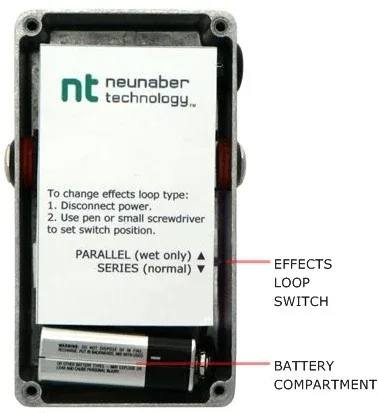
| Effects loop switch (internal) | Selects series (normal) or parallel effects loop operation1 |
Power and battery
The power jack accepts a 9V center-negative input, drawing 30 mA, and the manual states it works with standard power supplies like the 1 Spot and Power-All1. Plugging into the power jack disconnects the battery, so the two power sources never fight each other1.
On battery, the pedal runs about 14 hours with a typical alkaline battery1. The manual specifies 9V (PP3) alkaline or lithium batteries only, and notes the compartment is not large enough for some rechargeable 9V batteries1. Unplugging from the input jack disconnects the battery to extend battery life when the pedal is stored1.
The battery compartment does not fit some rechargeable 9V batteries. The manual recommends alkaline or lithium only1.
Bypass behavior
The foot switch is true bypass, and the manual emphasizes that bypassing works even with a dead battery or no power applied1. For a player, that means a power failure mid-gig silences the reverb but leaves the dry signal passing through the pedal untouched.
Parallel mode
The internal effects loop switch selects between series (normal) and parallel effects loops1. In parallel mode, only the reverb signal is present at the output, and the Mix knob adjusts the reverb level1. This suits amplifiers or switchers whose loops blend the return signal with the dry signal themselves: feeding them reverb only avoids stacking two dry signals.
Specifications
| Specification | Value |
|---|---|
| Input level | 6 V pk-pk max1 |
| Input impedance | 1 MΩ1 |
| Output impedance | 470 Ω1 |
| Frequency response, dry signal | 20 Hz to 20 kHz, +/- 0.1 dB1 |
| Total harmonic distortion | Bypassed: < 0.001%, 20 Hz to 20 kHz; enabled, dry signal: < 0.01% at 1 kHz1 |
| Signal to noise ratio | Enabled, dry signal: 108 dB, unweighted, 22 Hz to 22 kHz; enabled, knobs at 50%: 102 dB, unweighted, 22 Hz to 22 kHz1 |
How it differs from the Wet Stereo Reverb
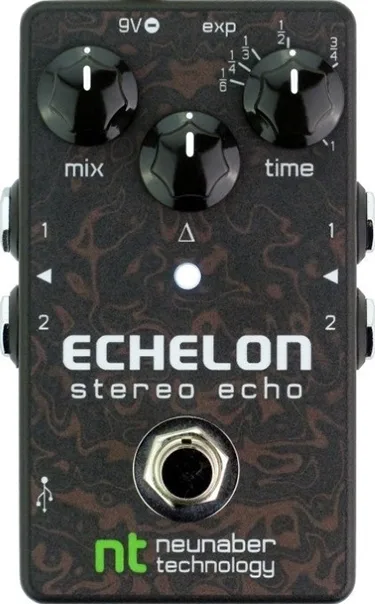
Neunaber also made the Wet Stereo Reverb v1, a stereo reverb pedal that shares a common hardware platform with the other pedals in that line, including the Echelon Stereo Echo v12. The two Wet pedals differ in several ways that matter to a player choosing between them:
- Mono vs. stereo: the Wet Reverb Pedal v1 has one input and one output; the Wet Stereo Reverb v1 is a stereo pedal12.
- Bypass: the Wet Reverb v1 is true bypass; the Wet Stereo Reverb v1 uses buffered bypass, which the manual says eliminates the tone change some bypassing schemes can cause12.
- Power: the Wet Reverb v1 runs on 9 V DC at 30 mA or a battery; the Wet Stereo Reverb v1 takes 9 to 12 V DC at 100 mA, center-negative, with a 5.5 mm OD x 2.1 mm plug12.
- Controls: the Wet Stereo Reverb v1 adds a reverb tone control, the Δ knob in its Wet setting, alongside its Mix knob2.
- Bypass options: the Wet Stereo Reverb v1 can be updated using Expanse Software to select between trails or normal bypass, where trails bypass lets the reverb trail off naturally after bypassing2.
The Wet Stereo Reverb v1's Mix knob also behaves differently: full counter-clockwise is 100% dry, full clockwise is a maximum effect level approximately equal to the dry signal level, and the dry signal is always at unity, with 0 dB gain at 0% Mix versus bypass2. Its foot switch bypasses the effect, equivalent to turning the Mix knob to zero, and bypassing does not significantly change power consumption2. The stereo pedal can also be set up for a wet-only (dry kill) mono signal: mono input into Input 2, mono output into Output 1, a dummy plug into Output 2, with the Mix control functioning as effect level2.
Questions
Is the Quilter Wet Reverb true bypass?
Yes. The manual states the foot switch is true bypass, and bypassing works even with a dead battery or with no power applied at all1.
How long does a battery last in the Wet Reverb?
About 14 hours with a typical alkaline 9V (PP3) battery. The manual recommends alkaline or lithium batteries only and notes the compartment is not large enough for some rechargeable 9V batteries. Unplugging the input jack disconnects the battery when the pedal is not in use1.
Can the Wet Reverb be used in an amp's effects loop?
Yes. The mono input jack accepts input directly from your instrument or an amplifier effects loop output, and the mono output jack feeds another pedal, an amplifier input, or an effects loop input1.
What does parallel mode do on the Wet Reverb?
The internal effects loop switch selects between series (normal) and parallel operation. In parallel mode, only the reverb signal is present at the output, and the Mix knob adjusts the reverb level1.
Is the Wet Reverb polarity center-negative?
Yes. The power jack accepts a 9V center-negative input at 30 mA, and the manual notes it works with standard power supplies like the 1 Spot and Power-All1.
What is the difference between the Wet Reverb and the Wet Stereo Reverb?
The Wet Reverb Pedal v1 is a mono pedal with true bypass and a battery option. The Wet Stereo Reverb v1 is a stereo pedal with buffered bypass, a 9 to 12 V DC power input at 100 mA, a reverb tone control, and firmware that can be updated to select trails or normal bypass12.
Sources (2)
- Wet Reverb Pedal v1 User Guide, Quilter Labs
- Stereo Effect Pedal (v1) User Guide, Quilter Labs