The four-cable method, usually shortened to 4CM, is a way of wiring a pedalboard or multi-effects unit to a guitar amp so that each effect lands in the right part of the signal chain. Instead of running every pedal in front of the amp, or every pedal in its effects loop, the method splits the chain: gain-based effects feed the amp's normal input and shape its preamp, while time-based effects sit in the amp's effects loop, after the preamp, where they stay clean no matter how hard the amp is driven.
Vertex Effects describes the arrangement plainly: the four-cable method is ideal for a mono pedalboard system where the "dry" effects, meaning distortion, overdrive and similar gain effects, run in front of the amplifier's preamp, and the "wet" effects run in the amplifier's FX loop1. The payoff is the same reason players put delay and reverb after overdrive on a ordinary board: echoes and ambience sound clearer when they are not being distorted by the gain stage in front of them. With 4CM the amp's preamp plays the role that the first drive pedal plays on a flat board.
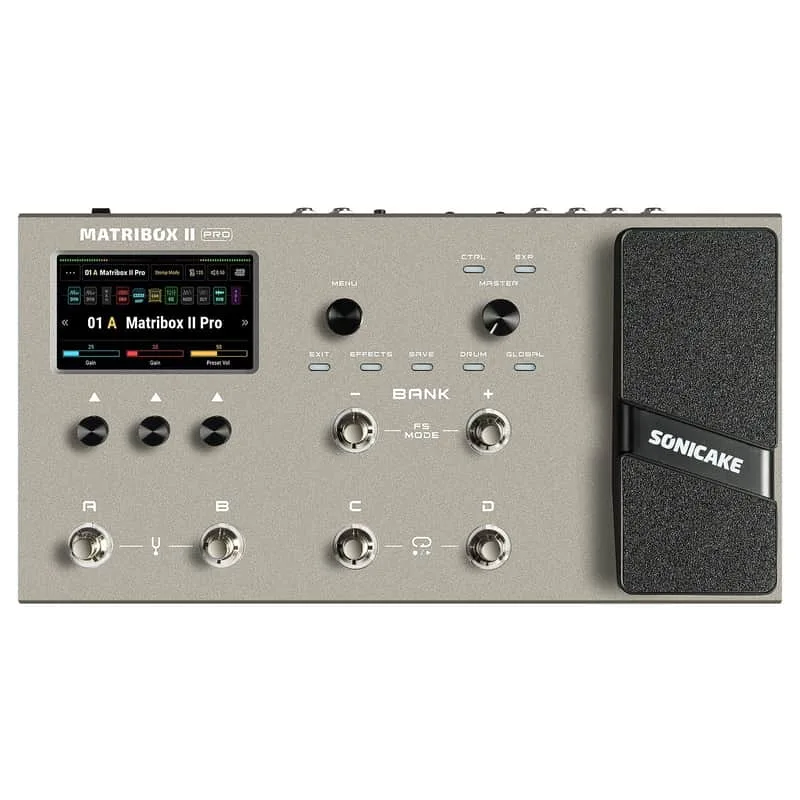
The method needs exactly what its name promises: four cables, an amp with an effects loop, and a multi-effects unit or pedalboard interface with the right send and return jacks. It is supported by a wide range of current gear, from the Line 6 HX Stomp to compact units like the Sonicake Matribox II, whose FX LOOP interface is built to support the 4 Cable Method for connecting other devices2.
What the amp's effects loop does
An effects loop is a pair of jacks on the amp, usually labeled FX Send and FX Return, that break the signal path between the preamp and the power amp. Anything plugged between them processes the signal after the amp's tone shaping but before the volume stage. Dolf Koch of Koch Amps explains that a loop circuit has four jobs: bring the high signal level of the tube amp back down to the low level the effects unit expects at the Send, bring the Return signal back up to amp level, match impedances, and do all of this without affecting the amp's sound4. He notes that such a circuit can be built with tubes, with opamps, or with a combination of both4.
Loops come in two main kinds, and the difference matters for 4CM:
| Loop type | How it works | What it means for you |
|---|---|---|
| Serial | The amp's signal is completely routed through the effects unit4 | The classic choice for 4CM; everything in the loop is in the path |
| Parallel | The dry signal stays in the amp and the wet signal is blended in | Wet effects blend with untouched amp tone |
Koch points out that the serial loop's advantage is that you can connect several effect units in serial to one loop4. He is also candid about a weakness: most effect units in combination with their connecting cables will affect the sound of the amp, mostly because of low quality components inside4. That is one reason the four-cable method rewards decent cables and a well-designed loop.
If your amp has no loop at all, the classic four-cable wiring is off the table. Some switching products work around this: Jad Freer Audio's Patch 4 is built to adapt to different amplifiers and setups with or without an FX loop, in a 2 or 4 cable setup, with no added cables or signal routing changes5.
The multi-effects unit or pedalboard side
The other half of the method is a unit that can split its own effects into two groups: those that go out of an early send, and those that come back in and continue to the main output. Many current multi-effects and preamp pedals are designed with this in mind:
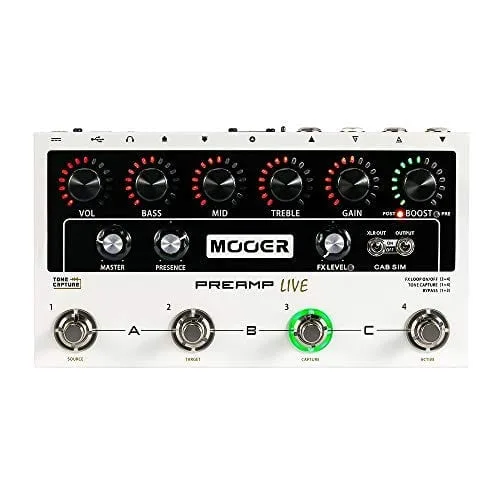
- The MOOER Preamp Live has a fully programmable effects loop with serial and A/B modes, for use with external effects or combining with your head or combo amp6.
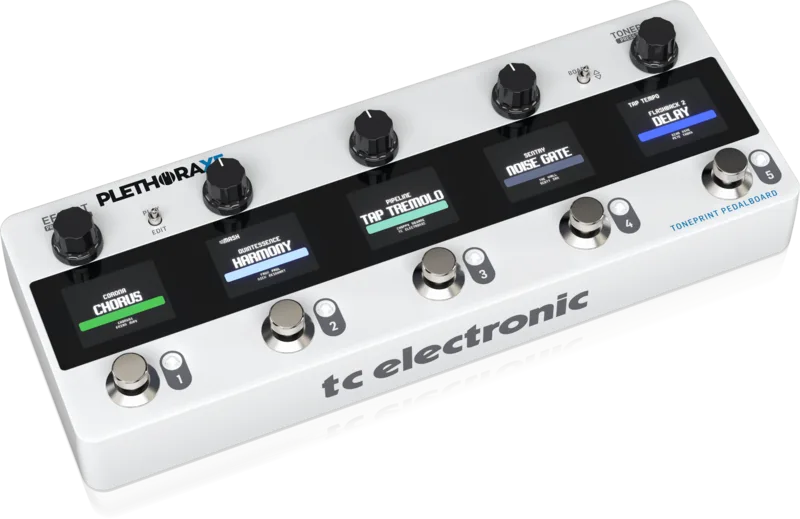
- The TC Electronic Plethora X5 has an insert you can use for a 4-cable method setup with your amplifier, letting you choose which effects go in front of the amp and which go in its loop7.
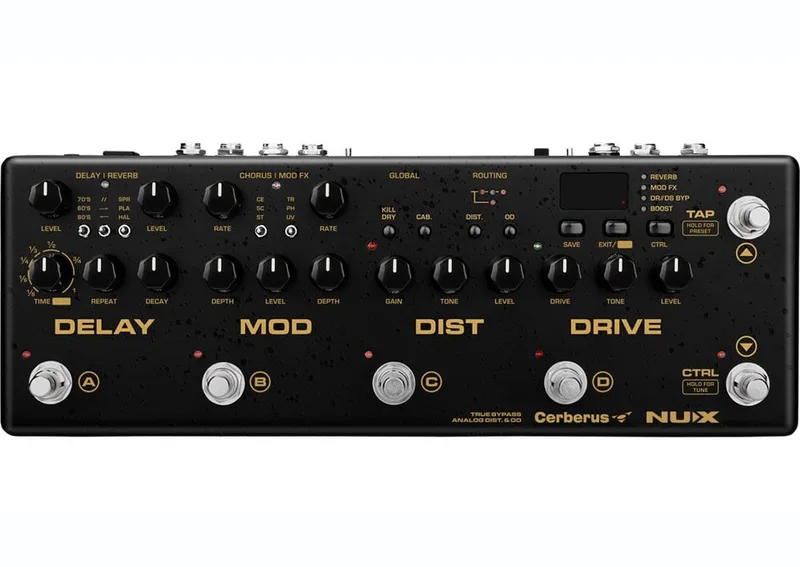
- The NUX Cerberus can be used either as a standalone unit or integrated into your rig via the 4-cable method8.
- The JOYO R-23 Legal Done supports both the 2 cable method and the 4 cable method9.
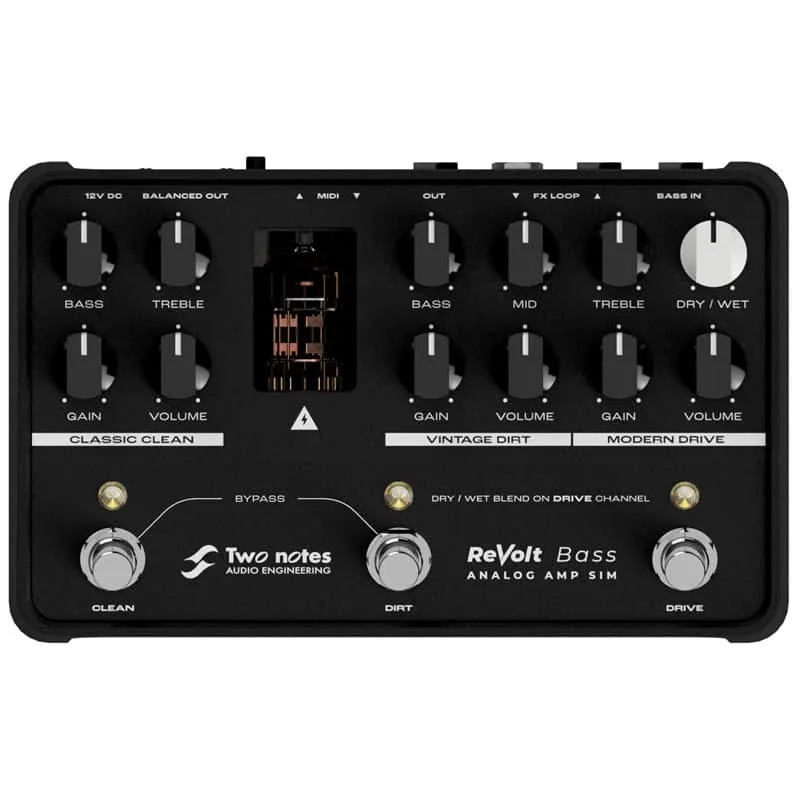
- Two notes builds a 4-Cable mode into the ReVolt Bass, for adding three pristine channels to your amp head10.
A multi-effects unit brings practical advantages over a board of separate pedals. BOSS's own genre guide for blues players notes that a multi-effects unit means one power source and fewer cables11. The four-cable method adds four of those cables back, which is the trade-off for getting the amp's preamp into the middle of the chain. For help with the power side of a board like this, see How to Power a Pedalboard.
How to connect the four cables
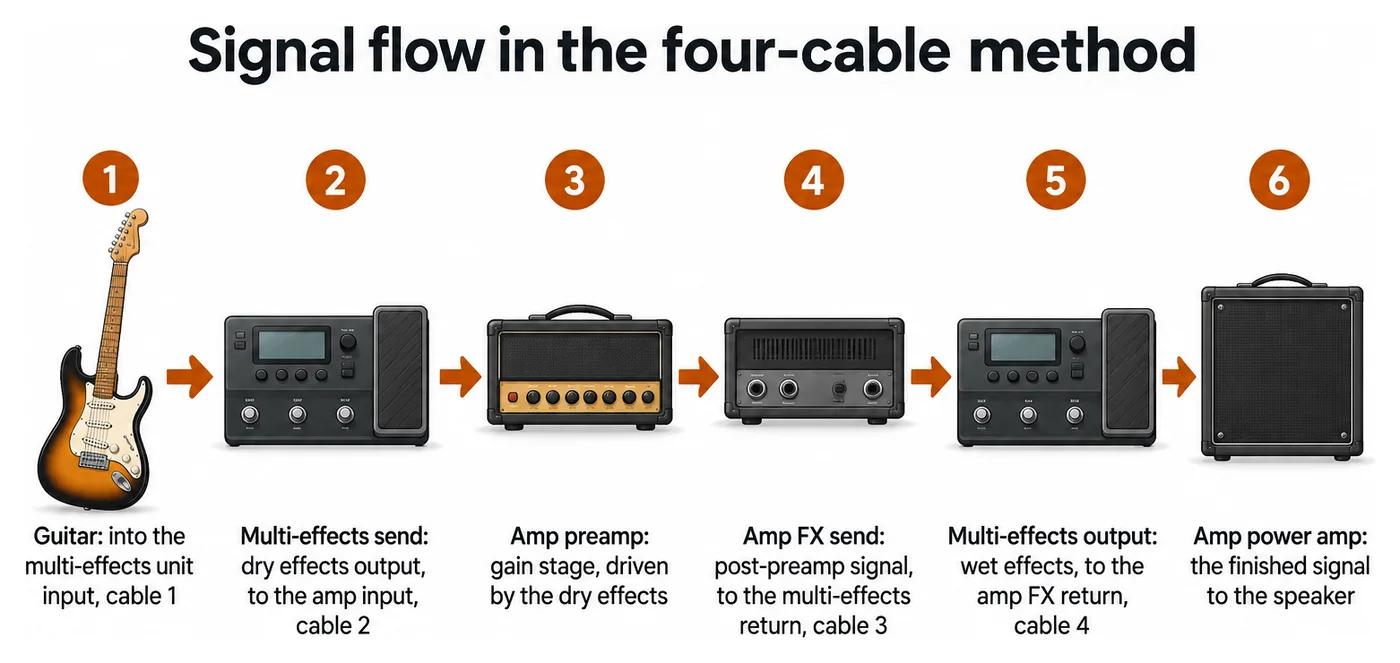
The wiring is easier to follow than it first looks. Number the cables in the order the signal travels:
- Cable 1, guitar to unit input. Your guitar plugs into the multi-effects unit or board interface as normal.
- Cable 2, unit send to amp input. The unit's send, carrying your dry effects, plugs into the amp's normal guitar input. The amp's preamp now sees your drive and compression.
- Cable 3, amp FX send to unit return. The amp's FX Send, carrying the post-preamp signal, plugs into the unit's return. Wet effects are processed here.
- Cable 4, unit output to amp FX return. The unit's main output, now carrying the wet effects, plugs into the amp's FX Return, and the signal continues to the power amp. Fryette's ground loop flow chart for a multi-FX rig labels this cable exactly that way: Helix Left/Mono Out to PS FX Return3.
Inside the unit, you then assign effects to the two halves of the chain. Temple Audio's 4X MOD Pro V2 manual describes the same idea at the pedalboard level: the setup lets you place some of your pedals, for example compressors and overdrives, before the amplifier's preamp/EQ section, and the rest in the FX loop after it12. The unit's manual will tell you which blocks sit before the send and which sit after the return; on the Plethora X5 you choose which effects go in front of the amp and which go in its loop7.
The four-cable method is a mono arrangement. Vertex Effects specifies it for a mono pedalboard system, with dry effects in front and wet effects in the loop1. If you run a stereo rig, the same idea extends to more cables and a stereo loop, covered in Stereo Pedal Rigs.
Patchbays and interfaces that tidy the wiring
Four cables running between a pedalboard and an amp get tangled fast, and several makers sell junction boxes that gather them into one panel. These do not change the signal routing; they give every connection a labeled home on the board.
- Saturnworks' 4-channel patch bay makes the 4-cable method easy to set up by having all the connections in one spot13.
- American Loopers also makes a 4-way buffered junction box that lets you hook up your guitar and your amp's FX loop, with an additional set of jacks for your amp's channel changing footswitch, and it can be used in many other ways, including the four-cable method14.
- A further American Loopers variant can reroute your wet effects from the amp's FX loop to the front automatically, simply by disconnecting cables, enabling the four-cable method or an all-front setup15.
- DSM Noisemaker's Loopster can be hooked up with an amp using the 4 cable method for solo and rhythm tones16.
Temple Audio's 4X MOD Pro V2 treats the four-cable method as its recommended configuration, but notes the unit can be used for any setup requiring 2 inputs and 2 outputs12. For more on why a buffer at the board's edge matters over long cable runs, see True Bypass and Buffers.
Common problems: hum, ground loops and noise
The standard fix is a ground lift, which breaks the shield connection on one cable while leaving the signal intact:
- Goodwood Audio's FX Loop Pro guidance for the four-cable method says that if you are getting a ground loop, try running the FX Loop Pro's Right output to your amp's FX Return, where its ground lift can be used17.
- KHE Audio Electronics, in its Quad Cortex 4CM setup, advises: "In case of hum or digital noise, experiment with the QC's and the KHE's Ground Lift switches and see which combination results in the least noise"18.
Cable length plays its part too. The general principle from Molten Voltage's OSMOSIS manual, written about MIDI but true of any long cable run, is to keep cables as short as possible, because long cables cause errors19. Shorter runs also pick up less noise in the first place.
A different noise problem is the amp itself. In a 4CM rig the preamp is in the middle of the chain, so amp hiss and gain-stage noise pass straight into your delay and reverb. GUP Tech builds noise gates for precisely this wiring: the MWAC can be used in 2, 3 or 4 wire methods202122, and the Lab #57 is another 4-wire noise gate that can be used in 2, 3 or 4 wires methods202122. GUP Tech also documents a player named Jesse using the SUN Gate exclusively in the 4 cable method, in a high gain hybrid rig with a solid state power amp23. A gate placed before the amp input, or wired in a 4-wire configuration around the loop, silences the gaps between phrases without choking your sustained notes. See Noise Gate Pedals for more on how these work.
Using 4CM with a modeler
The four-cable method is not limited to traditional multi-effects units. Modelers work just as well, provided you treat the real amp as the amp and the modeler as an effects processor.
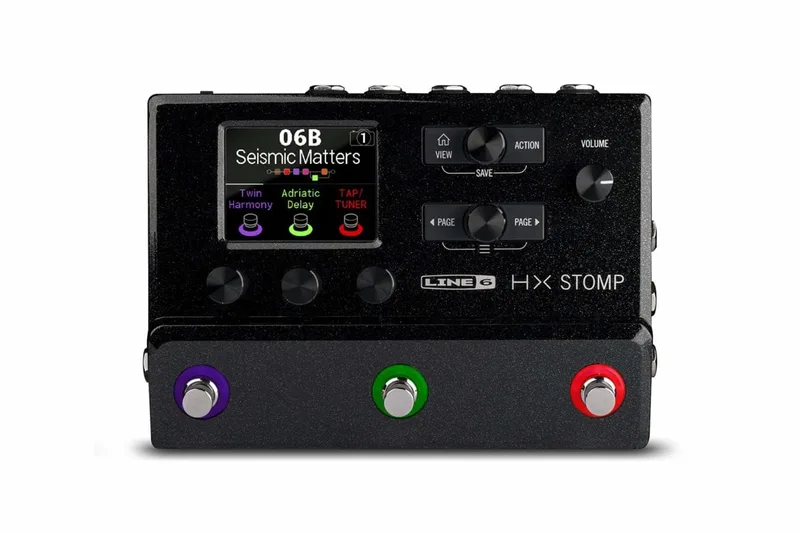
The Line 6 HX Stomp is a multi-effects and amp/cab modeling processor that Morningstar's in-depth review described as "a fully featured Helix system in a tiny enclosure"24. Line 6 itself lists the four-cable method among its uses: you can access up to six amp, cab, effect and IR blocks simultaneously as a backup or travel rig25. The Stomp also carries a 1/4" expression pedal input that accepts up to two expression pedals with a split Y cable, as well as aux switches24, which makes it a compact centerpiece for a 4CM board.
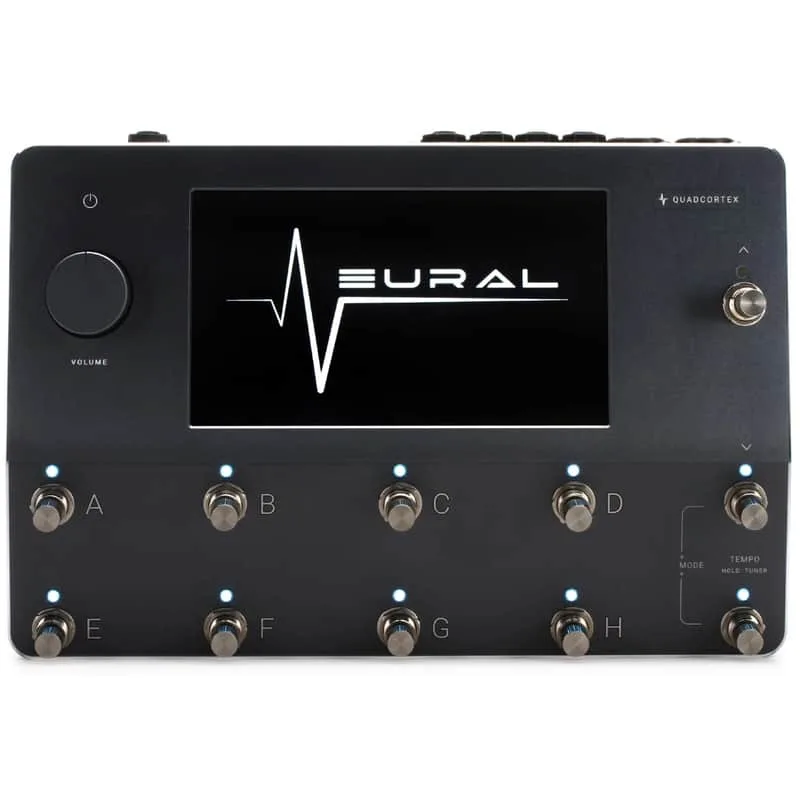
The Neural DSP Quad Cortex takes a similar role through KHE Audio Electronics' dedicated 4CM interface. In that setup, the QC functions as a mono multi-effect unit: only the stompbox and effect blocks are active, and all amp and speaker modeling blocks are disabled18.
Turning off the amp sims
That last point is the rule for every modeler in a 4CM rig: turn the amp and cab modeling off. Your real amplifier is already doing that job, and stacking a modeled preamp in front of a real one doubles the gain staging and colors the tone twice. KHE's Quad Cortex instructions are direct: "Make sure to deactivate all amp- & cab-models on the preset"18. The same logic applies to the HX Stomp, the Plethora X5's insert setup, or any unit whose amp blocks can be bypassed. What remains is the unit's stompbox and effect processing, split around the amp's preamp exactly as a pedalboard would be.
For players running modelers as the amp itself rather than alongside one, the related trade-offs are covered in Using Pedals with Amp Modelers.
Pedals on this page
Questions
Does my amp need an effects loop for the four-cable method?
Yes, in its usual form. The method depends on the amp's FX Send and FX Return jacks to split your signal around the preamp, so an amp without a loop cannot host it. Some switching boxes, like the Jad Freer Audio Patch 4, adapt to amps with or without a loop by switching between a 2-cable and 4-cable setup, but the classic four-cable wiring itself requires the loop.
How do I fix noise or hum with the four-cable method?
Hum usually comes from a ground loop formed by the multiple cable paths between amp and board. Try the ground lift switches on your interface or unit: KHE Audio Electronics advises experimenting with the ground lift switches on both the Quad Cortex and its interface to find the quietest combination. Goodwood Audio suggests sending an output with ground lift to the amp's FX Return. Keeping cables short also helps.
Can I use the four-cable method with a modeler like the Line 6 HX Stomp?
Yes. Line 6 lists 4-Cable Method as one of the HX Stomp's uses, running up to six amp, cab, effect and IR blocks as a backup or travel rig. The same approach works with other modelers and multi-effects units that have both an input/send and output/return path, such as the Neural DSP Quad Cortex with a suitable interface.
Do I turn off the amp sims in my multi-effects for the four-cable method?
Yes. Because your real amp is providing the preamp and power amp tone, the modeling blocks would double up on it. KHE Audio Electronics' Quad Cortex setup instructs you to deactivate all amp and cab models on the preset, leaving the unit working as a mono multi-effect with only stompbox and effect blocks active.
Sources (25)
- DIY Four Cable Method (4CM) & Wet/Dry Pedalboard Interface, vertexeffects.com, 2020-11-09
- SONICAKE QME-100 Matribox II Multi-effects Processor, Sonicake
- GroundLoopFlowChart_Multi-FX_PS2, Fryette, 2021
- Koch Blog, Koch Amps, 2013-12-09
- Patch 4 | Jad Freer Audio, Jad Freer Audio
- PREAMP LIVE_MOOER Audio, MOOER Audio
- PLETHORA X5, TC Electronic
- Cerberus, NUX Audio, 2026-05-11
- R-23 LEGAL DONE_JOYO, JOYO
- ReVolt Bass, Two notes, 2025-10-23
- Multi-Effects Genre Guide: Crafting Blues Guitar Sounds, BOSS (articles.boss.info), 2026-03-11
- 4XMOD Pro v2 Setup, Temple Audio, 2026
- Patch Bays, Saturnworks
- 4 Way Buffered Junction Box, American Loopers (www.americanloopers.com)
- 4 Way Junction Pedalboard Box, American Loopers
- loopster booster blender pedal, DSM Noisemaker
- FX Loop Pro, Goodwood Audio
- KHE + Neural Quad Cortex 4CM, KHE Audio Electronics
- OSMOSIS_-_MIDI_Mapper_and_Filter_by_Molten_Voltage_-_Owners_Manual.pdf, Molten Voltage, 2015
- MWAC Noise Gate Pedal Douche Edition, GUP Tech (guptech.ca)
- MWAC Gate, guptech.ca
- GUPtech - MWAC 4-wire Noise Gate Pedal, GUPtech (guptech.ca)
- SUN Noise Gate Guitar Pedal, GUP Tech (guptech.ca)
- Line 6 HX Stomp In Depth Review, Morningstar, 2018-10-21
- Line 6 | HX Stomp | Amp & Effects Processor, Line 6