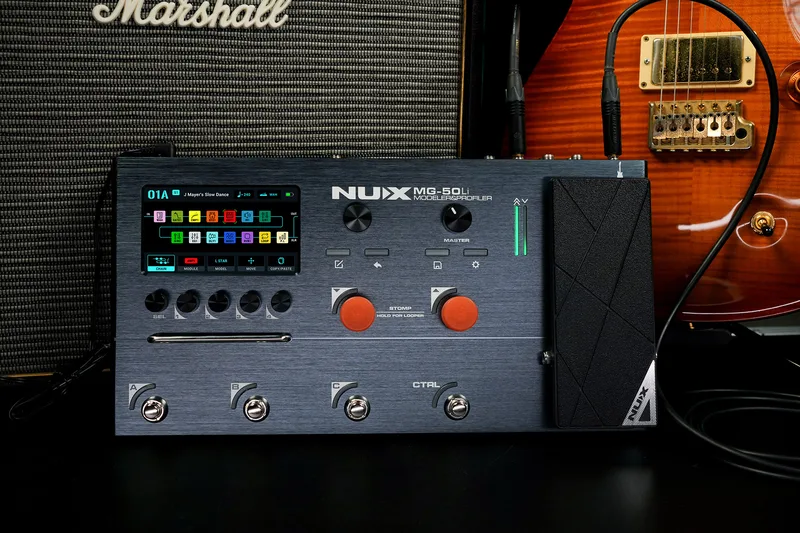


The NUX MG-50Li is NUX's flagship multi-effects processor for guitar and bass: a digital floor unit that combines amp modeling, amp profiling and impulse responses in one battery-powered package1. NUX describes it as a "Modeler & Profiler," pairing TS/AC-4K white-box physical modeling amps with Deep Image profiling amp models1. Guitar World's Paul Riario called it "an impressive new floor processor for guitarists and bassists" and the current flagship of NUX's MG series2. It lists at $4992.
Amp models, profiles and IRs
The MG-50Li carries three families of amp sounds. There are 28 White-box Modeling Amps built on NUX's TS/AC-4K physical modeling, 30 Deep Image profiling amp models, and 30 User Amp slots for your own captures1. Cabinet simulation uses 42 factory Cyber IRs in stereo plus 60 user IR slots in stereo1.
On Andertons' demo, Pete walked through a modeled Fender Deluxe Reverb with controls for gain, bass, treble, bias and level, and even a choice of which amp input the virtual guitar is plugged into4. The IR editing goes beyond picking a cabinet: a grid lets you move the virtual microphone, change its distance and angle, with 20 different IRs available per position4.
In a comparison against a NAM capture of a Friedman Pink Taco, the reviewers found the Deep Image profile a bit fizzier with more top end, while the NAM profile sounded slightly more realistic and more open4. Stereo rigs are supported through the UR Cyber IR stereo cabinet engine2.
| Sound source | Count | Notes |
|---|---|---|
| White-box modeling amps | 28 | TS/AC-4K physical modeling1 |
| Deep Image profiling amps | 30 | Profiling engine1 |
| User amp slots | 30 | Your own captures1 |
| Factory Cyber IRs | 42 (L/R) | Stereo cabinet engine1 |
| User IRs | 60 (L/R) | Stereo1 |
The signal chain offers 14 effect blocks (noise gate, compressor, EFX, amp, EQ, send/return, IR, delay, reverb, wah, modulation and more) arranged in Serial, Parallel or Split configurations1. Presets number 96 factory and 201 user1. System latency is rated at 3 ms or less, with 48 kHz / 32-bit processing and a 32-bit AD/DA converter1.
The controls: knobs, footswitches and play modes
The front panel centers on a 5-inch high-definition color LCD, six footswitches and seven encoders, all in an aluminum alloy enclosure1. The screen is not touch-sensitive: MusicRadar noted that "the 5-inch HD colour LCD screen doesn't feature any touch compatibility, so 7 encoders allow for control over parameters"3. On Andertons' video, Lee Anderton was blunt about it: "It's not touchscreen," and the pair agreed it takes a bit of getting used to if you are coming from a touchscreen unit4.
The large Edit encoder is the heart of the interface, handling preset scrolling, the signal chain view, and selecting or toggling effect blocks2. Five smaller encoders correspond directly to the on-screen choices, used for scrolling, swapping effects, adjusting settings and moving between screen pages2. A dedicated knob handles Master volume2.
The six footswitches divide the work:
- Four main footswitches: three preset patches per bank, plus a control footswitch assignable to a specific function, up to two additional scenes within a preset, or the tuner2
- Two bank footswitches: select banks down and up; held together, they activate the onboard looper2
The unit has three play modes4:
- Preset mode for switching whole patches4
- Stomp mode, where footswitches A, B and C plus an assignable control pedal toggle individual effects, and one stomp can turn multiple pedals off at once4. Firmware V1.1.1 added LATCH control in stomp mode1
- Scene mode, with three scenes that change the entire setup, including pedal settings, with no preset-change lag; scenes are built from scratch or copied4
The looper itself is straightforward: footswitch A is record and stop, B is pause and clear, C is exit4.
Expression control works through an optional external EXP pedal or the NMP-2 Lite footswitch1. Firmware V1.1.1 also brought LATCH control to STOMP mode1.
Connections, software and battery
Connectivity is generous for the price: 1/4" and 1/8" aux inputs, two XLR DI outputs, two 1/4" outputs, an 1/8" headphone jack, four 1/4" send/return loop jacks, and MIDI in/out24.
The standout practical feature is the internal battery: 5,000 mAh at 7.4 V, rated for 6 hours of playing and 5 hours to fully recharge1. That, plus the 2.8 kg weight, makes it a unit you can gig without a power supply1.
The MG-50Li runs on 12V DC at up to 1.5A, center negative, with a current draw under 1400 mA1. That rules out a daisy chain shared with typical low-current pedals; use the supplied adapter or the internal battery.
What reviewers said
Guitar World's Paul Riario found it an impressive floor processor and highlighted the flexibility of the control footswitch and the stereo IR engine2. MusicRadar's reviewer focused on the encoder-based workflow as the main trade-off for the lack of a touchscreen3. On Andertons' video, Lee and Pete praised the depth of the amp and IR editing but flagged two things: the non-touchscreen operation takes getting used to, and some effects are lighter on parameters than others, with a plate reverb offering only about two adjustable settings4.
The unit comes in two colors, gray and white4.
Videos
NUX
NUX
Ola Englund
Questions
How long does the NUX MG-50Li battery last?
NUX rates the internal battery at 6 hours of playing time. It is a 5,000 mAh, 7.4 V pack that takes about 5 hours to fully recharge. The unit can also run from its 12V DC center-negative power supply1.
Does the NUX MG-50Li have a touchscreen?
No. The 5-inch HD color LCD is not touch-sensitive. You operate it with seven encoders and buttons instead, and reviewers noted that players used to touchscreen units need some time to adapt to the knob-based workflow43.
Does the NUX MG-50Li have a looper?
Yes. Holding the two bank footswitches together activates the onboard looper. In the looper, footswitch A records and stops, B pauses and clears, and C exits4.
Can the NUX MG-50Li be controlled over Bluetooth?
Yes. The unit ships with the NBT-1 Bluetooth module, which supports app control through the NUX Audio App. There is also a USB-C connection for a PC editor, USB audio and firmware updates1.
What colors does the NUX MG-50Li come in?
It comes in two colors: gray and white. Both versions share the same aluminum alloy enclosure and specifications4.
Is the NUX MG-50Li true bypass?
No. NUX specifies buffered bypass switching rather than true bypass. As with most digital floor processors, the signal passes through the unit's converters when bypassed1.
Sources (4)
- MG-50Li - NUX Audio, NUX Audio (nuxaudio.com), 2026-09-14
- Nux MG-50Li review, Guitar World, 2026-05-02
- Nux MG-50Li review, MusicRadar, 2026-06-10
- Do We Need Another Multi-FX?! NUX MG-50Li Multi-FX Processor & Profiler!, Andertons Music Co, 2026-06-24