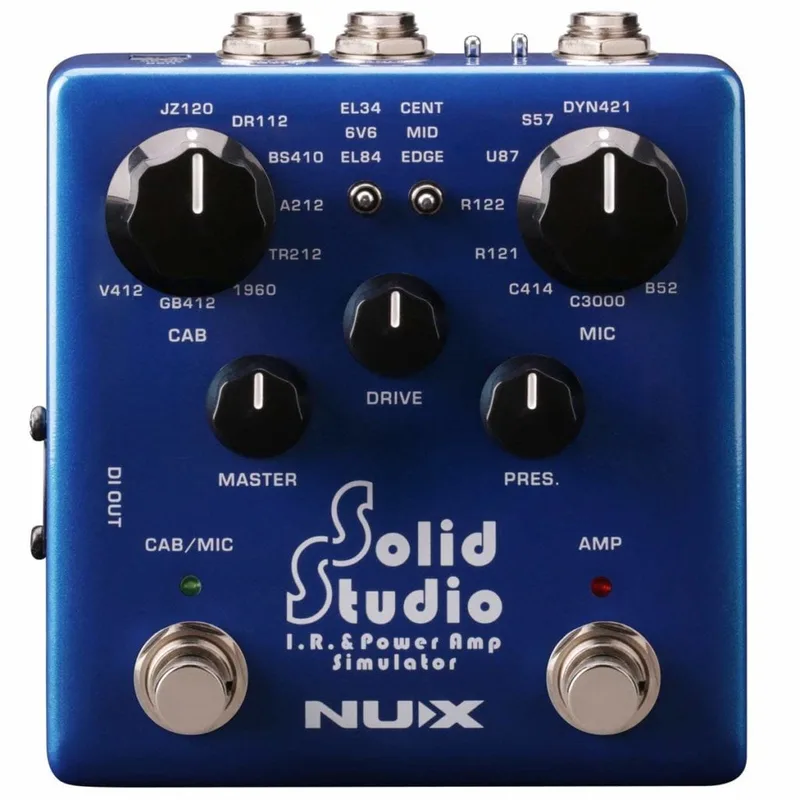


The NUX Solid Studio MKII is a preamp, power amp simulator and IR (impulse response) loader in a stompbox enclosure, made by NUX. It is built for amp-less playing: you plug your guitar in, and it supplies the amp and speaker character, sending the result to a PA, a pair of headphones or a computer. NUX sums up its approach as "Analog Feeling, Digital Advantage," meaning the unit is digital but is voiced to respond like a tube amp1.
The MKII is a stereo unit, and it improves on the original Solid Studio in amp modeling, IR loading, latency, stereo I/O, USB features and dynamic range, according to Delicious Audio's coverage2. It launched at international dealers in June 2025, listed at $199 and equivalent3.
What it does and how it is controlled
At the heart of the MKII is NUX's TSAC-4K white-box amp modeling algorithm, which the maker says brings realistic playability and a tube amp's negative feedback response, with independent preamp and power amp blocks you can combine2. Signal routing is block-based, so you can customize the processing chain rather than being locked into a fixed order2. On top of the amp and cab stages there are 8 ambient effects, reverbs and delays, in stereo for spatial depth3.
Navigation is through a 2.86-inch color LCD display at 960 x 376 resolution, which Guitar Pedal X called intuitive to operate2. Delicious Audio likewise highlighted the color screen as crucial for navigating the pedal's many features2. Firmware is at version V1.1.4 for macOS and Windows1.
The unit has two input modes, NORMAL and INJECT. NUX describes INJECT as a way to parallel the power amp signal, which suits players who want to keep a real power amp in the chain while still using the MKII's cab and IR stages1. There is also a THROUGH jack that parallels the power amp signal, alongside USB-C MIDI, the stereo balanced outputs with ground lift, and a Phones output for silent practice3.
USB audio and recording
The MKII works as a USB audio interface, streaming 24-bit/48kHz audio with simultaneous dry and wet recording, which Delicious Audio called ideal for re-amping and studio work2. Recording the dry signal alongside the processed one means you can re-amp the same performance through different amp and IR settings later. The converters are a TI PCM1840 ADC and an AKM AK4454VN DAC2.
The original Solid Studio offered only basic USB audio at 16-bit/44.1kHz, so the MKII's higher resolution and dry/wet recording are a meaningful step up for anyone recording direct2.
MKII versus the original Solid Studio
The original Solid Studio, which NUX lists among its legacy Verdugo Series stompboxes as an IR & Power Amp Simulator4, differs from the MKII in several ways that Delicious Audio laid out side by side2:
| Solid Studio (MkI) | Solid Studio MKII | |
|---|---|---|
| Amp modeling | Earlier version of TSAC, focused on preamp emulation | TSAC-4K white-box algorithm with independent preamp and power amp1 |
| IR loading | Mono IRs, basic mic simulation | True stereo IR loading, 60 L + 60 R slots2 |
| Latency | ~2.5ms bypass, ~3.5ms engaged | 0.85ms bypass, 1.9ms engaged2 |
| USB audio | 16-bit/44.1kHz | 24-bit/48kHz with dry/wet recording2 |
| I/O | Mono | Stereo, balanced outs with ground lift, Phones out3 |
The MKII's 110dB dynamic range is another improvement over the first version, and Delicious Audio noted it ensures compatibility with overdrives and compressors in front of the unit without unnatural compression2.
What reviewers said
Delicious Audio's verdict on the MKII was positive across the board:
"outperforms its MkI predecessor and rivals with next-gen processing, ultra-responsive amp modeling, and near-zero latency."2
Delicious Audio, January 20262
Guitar Pedal X's launch coverage highlighted the MKII's color LED screen as crucial for navigating the pedal's many features, alongside 8 ambient effects (reverbs, delays) in stereo for spatial depth2.
Power and practical notes
The MKII draws under 600mA at 9V DC with a negative tip1. That is well above what a typical compact analog pedal needs, so it should be on a properly rated isolated output rather than shared with low-current pedals.
For players comparing amp and cab simulators generally, the MKII sits in the same category as other speaker simulation pedals, with its stereo IR loading and USB recording as its distinguishing features2.
Videos
NUX
NUX
Ola Englund
News
Questions
What is the latency of the NUX Solid Studio MKII?
NUX's published figures for the MKII are 0.85ms in bypass and 1.9ms engaged, which Delicious Audio described as near-zero latency overall. The original Solid Studio ran at roughly 2.5ms bypassed and 3.5ms engaged, so the MKII is faster in both states.
How many IRs can the NUX Solid Studio hold?
The Solid Studio MKII has 60 left and 60 right user IR slots, supporting true stereo IR loading. The original Solid Studio was limited to mono IR loading with basic microphone simulation.
What does INJECT mode do on the NUX Solid Studio?
INJECT is one of the MKII's two input modes, alongside NORMAL. NUX describes it as a way to parallel the power amp signal, so the unit can sit alongside an existing power amp rather than replacing it in the chain.
Is the NUX Solid Studio stereo?
Yes. The Solid Studio MKII is a stereo unit with true stereo IR loading, stereo balanced 1/4-inch outputs with a ground lift, and 8 ambient effects in stereo. The original Solid Studio was a mono IR loader.
What power supply does the NUX Solid Studio MKII need?
It runs on 9V DC with a negative tip, the standard center-negative pedal supply, and draws under 600mA. That current draw is high for a compact pedal, so it needs a supply rated for it rather than a low-current output.
Sources (4)
- Solid Studio MKII, NUX Audio, 2025-12-16
- NUX Solid Studio MKII, Delicious Audio, 2026-01-07
- Guitar Pedal X, Guitar Pedal X, 2025-06-11
- Verdugo Series Stompboxes-legacy 归档, NUX Audio