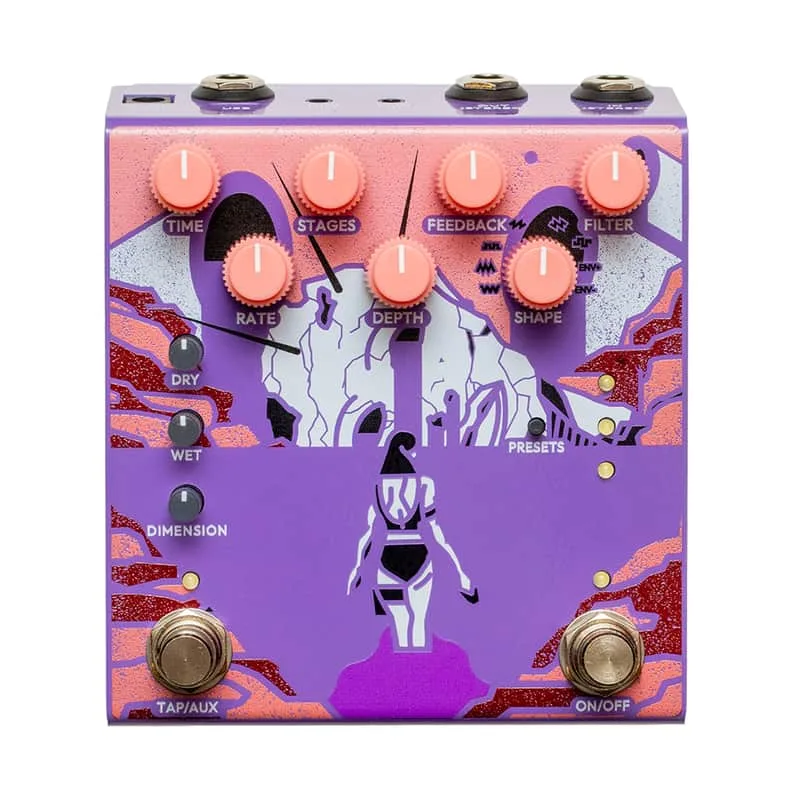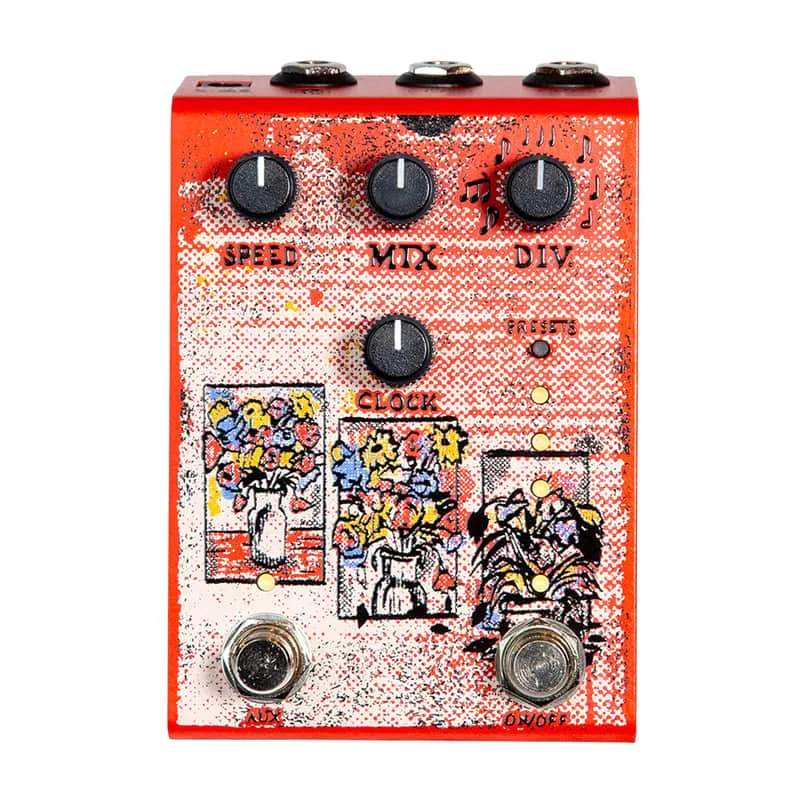


The Old Blood Noise Endeavors Parting is a stereo delay pedal built around chance: moments of chance give bursts of a glitch delay that can smear into a reverb, modulated by tremolo or vibrato, filtered, with lofi aliasing and reverse playback1. It was made in collaboration with harpist Emily Hopkins, and it combines chance-based delay or reverb, modulations, degradation effects, and randomized clock changes2. Delicious Audio's reviewer summed up the result as a pedal that blurs categories:
"It masterfully blurs the lines between glitchy rhythmic delay, atmospheric reverb, and dynamic modulation."
For a player, that means the Parting is less a metronome-style echo and more a generative texture machine: you set ranges and let the pedal's random clock changes and chance triggers reshape what comes out. It sits alongside other experimental Old Blood Noise Endeavors delay and reverb designs like the Bathing liminal delay and the Setback reverse effect, but with chance operations at its center21.
How the Parting shapes your sound
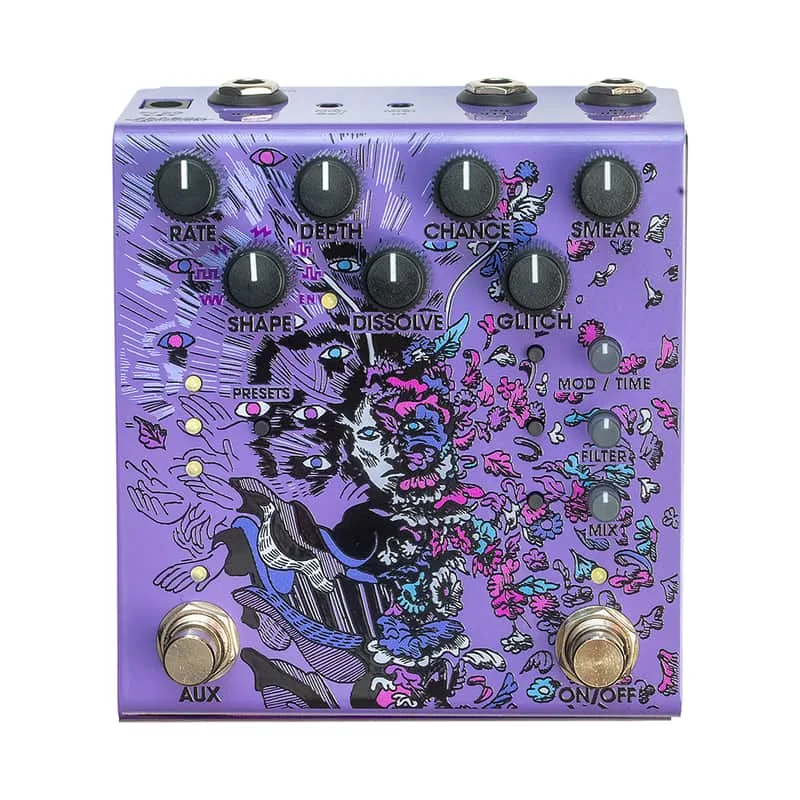
The pedal is organized into three core sections: Modulation, Glitch Delay/Reverb, and Dissolve3. Each knob interacts with the chance system, so the same setting can produce different results from one burst to the next.
| Control | What it does |
|---|---|
| Smear | Adds diffusion and feedback to the delay lines, turning them into a lush reverb as the knob is turned up1 |
| Glitch | Creates various clock subdivisions1 |
| Dissolve (below noon) | Reduces sample rate, creating an increasingly degraded version of the signal1 |
| Dissolve (above noon) | Reverses the signal, and repeatedly cuts the reverse clock in half as the knob is turned, creating an increasingly long and degraded reverse1 |
| Rate | Sets the rate of the modulation LFO, which is also the frequency of triggers for moments of chance1 |
The Dissolve control is the heart of the pedal's character. Below noon it works as a sample-rate crusher, moving the signal toward lofi aliasing; above noon it flips into reverse and keeps halving the reverse clock, so the reversed copy gets longer and more degraded as you turn it up1. Smear is the bridge between delay and reverb: at low settings the glitch repeats stay distinct, and turning it up feeds the delay lines back on themselves until they read as a reverb wash1.
Additional depth comes from internal trimmers for Mix, a post-effect high/low-pass filter, and Time range3, which let you tailor the overall level, the tonal window of the effected signal, and how far the time controls can reach.
Control, presets, and connections
The Parting is built for players who want deep control, both on the pedal and from the outside21:
- Presets, with the Aux footswitch assignable to preset switching12
- Aux switch for tap tempo, half speed, or preset switching1
- Expression control over every knob2
- MIDI control over everything in the pedal, including MIDI clock in and out for external syncing2
- Soft-touch On/Off footswitch with relay switching for minimal switch noise1
- Trails or true bypass switching2
The rear panel carries TRS stereo in, TRS stereo out, MIDI in, MIDI out, expression, USB-C, and the 9V DC power jack5. Stereo in and out run with an analog dry-through path2, which Gearnews noted preserves the integrity of the original instrument's tone despite the pedal's complex digital heart4.
The Parting comes in several colorways: Green (the standard), Purple, Stone, Basic, and a limited Ikey's Likey edition25. The enclosure art is by James Roo2.
Where it came from
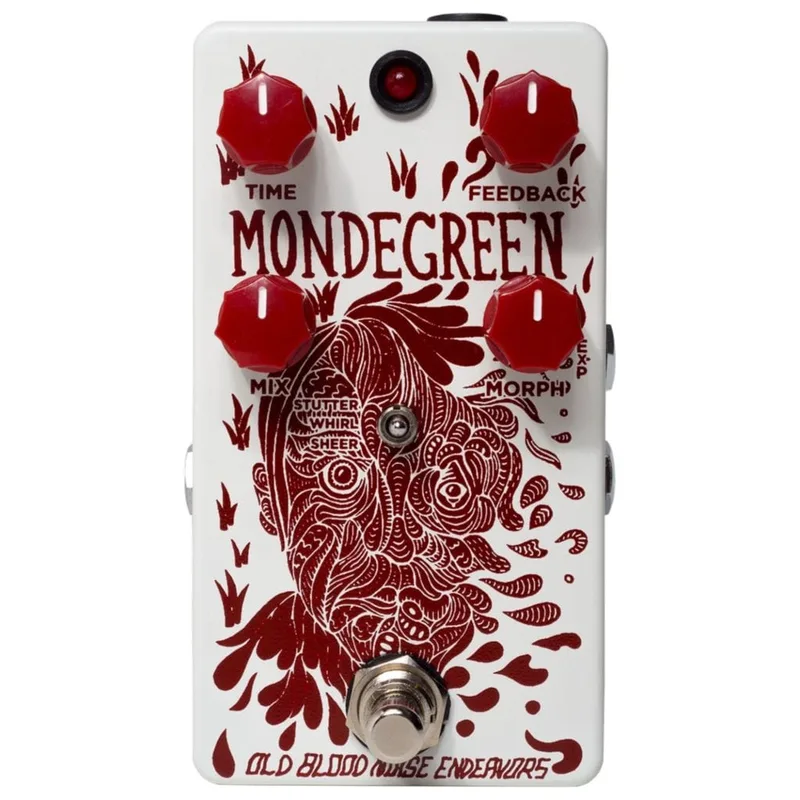
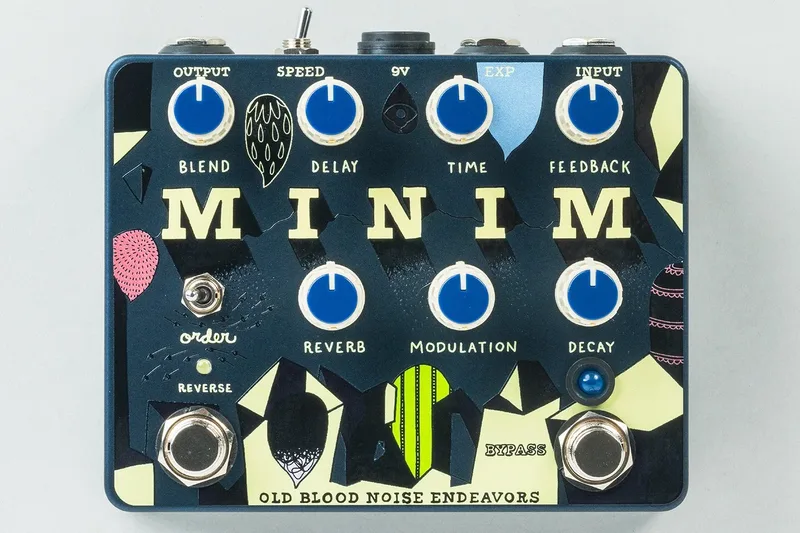
Old Blood Noise Endeavors and Emily Hopkins debuted the Parting in January 2026, announced as a glitch delay, reverb, and crushing modulation device priced at $329 / €385 / £3295. At the time of the announcement, Gearnews reported it was not yet available at Thomann4. The pedal is hand-made in Oklahoma, USA5, continuing the small-shop approach OBNE applies across its range, from the Mondegreen to the Minim reverb/delay/reverse.
What reviewers said
Delicious Audio reviewed the Parting in March 2026 and found it a genuinely musical tool rather than a novelty3:
"the Parting is an incredibly musical and inspiring tool for composers and performers seeking to move beyond traditional delay into the realm of generative, glitch-inflected ambience"
The same review highlighted the three-section layout and the internal trimmers as sources of additional depth beyond the surface controls3.
Power and setup notes
The Parting requires a 9V DC center negative 2.1mm power supply capable of 350mA, and the supply is not included2. At 350mA it draws more current than a standard one-spot style supply is typically built for, so check your power brick's per-output rating before plugging in. There is no battery option.
Videos
JHS Pedals
Old Blood Noise Endeavors
Harp Lady
Questions
Is the Parting stereo?
Yes. The Parting has TRS stereo input and output with an analog dry-through path, so your original signal stays untouched while the effected signal runs in stereo. It connects with TRS cables on the rear panel alongside its MIDI and expression jacks.
Does the Parting have presets?
Yes. The Parting stores presets, and the Aux footswitch can be assigned to preset switching so you can move between sounds with your feet. MIDI control over everything in the pedal gives another route to recall settings.
Does the Parting have tap tempo?
Yes, through the Aux switch. The Aux footswitch can be assigned as a tap tempo, a clock halver, or a preset switch. The pedal also accepts MIDI clock in and out for syncing its timing to external gear.
Who is Emily Hopkins and what did she do on the Parting?
Emily Hopkins is a harpist and effects experimenter, and the Parting is a glitch pedal Old Blood Noise Endeavors made in collaboration with her. Her involvement shaped a pedal built around chance-based delay, reverb, modulation, and degradation effects rather than a conventional delay.
Does the Parting have trails bypass?
Yes. The Parting offers a choice of trails or true bypass switching, so you can either let repeats and reverb tails ring out after you switch the effect off, or cut the signal completely clean.
Is the Parting analog or digital?
It is digital, with an analog dry-through path. Gearnews described it as having a complex digital heart while keeping the original instrument's tone intact through an analog dry path, and it needs 350mA at 9V DC to run.
Sources (5)
- Old Blood Noise Endeavors, Old Blood Noise Endeavors
- Old Blood Noise Endeavors, Old Blood Noise Endeavors
- Old Blood Noise Parting Delay/Reverb (Emily Hopkins Collab), Delicious Audio, 2026-03-26
- Parting: Emily Hopkins and OBNE Debut Creative Chaos, gearnews.com, 2026-01-21
- Guitar Pedal X, Guitar Pedal X, 2026-01-21