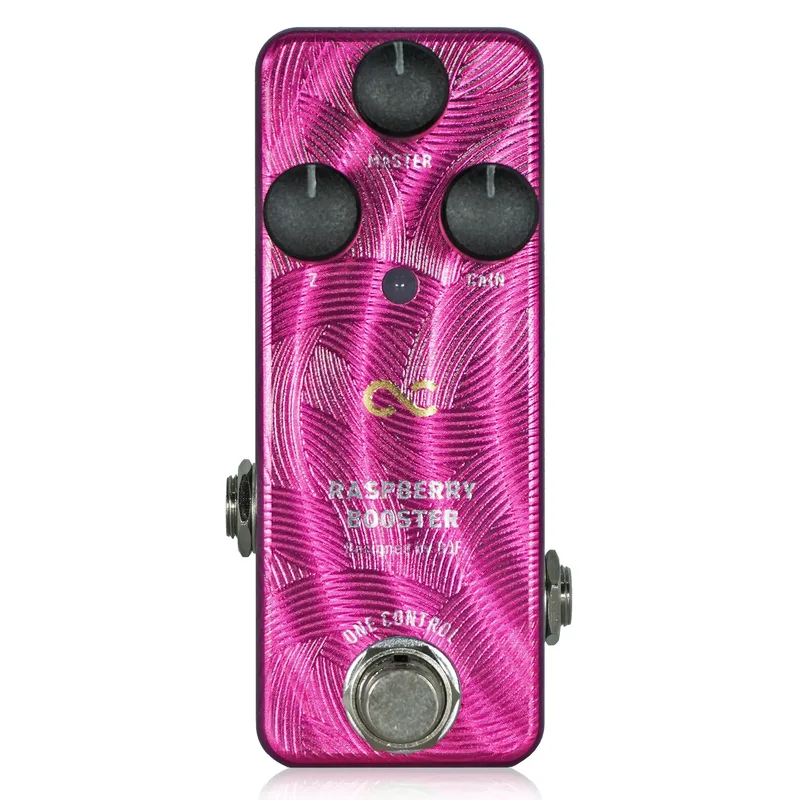


The One Control RASPBERRY BOOSTER is a boost pedal from One Control, designed by BJF (Bjorn Juhl) to recreate the tone of a vintage boost or overdrive pedal driving an old school tube amp. One Control describes it as designed to increase gain boost while maintaining tonal details by controlling the fine textures of the outputted distortion1. It sits in the boost pedal family, but its Z knob, which changes the input impedance the guitar sees, gives it a tone-shaping role most boosts do not have.
The maker's product page lists the pedal as sold out1.
The controls: Gain, Master and Z
The Raspberry Booster has three knobs, and each does a different kind of work on the signal.
| Control | What it does |
|---|---|
| Gain | Raising it increases the compression of the boost; at the maximum level, One Control says to expect a good amount of distortion while maintaining a detailed, clean tone1 |
| Master | Used for volume cuts as well as an overall volume boost1 |
| Z | Controls the input impedance, from 9.8K to 319K, letting the guitarist manipulate how the top end of the tone rolls off1 |
The Z knob is the pedal's distinguishing control. It changes what the guitar's pickups are loaded by, and so how the high frequencies roll off. One Control gives a concrete example of the effect at its extreme: if you set it to the minimum, the solid body's single coil becomes soft and warm like a plump semi-acoustic humbucker1. That makes the pedal a tone tool as much as a gain tool, and it is the reason for the placement rule below.
BJF's design intent, as One Control tells it, is a distinction between eras of overdrive: today's modern overdrive pedals actually produce distortion, whereas vintage overdrives were designed to distort the amplifier1. The Raspberry Booster is aimed at the vintage behavior, pushing an amp rather than generating all of its own grit, which places it near the border between boost pedals and overdrive pedals.
Power and specifications
The pedal runs at 9 V and takes either a 9V battery or a standard DC power supply1. Its consumption draw is 1.5 mA1, low enough that a battery is a practical long-term option and that the pedal poses no problem for any pedalboard power supply output.
| Specification | Value |
|---|---|
| Drive voltage | 9 V1 |
| Power | 9V battery or standard DC power supply1 |
| Consumption draw | 1.5 mA1 |
| Input impedance | 9.8K to 319K1 |
| Output impedance | 25K1 |
| S/N ratio | -80 dB1 |
| Size (not including projections) | 39 W x 100 D x 31 H mm1 |
| Size (including projections) | 47 W x 100 D x 48 H mm1 |
| Weight | Approximately 160 g1 |
| Enclosure | High quality aluminum enclosure1 |
Placement in the pedal chain
One Control is explicit about where the pedal belongs: it is important to place the RASPBERRY BOOSTER at the beginning of your pedal chain in order to take advantage of the Z (impedance) control1. The Z knob works by presenting a load to the guitar's pickups, so anything between the guitar and the pedal, such as a buffer or a wireless system, changes what the control can do. Placed first, it shapes the signal from the pickups onward; placed later, the Z control loses its point.
Videos
Robert DeVito
Visual Guy
Guitar Pedal Demos
Questions
Does the One Control Raspberry Booster run on a battery?
Yes. One Control lists the power options as a 9V battery or a standard DC power supply, at a drive voltage of 9 V. The pedal draws only 1.5 mA, so a battery lasts a long time, and the low draw also makes it easy on any pedalboard power supply.
What does the Z knob do on the Raspberry Booster?
The Z knob controls the pedal's input impedance, from 9.8K to 319K, which lets the player manipulate how the top end of the tone rolls off. One Control notes that setting it to the minimum makes a solid body's single coil soft and warm, like a plump semi-acoustic humbucker.
Where should the Raspberry Booster go in the pedal chain?
One Control says it is important to place the RASPBERRY BOOSTER at the beginning of the pedal chain in order to take advantage of the Z (impedance) control. The Z knob works by changing what the guitar's pickups see, so it needs to sit first to do its job.
Is the Raspberry Booster true bypass?
Yes. One Control lists the pedal as having True-Bypass Switching, so when it is off, the guitar signal passes through without the circuit in the way.
Who designed the One Control Raspberry Booster?
The pedal was designed by BJF, the designer Bjorn Juhl. One Control says BJF designed it to recreate the tone of a vintage boost or overdrive pedal driving an old school tube amp.
How much current does the Raspberry Booster draw?
One Control lists the consumption draw at 1.5 mA, a very low figure that suits both battery power and any standard pedalboard power supply output.
Sources (1)
- RASPBERRY BOOSTER (OC-RBBn), One Control USA