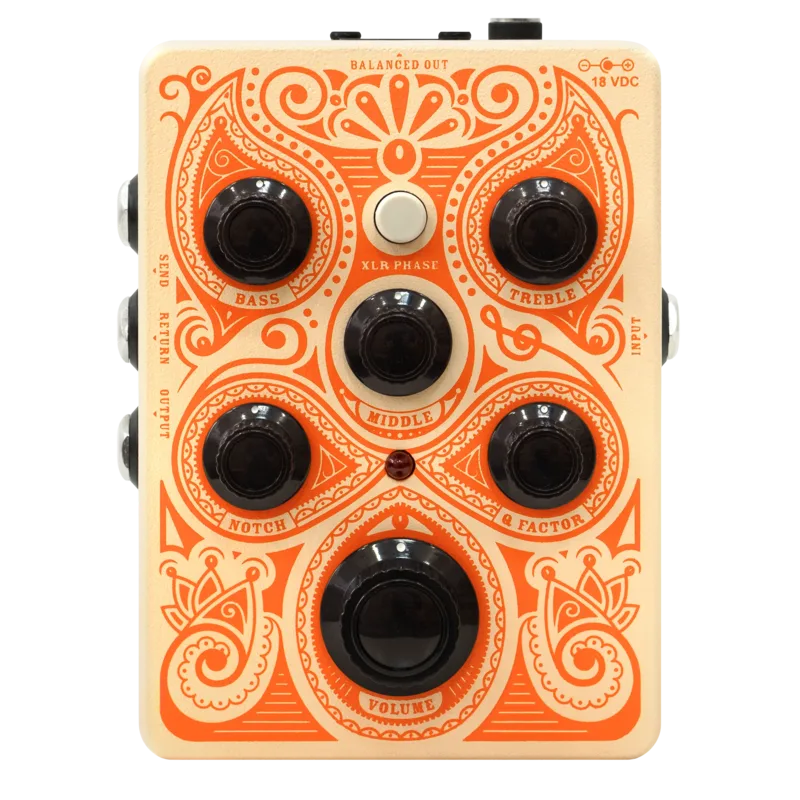


The Orange Acoustic is a compact acoustic pedal from Orange that puts a preamp, EQ and DI in one box. Orange describes it as "a studio-quality acoustic preamp, EQ, and DI all in a compact, stage-ready box," built around a low-noise JFET preamp circuit and designed to preserve the character of your acoustic guitar and pickups with minimal coloration1. RockBoard's PedalPedia listing, drawing on Orange's own material, says the circuit takes its know-how from Orange's Acoustic Pre TC preamp and Crush Acoustic 30 amplifier2.
For a player plugging a piezo or magnetic pickup straight into a PA or interface, it covers the three jobs that usually need separate boxes: boosting and conditioning the signal, shaping the tone, and feeding a balanced line to the desk123.
What it does to your sound
The core of the pedal is a JFET-driven preamp. GuitarPlayer's reviewer, Jimmy Leslie, found the result is not entirely neutral: "The Acoustic Pedal's core tone is downright amp-like. It sounds and feels almost like playing through an acoustic-friendly amp," adding that it colors the sound in a good way with harmonic content, gain and sustain4. Orange's own positioning is the opposite in spirit, describing the pedal as designed to preserve your guitar's character with minimal coloration1. Both can be true at once: the EQ is transparent when set flat, while the preamp itself has a character some players will like.
The EQ is a 3-band layout (bass, middle, treble) with two extra tools that matter more for acoustic players than for electric14:
| Control | What it does |
|---|---|
| Volume | Sets overall output level1 |
| Bass / Middle / Treble | 3-band EQ1 |
| Notch | Selects the frequencies affected by the middle control, 68Hz to 1.2kHz4 |
| Q Factor | Sets the width of the midrange band: narrow for sharp boost or feedback control, wide for general mid shaping4 |
| XLR phase | Phase reverse switch on the balanced output1 |
The notch and Q Factor controls are the feedback-fighting heart of the EQ. MusicRadar's reviewers found the notch filter "effective across 68Hz to 1.2kHz" and said it "will help you weed out feedback," with the Q Factor adjusting the size of the midrange band for fine-tuning5. GuitarPlayer's reviewer explains the mechanics: the notch selects which frequencies the middle control affects, and a narrow Q setting is "super handy for homing in on a specific frequency range" for feedback control, while a wide setting works for general mid shaping4.
Power and connections
Two listings give conflicting polarity for the 18V supply: Orange's product page says center positive1, while RockBoard's PedalPedia listing says center negative2. Reversed polarity can damage a pedal, so this difference matters when wiring a supply.
The connection set, per GuitarPlayer, covers everything an acoustic rig needs: input, output, FX send and return, XLR balanced out, and the 18V DC adaptor input4. The effects loop is buffered1, so it can sit around time-based pedals without losing high end through long cable runs.
The two outputs work simultaneously. Orange states that "because the quarter-inch jack output stays active at the same time, you can still feed a stage amp or tuner" while the XLR goes to the desk1. The XLR also carries the phase reverse switch, which helps when combining the PA feed with a stage amp or when two sources combine out of phase1.
Where it came from and how it differs
Its circuit draws on two existing Orange products: the Acoustic Pre TC preamp and the Crush Acoustic 30 amplifier2. GuitarPlayer identifies the topology as a single-ended Class A preamp, the same class of operation associated with Orange's tube amps4.
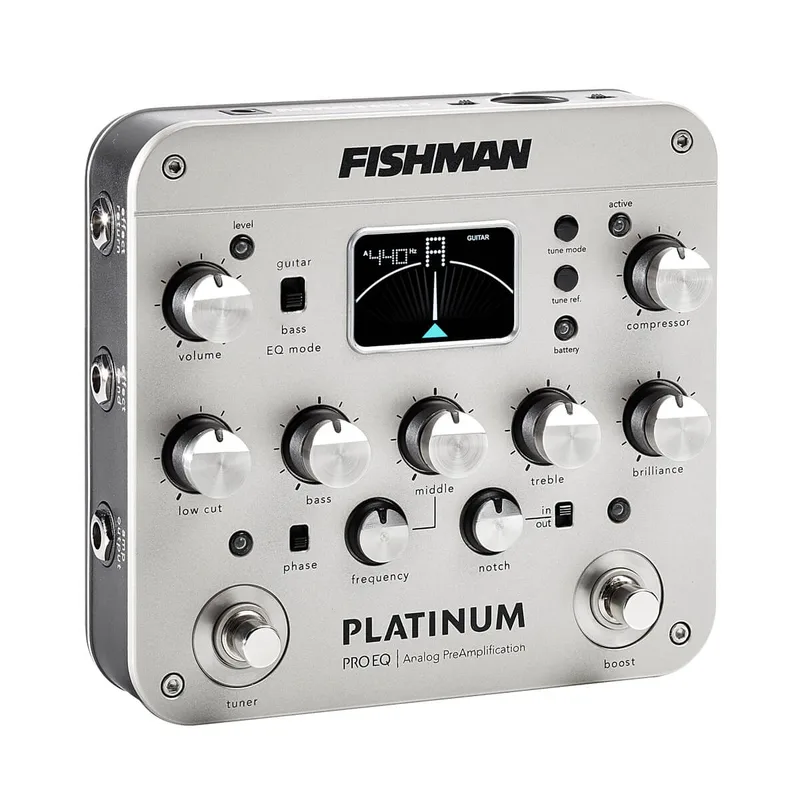
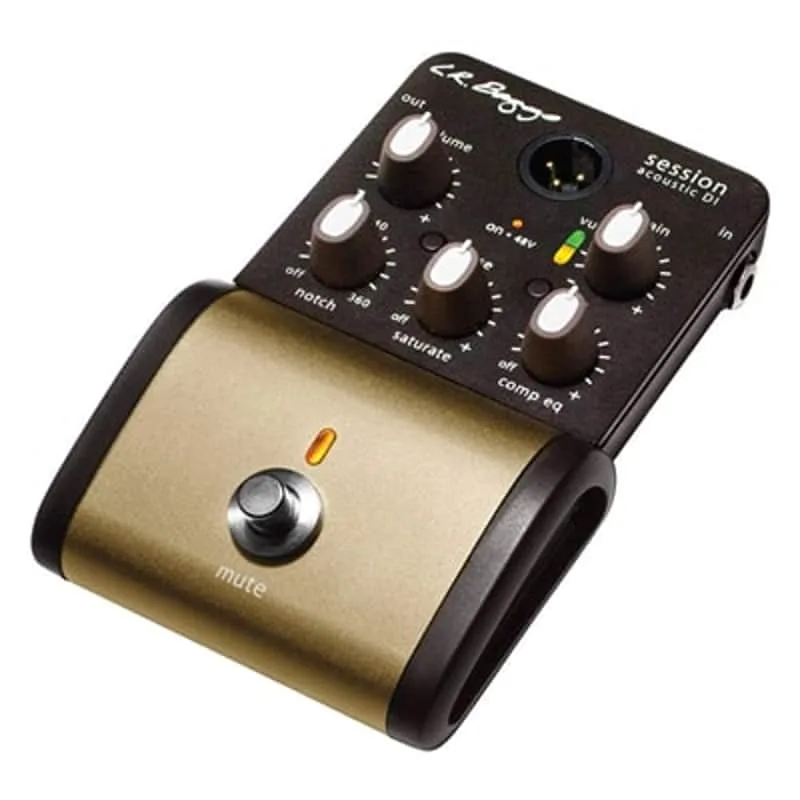
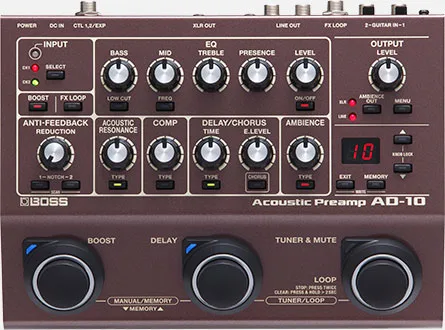
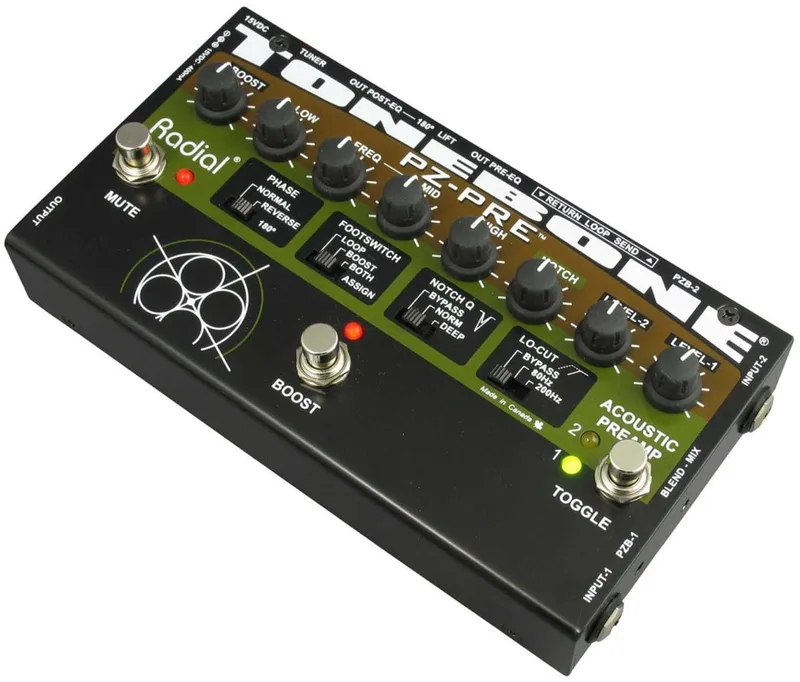
Compared with other acoustic preamp and DI pedals in this space, such as the LR Baggs Session DI, the Boss AD-10 Acoustic Preamp or the Radial Tonebone PZ-Pre, the Orange's distinguishing points are the amp-like JFET preamp character, the sweepable notch with variable Q, and the absence of any footswitch or bypass4. It is an always-on tone-shaping box rather than a switchable effect.
What reviewers said
Published reviews were positive about the EQ and the core tone. MusicRadar highlighted the notch filter and Q Factor as the keys to the EQ's usefulness against "errant frequencies and feedback," alongside the XLR phase button5. GuitarPlayer's Jimmy Leslie praised the amp-like character and the feedback tools, while noting plainly what the pedal lacks: no bypass or mute4. Guitar World's review listed the price as $169/£1396, against Orange's own £159.00 GBP list price1.
The enclosure follows Orange's visual tradition: GuitarPlayer describes "a psychedelic swirl surrounding six jet-black knobs on a cream-colored box"4. Unboxed it measures 10.5 x 6 x 13.7 cm (4.1 x 2.4 x 5.4 inches) and weighs 400g (14.1 oz)1.
Videos
Orange Amps
Orange Amps
Orange Amps
Questions
Does the Orange Acoustic Pedal have a footswitch?
No. GuitarPlayer's review lists no bypass or mute, and there is no footswitch. The pedal is always on when powered, so it works as a set-and-forget preamp and DI at the start or end of your signal chain rather than something you stomp on mid-song.
Can the Orange Acoustic Pedal run on 9V?
No. It takes an 18V DC power supply, so a standard 9V pedal supply will not run it. Orange's product page specifies 18V center positive, while RockBoard's PedalPedia listing gives 18V DC, center negative, so the two listings conflict on polarity.
Does the Orange Acoustic Pedal help with feedback?
Yes. Its Notch control works with the Q Factor control to target problem frequencies, and MusicRadar notes the notch filter is effective across 68Hz to 1.2kHz for weeding out feedback. GuitarPlayer adds that a narrow Q setting is handy for homing in on a specific frequency range for feedback control.
Where is the Orange Acoustic Pedal made?
GuitarPlayer's review lists it as built in England. It is made by Orange, the British amplifier company, and carries the brand's cream-colored enclosure with psychedelic orange swirl around six black knobs.
Can I use the XLR and 1/4 inch outputs at the same time?
Yes. Orange states that the quarter-inch jack output stays active while the balanced XLR output is in use, so you can feed the mixing desk from the XLR and still send a signal to a stage amp or tuner from the jack.
Sources (6)
- Acoustic Preamp and EQ Pedal, Orange Music Electronic Co Ltd
- Acoustic Pedal by Orange, RockBoard PedalPedia, 2026
- [Acoustic Preamp and EQ Pedal | Orange Amps
- Orange Acoustic Pedal Review, GuitarPlayer (www.guitarplayer.com), 2021-10-20
- Orange Acoustic Pedal review, MusicRadar, 2021-12-22
- Orange Acoustic Pedal review, Guitar World, 2021-10-15