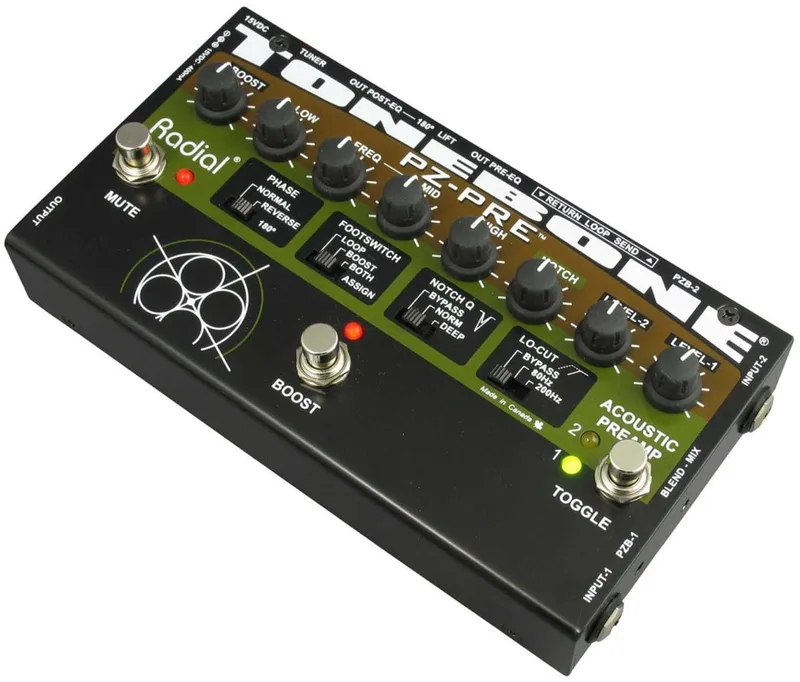


The Radial Tonebone PZ-Pre is a floor-pedal acoustic instrument preamp and direct box from Radial Engineering, built around two channels that you can switch between or blend together1. Radial describes it as "a powerful acoustic instrument preamplifier with a powerful EQ and feedback control section and loads of connectivity options giving you complete control over your rig"1. Premier Guitar's reviewer summed it up as "a DI, a preamp, a booster, a feedback-buster, an A/B-Y and an EQ in a single unit, let alone in a stompbox"2. MusicRadar's Dave Burrluck called it "pretty much the most feature-laden dual-input acoustic guitar/instrument preamp we've encountered"3.
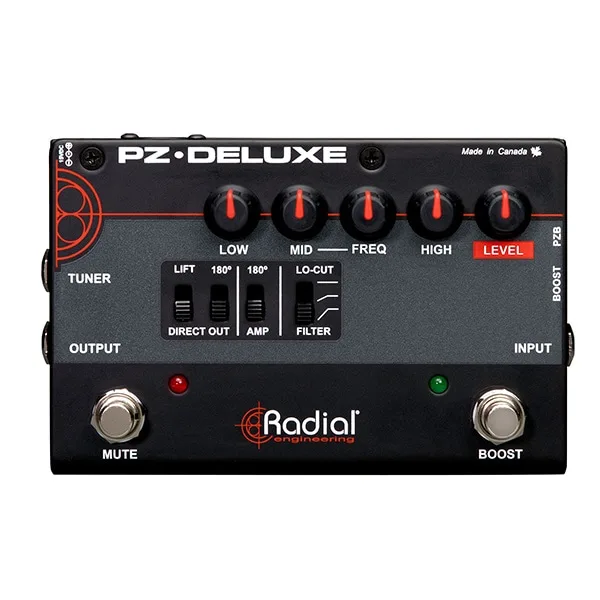
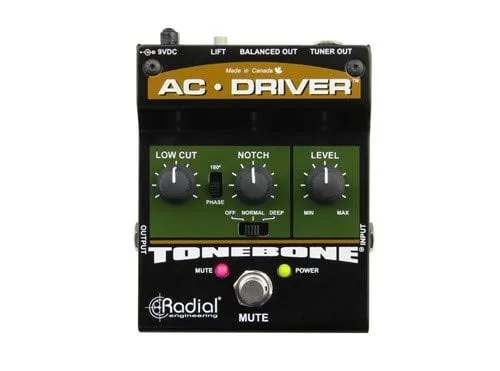
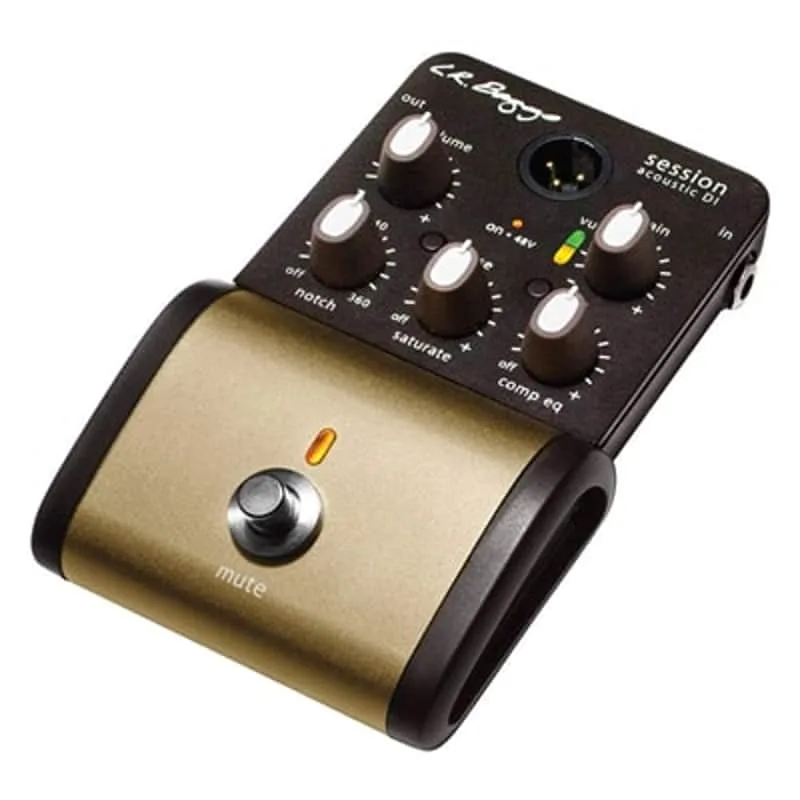
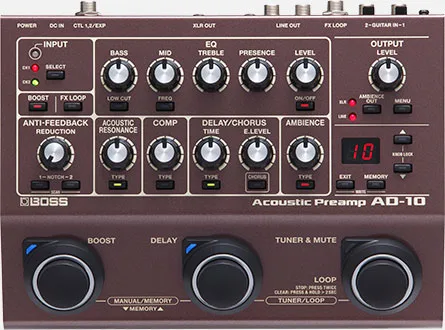
The circuit is analog, with 100% discrete class-A PZB piezo boosters and what Radial calls an ultra-quiet preamp circuit that adapts to any pickup system14. Radial's own support material describes it as "a very good sounding, clean & natural instrument preamp"5. It sits in the same family as the Radial Tonebone PZ-Deluxe and the Radial AC Driver, and competes in the acoustic preamp lane with units like the LR Baggs Session DI and the BOSS AD-10.
What the PZ-Pre does
The PZ-Pre is built for the working acoustic player on stage. Its two inputs serve two jobs: quick instrument changes between songs, or blending two pickups from one instrument at the same time1. Each input has a recessed switch that activates a class-A piezo buffer at 10 meg-ohms, an impedance Radial says is there specifically to load piezo pickups correctly25. Each input also has its own gain control, so matching levels between a quiet pickup and a hot one is a knob turn rather than a compromise2.
A recessed blend switch engages both channels at once, which Premier Guitar's reviewer found "ideal for instruments with two pickups and two outs"2. Radial's own instructions for combining a magnetic pickup with a piezo are direct: engage BLEND so both channels are on, activate the PZB booster for the piezo, then adjust the relative volumes to suit5. Radial notes that Sunrise magnetic pickups work fine with or without the Sunrise buffer box5.
The unit also carries a power booster and a mute for stage control1. Radial positions the whole package around live problem solving: "many of the PZ-Pre's features are designed to solve problems on live stages"5. It can record direct, but that is not its primary design goal5.
The controls and footswitches
The front panel is organized around three footswitches and a set of knobs. Radial's feature list breaks the controls down as follows6:
| Control | What it does |
|---|---|
| Level 1 & 2 | Sets the input volume on each channel6 |
| 3-band EQ | Bass, semi-parametric midrange and high frequency controls6 |
| Boost | Up to 8dB of added gain for solos, works with the boost footswitch6 |
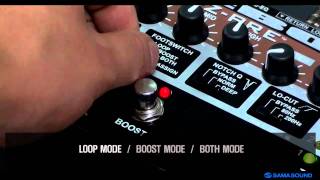
| Footswitch Assign | Sets the boost footswitch for boost, effects loop, or both6 |
| Notch | Sets the center frequency of the notch filter, used to eliminate feedback6 |
| Notch-Q | Selects normal or extra deep notch, works with the notch frequency control6 |
| Lo-Cut | 3-position filter that reduces low frequency rumble and resonance that can cause feedback or muddy the sound6 |
| Loop Send / Return | Inserts effects into the signal path, activated with the boost footswitch6 |
The three footswitches each have a distinct job6:
- Toggle: selects between channel 1 and channel 2, with LEDs showing the active input6
- Mute: turns off all outputs except the tuner out, for quiet on-stage tuning6
- Boost: activates the booster or the effects loop, working with the Boost Assign setting6
Premier Guitar's reviewer found the mute toggle indispensable once accustomed to it, and noted the input selector has an indicator light for each input2. The boost itself is a 12 dB variable switch placed "front and center for a reason," with an assignable switch that can control the boost, the effects loop, or both2. One detail worth knowing: the boost knob is simply out of the circuit when the footswitch is assigned to LOOP5.
The effects loop is in series, so all of the instrument signal passes through it when engaged5. On the latest version of the PZ-Pre, a recessed switch on the left side lets the loop be either footswitch controlled or on all the time5. Radial also changed the artwork and paint scheme on later units, purely for aesthetics, with no functional change5.
Feedback control: notch, Notch-Q and phase
Feedback is the core problem the PZ-Pre's EQ section is built to attack. Radial says its "powerful semi-parametric EQ and feedback eliminating controls allow the user to fine-tune their sound while eliminating troublesome frequencies"1, and lists notch and resonance filters among its headline features1.
The tools work together. The notch control sets the center frequency of the notch filter, sweeping to find the frequency that is ringing6. The Notch-Q control then selects between a normal notch and an extra deep notch, so a stubborn resonance can be cut harder6. The Lo-Cut filter handles the low end, with three positions that reduce rumble and resonance that can cause feedback or muddy the sound6. Premier Guitar's reviewer also found the high pass filter, with 80Hz and 200Hz settings, useful for cutting "annoying low moans"2.
On the EQ itself, the reviewer's verdict was positive:
Premier Guitar's reviewer found the 3-band EQ with the semi-parametric mid to be very rich, with only slight nudges being necessary to round out the Martin DCX1E, with flat onboard EQ'ing2.
The Notch Q switch, with its dedicated pot and normal and deep V settings for cutting midrange feedback, was new territory for the reviewer: "I am now a big fan"2.
Power and connections: 15V DC and twin XLR outputs
The PZ-Pre runs on a 15V DC power supply, which is included with the unit62. RockBoard's independent listing gives the full electrical picture: 15V DC, center negative at the supply side, and a 400mA current draw4. The polarity detail matters: Radial states the PZ-Pre needs center pin positive polarity, so if your power supply is center pin negative you need a 2.1mm barrel-connector polarity reverse cable5.
The PZ-Pre runs on a 15VDC power supply, which is included with the product26. Radial notes that the Cioks DC10 and AC10 both have 15V outlets that work for Tonebone pedals5. Because the PZ-Pre has an onboard regulator, it may be used with an unregulated power supply, such as the one included with the product5. Running it at 18V instead of 15V shortens the lifespan of the internal voltage regulators from approximately 20 years to 18 years5.
On the output side, the PZ-Pre carries two balanced mic-level XLR direct outs2. The Pre-EQ output sends a dry signal, without EQ, to the PA system, while the Post-EQ output sends the wet, EQ'd signal to the PA or monitors6. RockBoard describes the practical benefit: "the PZ-Pre can be used send a dry signal to the house and performer tailored sound to monitors"4. A recessed ground lift switch disconnects pin-1 ground at the XLR outputs to help eliminate hum and buzz caused by ground loops62. There is also an always-on buffered tuner output that keeps working when the mute footswitch is engaged6.
Radial says the output circuits are similar to the output stage of the Radial J48 direct box5. The inputs are protected by built-in safety capacitors that guard against external DC voltages, which matters if phantom power shows up on a line5. The PZ-Pre cannot supply phantom power itself; a phantom powered microphone needs an external 48V supply5.
Build quality and what reviewers said
The enclosure is 14 gauge steel, measuring 8"w x 4.25"d x 2"h2. Premier Guitar's reviewer found the casing "tougher than nails" and expected it to handle gig bag travel and stage stomping for a long time2. Radial also points to doubled solder points on the potentiometers, steel shafts and retention nuts that will not bend under stress, and switches with metal outer casings rated at over 20,000 cycles6.
On price, the reviewer addressed the objection directly:
"Some people think $400 retail/$300 street is a lot of money for a preamp/DI/EQ, but in this case I don't, considering everything this jewel does."
MusicRadar listed the PZ-Pre at £271 GBP in its 2026 coverage3. The unit came to Premier Guitar as a prototype from Radial Engineering president Peter Janis, who the reviewer says warned him "that it would do more than I expected"2.
Videos
Radial Engineering
samashop
Michael Epke-Wessel
Questions
Can I blend a magnetic pickup and a piezo with the PZ-Pre?
Yes. Engage the BLEND switch so both channels are on at the same time, activate the PZB piezo booster for the piezo pickup, then adjust the relative volumes of each channel to balance the two. Each input has its own gain control, so evening out the levels between a magnetic pickup and a piezo is straightforward.
Does the PZ-Pre provide phantom power for a microphone?
No. The PZ-Pre cannot power a phantom powered microphone. To use one you need to add an external 48V phantom power supply to your system. The PZ-Pre does have built-in safety capacitors on the input that protect it from external DC voltages.
What happens if I leave the PZB piezo booster on by mistake?
It will not hurt the PZ-Pre. Leaving the piezo boosters on will likely only result in distortion. If you are using an external piezo preamp, turn the PZB boosters off, because driving one buffer into the other will likely cause unnecessary noise and increase distortion.
Can the PZ-Pre be used for recording direct?
Yes, it can record direct, but it is primarily designed for live use. Many of its features, such as the mute footswitch, the boost and the feedback controls, are designed to solve problems on live stages. Its pre and post EQ balanced XLR outputs can feed a recording interface the same way they feed a PA.
Can the PZ-Pre blend two pickups at once?
Yes. The PZ-Pre has two inputs for quick instrument changes on stage or for blending two pickups together. A recessed switch blends both inputs, which is ideal for instruments with two pickups and two output jacks, such as a guitar with both a magnetic pickup and a piezo.
How does the Notch Q switch stop feedback?
The notch control sets the center frequency of a notch filter used to eliminate feedback, and the Notch Q control selects between a normal notch and an extra deep notch. A deeper notch cuts harder at the offending frequency, which is useful for stubborn midrange feedback on a loud stage.
Sources (6)
- PZ-Pre - Radial Engineering, Radial Engineering, 2026-09-24
- Review: Tonebone PZ-Pre DI Preamp, Premier Guitar, 2008-03-28
- Radial Tonebone PZ-Deluxe review, MusicRadar, 2016-03-11
- PZ-Pre by Radial Engineering, RockBoard PedalPedia, 2026
- PZ-Pre FAQ, Radial Engineering, 2019-05-13
- PZ-Pre Features, Radial Engineering, 2020-09-29