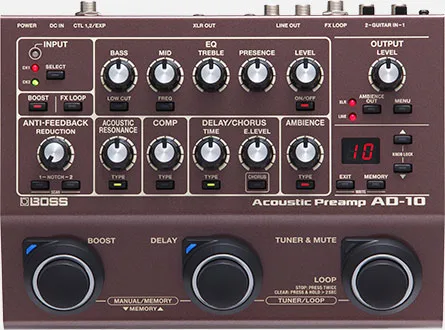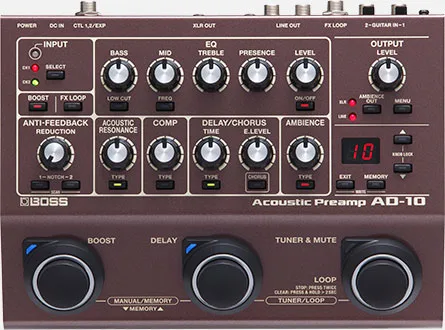


The Boss AD-10 is an acoustic guitar preamp in a floor-pedal format, built to sit between your pickup-equipped acoustic and the PA or amp. Its central feature is Acoustic Resonance, Boss's processing that analyzes the pickup signal and recreates the missing body and string resonances that a piezo or magnetic pickup alone does not capture, restoring what Boss calls the elements essential for natural acoustic sound1. Around that preamp core, the AD-10 packs a full set of stage tools: boost, chorus, delay, compression, a 3-band EQ, reverb, an 80-second looper and anti-feedback notch filtering2.
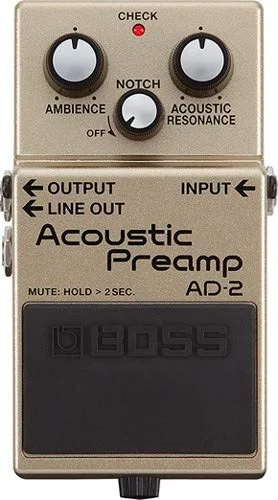
The AD-10 sits above Boss's compact AD-2 Acoustic Preamp in the line, offering more powerful processing, three different resonance types and the ability to balance tonal characteristics, along with two input channels rather than one3. Acoustic Guitar reviewed it in November 2017, when it was new, at $449.99 MSRP and $329.99 street2.
What the AD-10 does
The AD-10's job is to take the thin, quacky signal a pickup produces and turn it into something that sounds like a miked acoustic guitar. The Acoustic Resonance knob controls the software that does this, and it offers three options: Natural, an uncolored sound; Wide, mellow and warm with more bass emphasis; and Bright, with more emphasis on higher frequencies2. Boss describes the processing as analyzing your pickup signal and recreating the missing body and string resonances1.
The two input channels are a practical feature for working players. Boss says they allow you to set up tones for two different stage guitars, blend two pickup sources from one instrument, or run two instruments at once4. Each channel can carry its own settings, which the 10 onboard memories can store; Boss says these memories make it possible to save favorite setups for different instruments and songs5.
The effects cover the usual acoustic stage needs:
- Boost, chorus, delay and reverb2
- Compression and a 3-band EQ2
- Resonance processing2
- An 80-second looper2
- Anti-feedback with notch settings and a reduction control2
The Ambience effect provides three types of high-quality reverberation specially tuned for guitar3. Delay repeats are set through sub-parameter settings, reached by long-pressing one of the effect buttons; the Feedback parameter allows from 0 to 99 repeats2.
Acoustic Guitar's reviewer, Pete Madsen, plugged a Martin OM-28V outfitted with a Fishman Eclipse pickup into the AD-10, feeding a Schertler JAM 150 amp2. His overall verdict on the unit:
"Like the typical Boss pedal, the AD-10 is rugged and compact. It has all the multi-effect and preamp grooviness an acoustic guitarist could want."
The controls and footswitches
The control panel is organized in sections. The EQ section occupies the top row of dials, with standard Bass, Mid and Treble knobs plus Presence and an EQ level output, and a central Output Level control sits adjacent to the EQ knobs2. The bass EQ has a Low Cut button that selects a range to remove low frequencies between 10 Hz and 990 Hz, for tone shaping or additional feedback control2.
The anti-feedback section gives you two individual notch selectors that dial out two different feedback-causing frequencies; depressing both switches makes the unit scan for the offending frequencies itself2.
| Control | What it does |
|---|---|
| Acoustic Resonance knob | Selects Natural, Wide or Bright resonance processing2 |
| Bass, Mid, Treble, Presence | EQ section dials2 |
| Output Level | Central master level control2 |
| Low Cut button | Removes lows between 10 Hz and 990 Hz2 |
| Two notch selectors | Dial out two feedback frequencies; both together trigger a scan2 |
The three foot controls are Boost, Delay and Tuner/Mute, and they are offset at an angle to help prevent errant toe manipulation of the knobs2. Boss says the soft-touch footswitches are designed for unobtrusive operation in quiet acoustic settings, and can be configured to select memories, turn effects on and off, access the onboard tuner and more3.
The tuner is chromatic, with the three foot pedals lighting up to indicate whether you are flat (left pedal), sharp (right pedal) or on pitch (middle pedal)2. Madsen noted one quirk: the accidentals can look a little unfamiliar on the display, for example F# shows up as an F with a small square next to it2.
Inputs, outputs and power
The rear panel carries the full connection set. There are two 1/4-inch inputs, two XLR main outs, two 1/4-inch line outs, one 1/4-inch send for the effects loop, and a Type B USB output for interfacing with a computer2. Boss adds that stereo 1/4-inch jacks allow you to connect to your stage amp setup or headphones for monitoring3. Madsen observed that the stereo output is more for the effects such as reverb, and there is a stereo/mono switch2.
There is also a jack for connecting up to two footswitches or an expression pedal for controlling looper functions, volume, tap tempo, the anti-feedback scan and more1.
For power, the AD-10 supports the included AC adapter or batteries1. Acoustic Guitar's spec listing gives the power source as 6 AA batteries or a 9-volt DC power supply2. The unit measures 2.56 by 8.56 by 6.37 inches and weighs 2 lbs., 14 oz.2.
The AD-10's rear panel carries two XLR main outputs, two 1/4-inch line outputs, one 1/4-inch send, and a Type B USB port, alongside stereo 1/4-inch jacks for connecting to a stage amp setup or headphones for monitoring53. Inputs are two 1/4-inch jacks. Power comes from a 9-volt DC power supply or six AA batteries32.
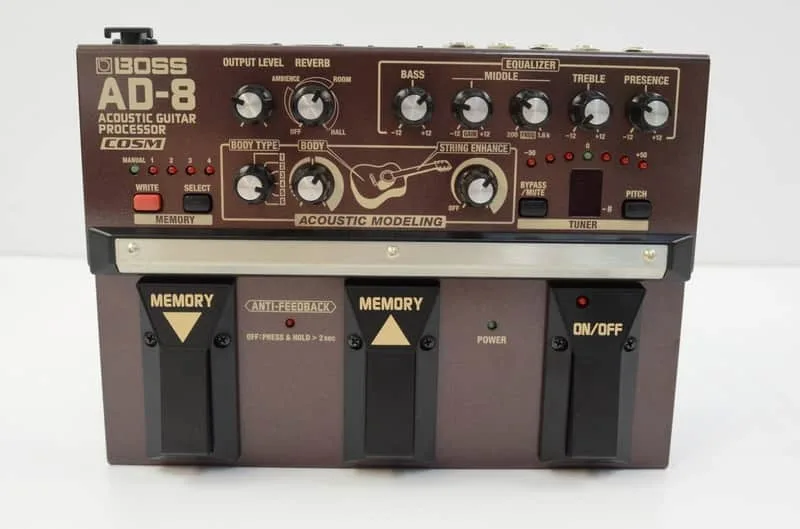
For players comparing acoustic preamps, the AD-10's two-channel design, full effects set and balanced XLR outputs place it among the more complete floor units in the acoustic pedals category, alongside earlier Boss entries like the AD-8 and the compact AD-242.
Videos
Andertons Music Co
BOSSchannel
BOSSchannel
Questions
Does the Boss AD-10 have an effects loop?
Yes. The AD-10 includes an effects loop with a 1/4-inch send jack on the rear panel, so you can run external effects into its signal path. Acoustic Guitar's review lists the effects loop among its other features, alongside the memory function for storing 10 sound setups.
Can the AD-10 run on batteries?
Yes. The AD-10 supports power from six AA batteries or a 9-volt DC power supply, and Boss says an AC adapter is included with the unit. Battery power gives you flexibility for performing situations where mains power is not available.
How many sounds can the AD-10 store?
The AD-10 has 10 onboard memories for saving favorite setups. Boss says these make it possible to store sounds for different instruments and songs, so you can recall a complete tone configuration with a footswitch press.
Does the AD-10 have a USB connection?
Yes. The rear panel carries a Type B USB output for interfacing with a computer. Boss has issued driver updates for the AD-10 over the years, including a version 1.0.2 release in May 2023 that added Windows 11 support.
Can I use an expression pedal with the AD-10?
Yes. The AD-10 has a jack for connecting up to two footswitches or an expression pedal. Boss says these can be used to control looper functions, volume, tap tempo, the anti-feedback scan and more.
How long can the AD-10 looper record?
The onboard looper can record up to 80 seconds. Acoustic Guitar's review lists the looper with 80-second recording capability among the AD-10's effects, which also include boost, chorus, delay, compression, EQ and reverb.
Sources (5)
- BOSS - AD-10 | Acoustic Preamp, boss.info
- Gear Review: Boss AD-10 Acoustic Preamp, Acoustic Guitar (acousticguitar.com), 2017-11-13
- BOSS - AD-10 | Acoustic Preamp, BOSS (www.boss.info)
- BOSS - AD-10 | Acoustic Preamp, boss.info
- BOSS - AD-10 | Acoustic Preamp, BOSS (boss.info)