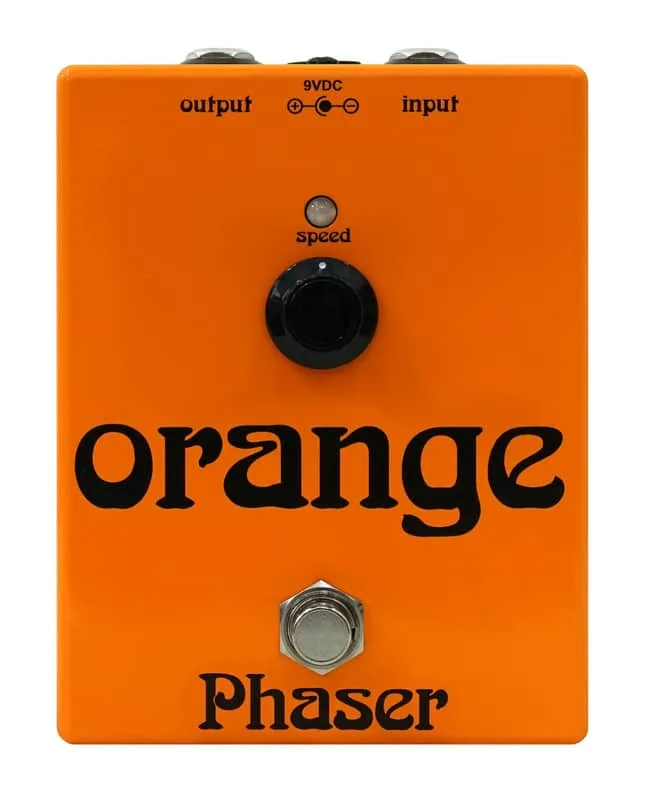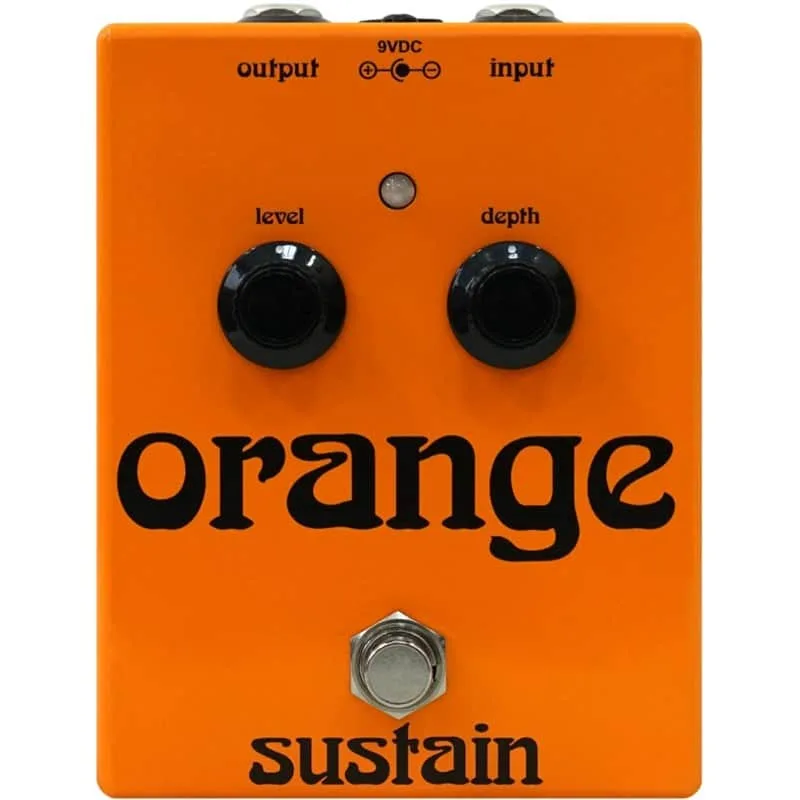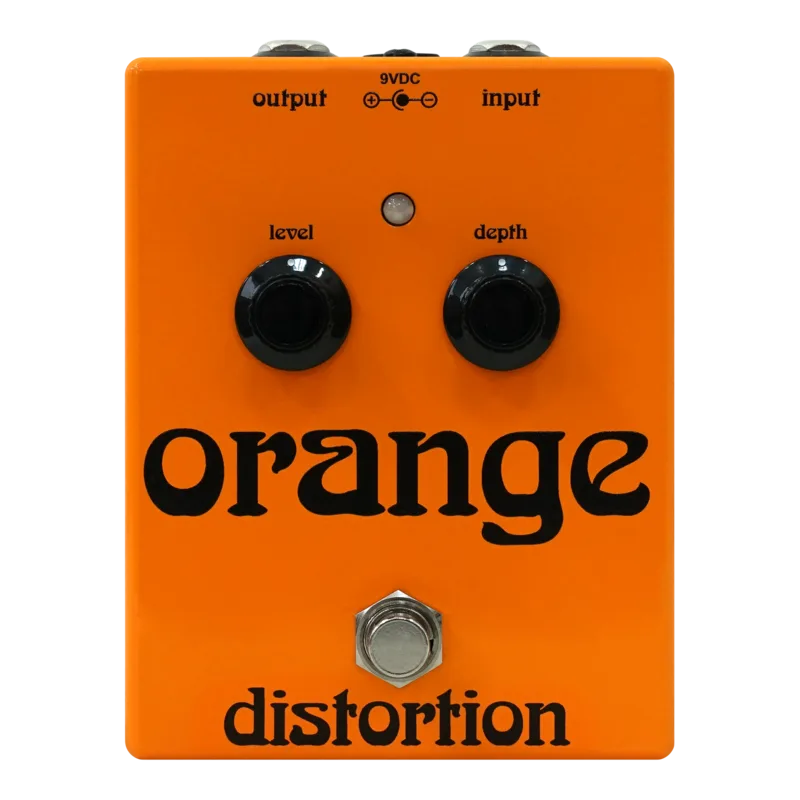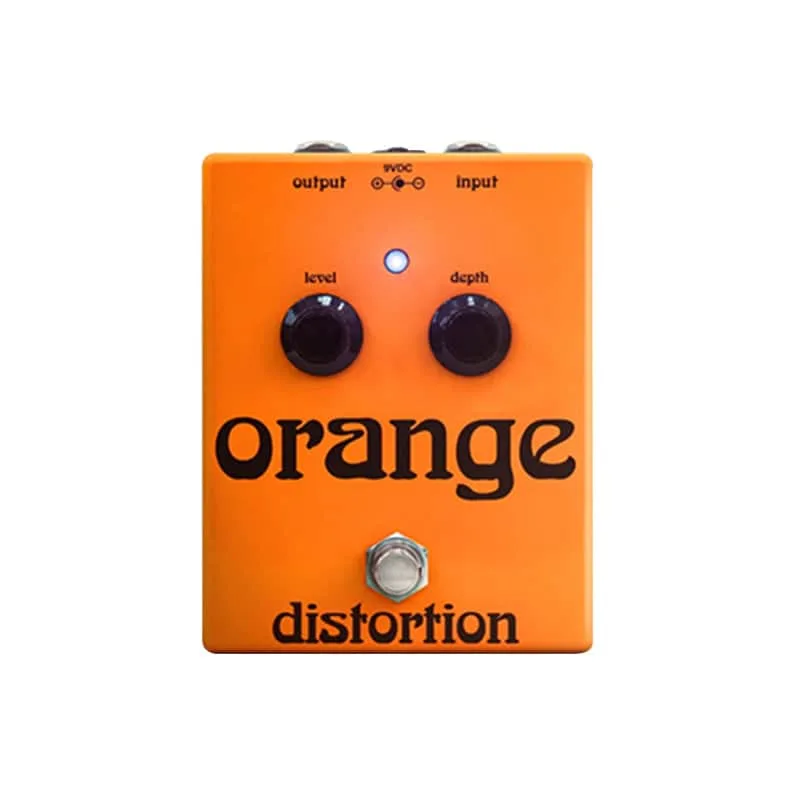
The Orange Distortion is a distortion pedal from Orange, the British amplification brand, and part of its Vintage Series reissues of the pedals the company made in the 1970s alongside the Phazer and Sustain1. While it carries the look of the original 1970s Distortion, it is not a clone: Orange designer Ade Emsley overhauled the circuit completely, replacing the original back-to-back diode design with a JFET-based amplifier circuit that includes a tone stack12.
Guitar World's reviewer Trevor Curwen described the result as Brit-style amp drive, from mild crunch to a screaming stack with loads of sustain, with a slight bass roll-off when the pedal is engaged1.
An amp circuit in a pedal
The original Orange Distortion, produced at Orange's UK factory between 1977 and 1979, used a back-to-back diode design, the classic approach of clipping the signal with diodes to ground13. The reissue takes a different route. Premier Guitar described it as "built around a JFET-based amplifier circuit with preset bass and midrange in the tone stack and a treble control that can be adjusted via an internal potentiometer"2. In other words, it behaves more like the gain stages and tone stack of an amplifier than a diode clipper.
Gearnews reported the same point when the reissues were announced in September 2022: "this one is a new design and a different circuit from the original. It replaces the original pedal's back-to-back diode design with an amp circuit and tone stack"4.
What that means for a player:
- The tone stack has preset bass and midrange, with treble set by an internal trimmer rather than a front-panel knob12.
- At the default factory-set trimmer position, the top end is slightly brighter than a regular tone setting, and there is a slight bass roll-off when the pedal kicks in1.
- The drive range runs from mild crunch to a screaming stack with loads of sustain1.
Premier Guitar noted that, of the three Vintage Series pedals, the Distortion "deviates most from the original," because Emsley "didn't love the sound of the original, so he overhauled the whole circuit"2.
Controls and features
The control set is minimal. A Level knob sets the output volume, and a Depth knob, which is basically the gain control, sets how hard the circuit is driven1. Guitar World noted that the pedal works as a clean boost: keep Depth at zero and dial the Level up above unity gain, which sits around two o'clock, for a volume jump1.
| Control | What it does |
|---|---|
| Level | Output volume; above unity gain around two o'clock, usable as a clean boost with Depth at zero1 |
| Depth | Gain control for the drive1 |
| Internal treble trimmer | Sets the tone stack's treble; factory position is slightly brighter than regular tone12 |
Other features include buffered bypass and an LED that indicates gain reduction1. Construction is a strong point: Guitar World found the build extremely solid, with hard-wired footswitches fixed directly to the chassis rather than attached to a PCB, so a switch replacement would be a simple job1.
Power
The pedal runs from a 9V DC adaptor, not supplied, drawing only 3mA1. Battery power is possible but not built in from the factory: the battery clip is an after-market addition, soldered into place and held by the pedal's height once the four-screw baseplate is reattached1.
There is no factory battery compartment. Running it on a battery means soldering in an after-market clip yourself, so most players will want a 9V DC supply on their board1.
Where it came from
Orange's 1970s pedal series consisted of three units: the Phazer, Sustain and Distortion, built at the company's UK factory between 1977 and 197913. The reissue project began when Mick Dines found the original, tea-stained schematics for all three pedals, and that information was passed to Ade Emsley, who created the set of same-size recreations13. Gearnews reported that the 2022 reissues added LEDs and DC inputs as modern tweaks to the '70s Vintage Pedals range42.
Guitar World characterized the reissues as essentially upgrades rather than exact clones of their vintage counterparts1.
What reviewers said
Guitar World's Trevor Curwen was positive about the pedal's balance of old and new1:
"Orange has done a great job of delivering a pedal with the look of the original while bringing it right up to date with features that current pedal users would expect as standard."1
Trevor Curwen, Guitar World1
He called it a welcome return overall1. Premier Guitar's review focused on how far the circuit had moved from the 1970s original, framing the Distortion as the most redesigned of the trio2.
Questions
Who designed the Orange Distortion pedal?
The reissue was designed by Orange engineer Ade Emsley. He did not love the sound of the original 1970s circuit, so he overhauled it completely, replacing the back-to-back diode design with a JFET-based amp circuit that includes a tone stack.
Does the Orange Distortion run on a battery?
It can. The pedal ships for 9V DC adaptor use, but a battery clip can be added as an after-market modification, soldered into place and held by the pedal's height once the four-screw baseplate is back on.
Is the Orange Distortion true bypass?
No. It uses a buffered bypass, with an LED that indicates gain reduction. Players who want to keep long cable runs sounding bright may see the buffer as a plus rather than a drawback.
Where is the Orange Distortion made?
The reissue is made in the UK, like the originals. The 1970s Phazer, Sustain and Distortion pedals were produced at Orange's UK factory between 1977 and 1979.
How much current does the Orange Distortion draw?
It draws 3mA from a 9V DC adaptor, which is not supplied with the pedal. That is a very light draw, so it is easy on a pedalboard power supply.
Is the new Orange Distortion the same circuit as the original?
No. Premier Guitar noted that among the Vintage Series trio it deviates most from its original. The 1970s pedal used a back-to-back diode design, while the reissue is a new JFET-based amp circuit with a tone stack.
Sources (4)
- Orange Distortion review, Guitar World, 2022-11-17
- Orange Phaser, Sustain, and Distortion Guitar Pedal Review, Premier Guitar, 2022-09-16
- Orange is planning to reissue its original Phazer, Sustain and Distortion pedals, Guitar World, 2020-06-08
- Orange Vintage Pedals reissued with modern tweaks, www.gearnews.com, 2022-09-16