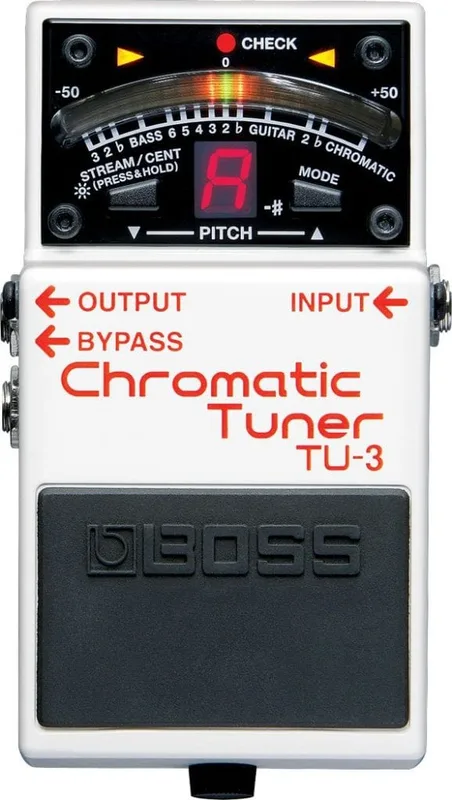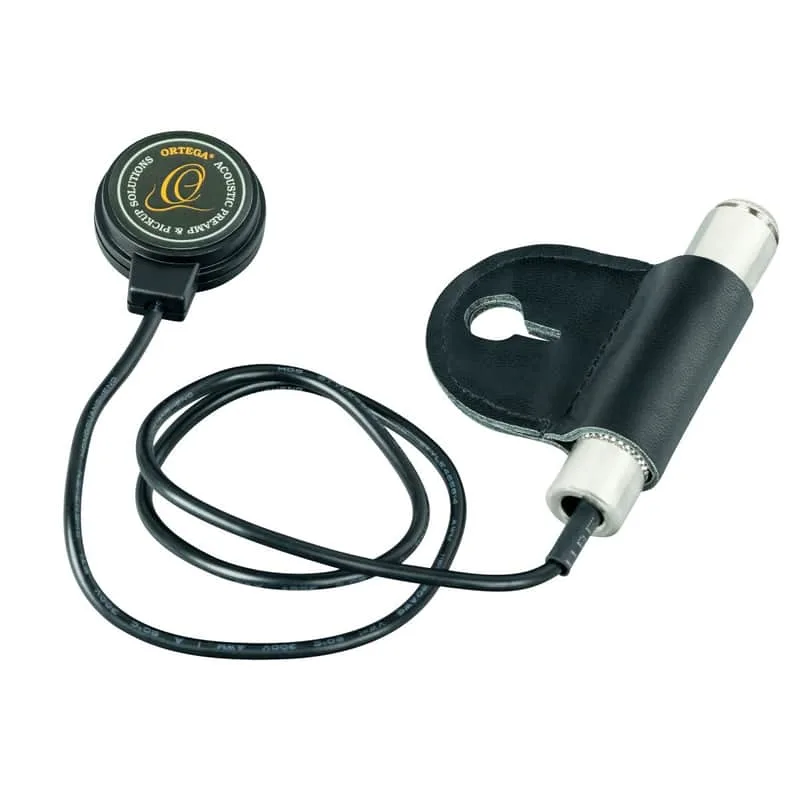


The Ortega Octopus, from Ortega, a brand of Roland Meinl Musikinstrumente GmbH & Co.KG, is two pedalboard essentials in one box: a chromatic pedal tuner and an eight-output power supply. Ortega's manual calls it a "PEDAL TUNER/POWER PLANT"1. It sits in the same family as other tuner pedals, but the power plant side is what sets it apart from a straightforward tuner like the Boss TU3 Tuner.
Power outputs: eight at 9V DC
The Octopus feeds eight pedals at once, but the outputs are not identical. The manual splits them into two groups with different current limits and different jobs1:
| Outputs | Voltage | Maximum current | Suited to |
|---|---|---|---|
| 1 to 6 | DC9V | 100 mA each | Ordinary analog effects |
| 7 to 8 | DC9V | 500 mA each | Digital effects and DC9V low-power guitar amplifiers |
Outputs 1 through 6 each supply 9V DC at up to 100 mA and are meant for ordinary analog effects, while outputs 7 and 8 each supply 9V DC at up to 500 mA and are meant for digital effects and 9V low-power guitar amplifiers1. If a channel draws more than its limit, the corresponding LED flashes and the current is limited1. High-draw digital pedals belong on outputs 7 or 8.
Each channel is protected on its own. According to the manual, "All 8 outputs in this unit have separate short-circuit protection, i.e. short-circuit in one channel won't affect other" channels1. If a shorted channel drops out, its green LED turns off with it, and the rest of the board keeps running.
Overcurrent is handled the same way, channel by channel. When instantaneous overcurrent occurs, the corresponding LED flashes and the unit limits the current of that channel: 100 mA on outputs 1 through 6, and 500 mA on outputs 7 and 81.
How the tuner mode behaves
Switch the Octopus into tuner mode and it mutes your signal, so you can tune silently between songs. The manual is emphatic about it: "Power on/off: When tuner is switched on the sound is muted!"1
Tuning feedback comes from the screen rather than a single fixed display. As the manual describes it, "The screen of this unit will change color, and the indicator will move, depending on how close the note ist to in tune"1. In practice that means two cues at once: the closer you get, the more the color shifts and the indicator settles toward center, so you can bring a string up to pitch by watching the display move.
What is in the box
The manual lists the following with the unit1:
- Octopus pedal x1
- DC18V power adapter x1
- DC power cables x8
- Polarity reversal cable x1
- Manual x1
Because the Octopus runs from a DC18V input, it needs its own higher-voltage adapter rather than a tap from a standard 9V pedalboard supply. The included adapter and the polarity reversal cable cover the usual hookup cases.
Videos
The Pedal Guy
Ortega Guitars
Questions
How many pedals can the Ortega Octopus power?
The Octopus has eight power outputs. Outputs 1 through 6 deliver DC9V at a maximum of 100 mA each and are meant for ordinary analog effects. Outputs 7 and 8 deliver DC9V at a maximum of 500 mA each and are suited to digital effects and low-power 9V guitar amplifiers. Each output has its own short-circuit protection, so a problem in one channel does not affect the others.
Which Octopus output should a digital pedal use?
Use output 8, or output 7. The manual states that outputs 1 through 7 might not work properly with digital effects of larger power consumption, and recommends output 8 in that case. Outputs 7 and 8 are rated for up to 500 mA, against 100 mA on outputs 1 through 6.
What happens if one output is shorted?
All eight outputs have separate short-circuit protection. A short circuit in one channel will not affect the other channels: the shorted channel and its green LED simply turn off, and the rest of the board keeps running.
What does a flashing LED on the Octopus mean?
A flashing LED signals instantaneous overcurrent in that channel. The unit limits the current of that channel, at 100 mA on outputs 1 through 6 and 500 mA on outputs 7 and 8, and the corresponding LED flashes until the condition passes.
What power input does the Ortega Octopus need?
The Octopus takes a DC18V input, where the included power adapter plugs in. It is not a standard 9V pedal in that respect, so it needs the higher-voltage adapter rather than a typical pedalboard supply tap.
Sources (1)
- Octopus_Manual_v06, Ortega (ortegaguitars.com), 2020