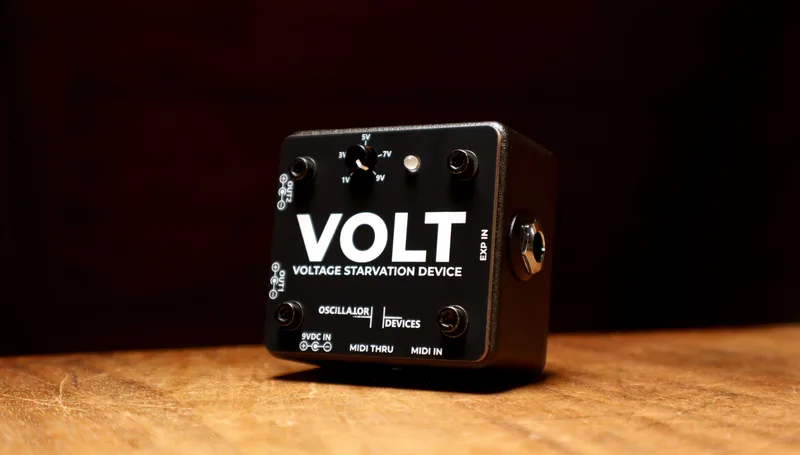
The Oscillator Devices VOLT is a MIDI controllable voltage source, designed to starve analog guitar pedals1. Starving means feeding a pedal less voltage than it expects, which changes how the circuit sounds. According to Oscillator Devices, "Probably most popular is the gated effect when starving a fuzz pedal"1, which is why voltage starvation is a favorite trick among players of fuzz, distortion and overdrive pedals.
Outputs and voltage control
The VOLT gives you two independent outputs that you can dial from the input voltage down to 1V1. Each output can deliver up to 50mA1. When a voltage knob is set to maximum (9V), the voltage control circuit is disabled and the output is supplied directly from the input voltage, so a pedal connected at full setting runs exactly as it would straight off your supply1.
Turning a knob overrides the voltage on both outputs, which the maker describes as a way "to find the sweet spot for your pedal"1.
Dying battery simulation
Beyond setting a fixed voltage, the VOLT can imitate the internal resistance of a drained battery. The resistance of the voltage outputs can be adjusted with trimpots, and Oscillator Devices notes that a drained battery's internal resistance "seems like it's somewhere between 50Ω and 150Ω"1. The trimpots are set to around 60Ω on delivery1. For a pedal that behaves differently as its battery dies, this reproduces that sag without an actual dying battery.
Expression pedal control
The expression pedal input allows control over the outputs via an expression pedal, and the VOLT includes an expression pedal calibration feature1. When using the expression pedal, both outputs are always controlled, but they can have different range and direction1. Two modes set how the pedal maps to voltage:
| Mode | Heel | Toe |
|---|---|---|
| Full Range | 1V | 9V |
| Toe limited by knob | 1V | knob position |
In Full Range mode, "The expression pedal moves from 1V (heel) to 9V (toe)"1. In Toe limited by knob mode, the toe position is whatever the knob is set to1.
MIDI and documentation
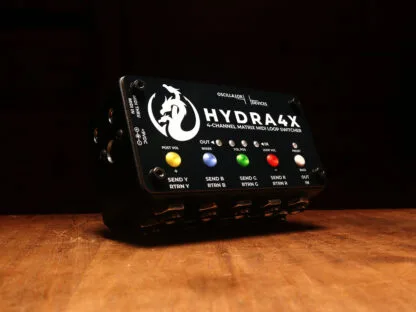
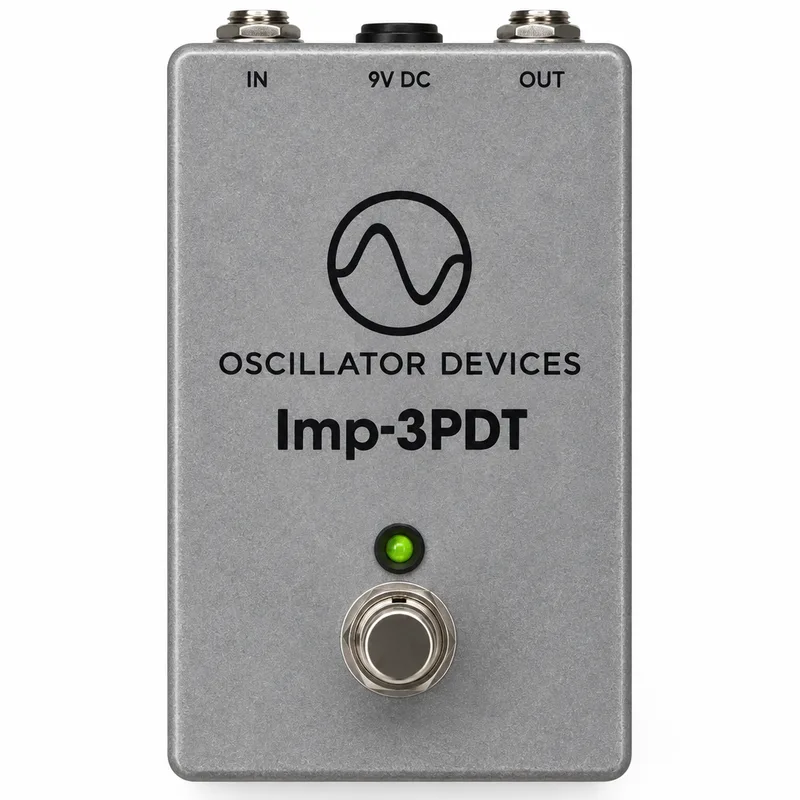
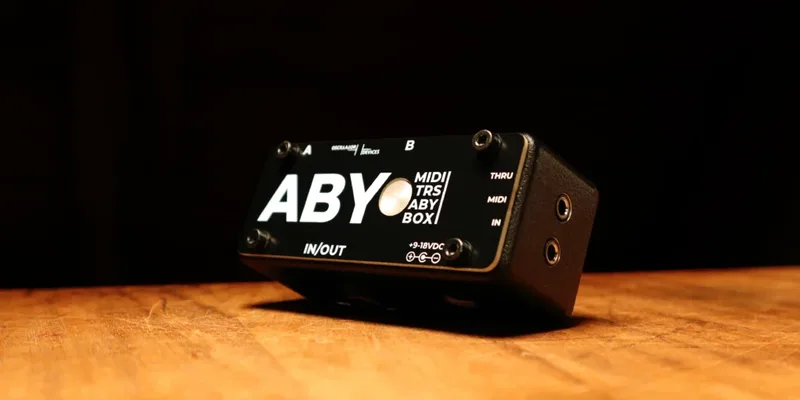
The VOLT is fully supported by Oscillator Devices' WebMIDI Interface1, which places it alongside the maker's other MIDI pedals such as the Siren, HYDRA4X and Imp-3PDT. The current documentation is VOLT 1.0, dated January 2026, with a User Manual and a Quick Start guide available as PDFs from the maker1.
Where it comes from
The VOLT is developed and built by Oscillator Devices1. The company documents the pedal in a user manual and quick start guide for firmware VOLT 1.0, dated January 20261, and describes the VOLT as fully supported by the WebMIDI Interface1.
Questions
What does the Oscillator Devices VOLT do?
The VOLT is a MIDI controllable voltage source designed to starve analog guitar pedals. It has two independent outputs that can be dialed from the input voltage down to 1V, so you can feed a pedal less voltage than it is designed for and hear how the circuit responds. Oscillator Devices notes that the most popular use is the gated effect you get when starving a fuzz pedal.
What is a starved pedal and why would someone starve a fuzz?
Starving a pedal means supplying it with less voltage than normal, which changes how its circuit behaves. According to Oscillator Devices, the probably most popular result is the gated effect you get when starving a fuzz pedal: the fuzz breaks up and gates in a way it will not at full voltage. The VOLT lets you dial that voltage in and control it over MIDI or an expression pedal.
What voltage range do the VOLT outputs cover?
The VOLT has two independent outputs ranging from the input voltage down to 1V. When a voltage knob is set to maximum (9V), the voltage control circuit is disabled and the output is supplied directly from the input voltage. The outputs can deliver up to 50mA.
Can an expression pedal control the VOLT?
Yes. The expression pedal input allows control over the outputs via an expression pedal, and there is an expression pedal calibration feature. When using the expression pedal, both outputs are always controlled, but they can have different range and direction. In Full Range mode the pedal moves from 1V at heel to 9V at toe; in Toe limited by knob mode it moves from 1V at heel to the knob position at toe.
What power connectors does the VOLT use?
The outputs are, like the inputs, center negative "Boss-Style" connectors, and the unit uses high-quality Neutrik sockets.
Where is the Oscillator Devices VOLT made?
The VOLT is developed and built by Oscillator Devices in Germany. The company was founded by Uwe Halmich in March of 2021 in Oberderdingen, Germany.
Sources (1)
- VOLT - Voltage Starvation Device - Oscillator Devices, Oscillator Devices, 2026-02-03