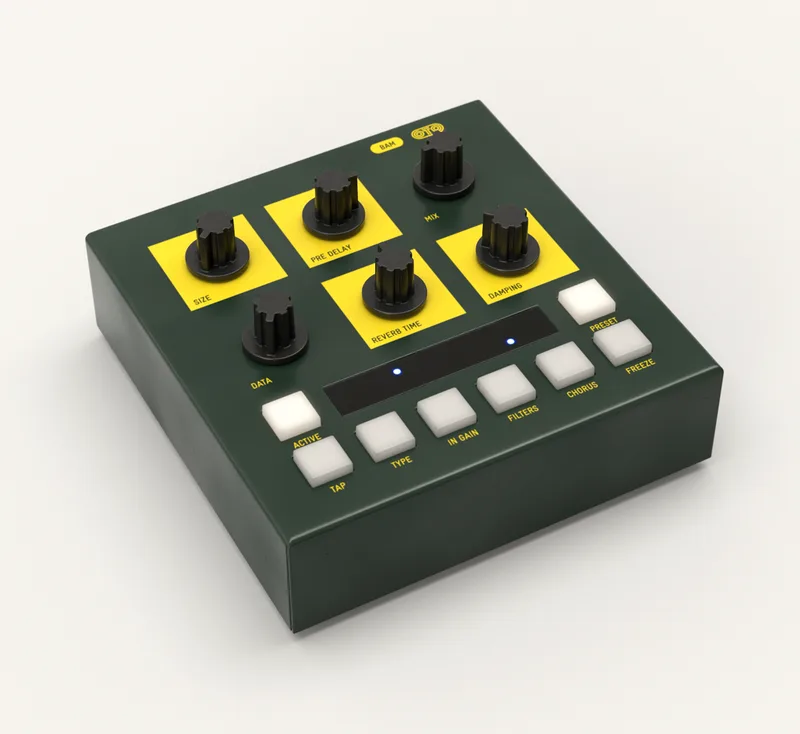


The Oto Machines BAM is a stereo reverb processor from the French maker OTO, built as a desktop effect in a compact format. Its stated aim is to recreate the sound of the digital reverberator units of the late 70s and early 80s: OTO says it "carefully listened to all digital reverberators built from 1976 to 1986" and studied their architecture. To that end the BAM uses 16 bit converters and 20 bit fixed-point processing, the same kind of technology those early units used, together with analog filtering and an input transformer transient simulator. OTO describes the result as combining "the sound quality of a vintage reverb processor with the playability of a desktop effect in a compact format," and characterizes the reverberations as grainy, warm and musical, in the manner of early digital units that are sought after by sound engineers, producers and musicians1.
The seven algorithms
The BAM runs seven algorithms, listed by OTO as Room, Hall, Plate, Ambient, Chorus, Non-Linear and Primitive1. The first three are the conventional spaces a player expects from any reverb, while Ambient, Chorus, Non-Linear and Primitive reach toward the more unusual programs that made the early digital reverberators distinctive. For a player, the spread means one unit can cover standard room and plate duty as well as the modulated and non-linear sounds associated with vintage rack gear.
Controls: pre delay, filters, size and chorus
The front panel is built around a small set of physical controls rather than menus1:
| Control | What it does |
|---|---|
| PRE DELAY pot | Pre Delay up to 500 ms |
| TAP switch | Pre Delay up to 1500 ms; Tap Tempo assignable to Pre Delay or Reverb Time |
| Size parameter | Continuous control of the reverb Size for fine tuning |
| Low-Cut Filter | 20 Hz, 80 Hz, 150 Hz, 250 Hz, 450 Hz |
| Hi-Cut Filter | 1,8 kHz, 4,5 kHz, 7 kHz, 9 kHz, 15 kHz |
| Chorus parameter | Adds modulation to the reverberator signal |
The pre delay range is the widest single control on the unit: 500 ms from the pot, or 1500 ms when set with the TAP switch, which can also be assigned to Reverb Time as a tap tempo. The low-cut and hi-cut filters shape what goes into and comes out of the reverb, from tightening the low end under a bass-heavy signal to darkening the tails. The Chorus parameter adds modulation to the reverberated signal, the effect that gives many early digital units their characteristic movement1.
MIDI and presets
The BAM has a MIDI input and responds to CCs and Program Change, so its sounds can be changed remotely from a switcher or controller, and it stores 36 user presets1. For players building a larger board around Midi Pedals, that means the BAM can sit at the end of the chain and be recalled like any other MIDI device. Its stereo operation also sets it apart from most Reverb Pedals, which are typically mono stompboxes; the BAM is a desktop processor in a rugged steel enclosure rather than a pedal1.
Oto Machines lists the next units of the BAM as arriving in November 2026, so availability is batch-based rather than continuous1.
Videos
OTOMACHINES
once upon a synth
once upon a synth
Questions
How many algorithms does the Oto Machines BAM have?
The BAM offers seven algorithms: Room, Hall, Plate, Ambient, Chorus, Non-Linear and Primitive. They cover the conventional spaces players expect from a reverb unit along with modulated, non-linear and deliberately primitive options that recall the character of early digital reverberators.
Does the Oto Machines BAM have MIDI?
Yes. The BAM has a MIDI input and responds to CC messages and Program Change, so its algorithms and parameters can be controlled from a MIDI controller, a pedalboard switcher or a DAW.
How many presets can the Oto Machines BAM store?
The BAM stores 36 user presets, so a player can keep a set of saved sounds across its seven algorithms and recall them by hand or over MIDI.
Is the Oto Machines BAM stereo?
Yes. Oto Machines describes the BAM as a stereo reverb processor, and it is built in a compact desktop format rather than as a stompbox.
Is the Oto Machines BAM analog or digital?
The BAM is digital, but deliberately so in an old way: it uses 16 bit converters and 20 bit fixed-point processing, close to the technology of the early digital reverberators it is modeled on, with analog filtering and an input transformer transient simulator in the signal path.
When is the next batch of Oto Machines BAM available?
Oto Machines lists the next units of the BAM as arriving in November 2026.
Sources (1)
- BAM - Oto Machines, Oto Machines