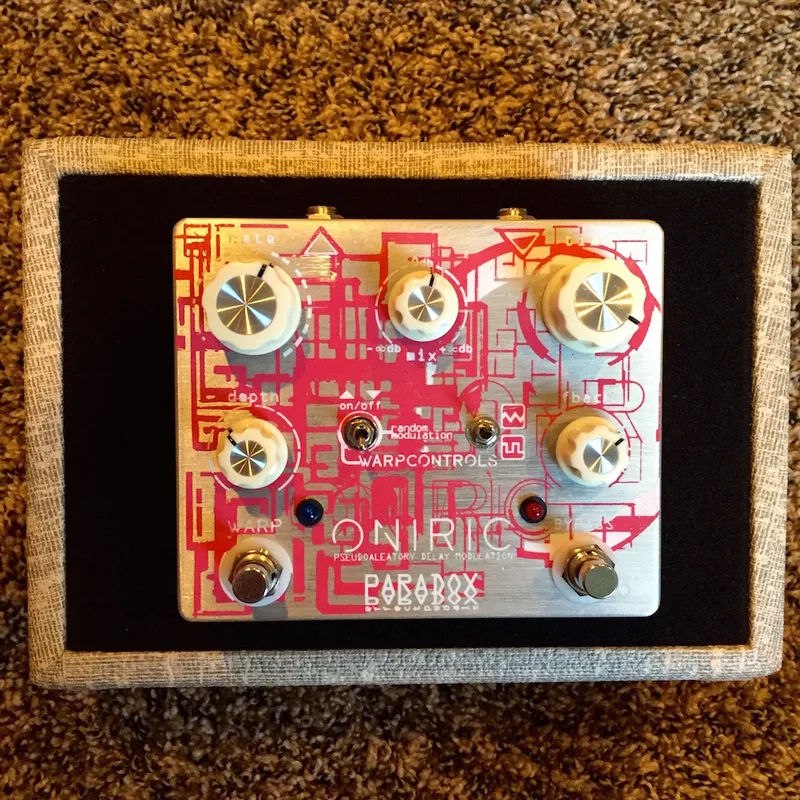


The Paradox Effects Oniric PseudoAleatory Delay Modulation is a delay pedal with a built-in modulation engine. Alongside the usual delay controls, it carries a second mode called Warp, engaged with its own footswitch, which adds pseudo-aleatory, meaning random or chance-based, modulation into the delay signal. Pedal of the Day's reviewer described the tones as "very Bucket Brigade-ish, giving off some wonderfully classic delay tones with every pick of your strings," a reference to the analog delay circuits of earlier decades1.
The controls: Mix, Time, Feedback and Warp mode
The Oniric's main delay section is handled by its primary knobs. The Mix knob blends your guitar's signal and the Oniric's delays, and the Time knob adjusts the space in between each delay repetition, up to 500ms1.
Warp mode is engaged with a second footswitch, and it has a set of controls all its own1:
| Control | What it does |
|---|---|
| Rate | A frequency/speed control for the modulation |
| Depth | The intensity of the modulation |
| Waveform toggle | Selects between Triangle and Square modulated waveforms |
| Random Modulation toggle | Takes the mode "even further out into outer space"1 |
According to the review, Warp mode utilizes various oscillators which help produce frequency fluctuations in the signal, providing ambient, spacey textures. The Random Modulation toggle pushes that unpredictability further still1.
What pseudo-aleatory modulation means
Aleatory means governed by chance, so pseudo-aleatory modulation is modulation that moves in a random, unpredictable way rather than a steady cycle. On the Oniric, that randomness is applied to the delay signal itself. The reviewer said the mode produces "everything from lush sonic landscapes to wac"1, in other words, sounds ranging from gentle ambient washes to more erratic, unstable repeats. Players who already use a chorus or vibrato pedal for movement in their delays will find the idea familiar, but with the regularity replaced by chance.
Digital circuit, analog-style character
Although it is technically a digital delay, the filtering inside is designed to add that analog warmth to the repeats, according to Pedal of the Day1. That places it among the many digital delays that model the darker, softening repeats of analog designs. For how it sits alongside other delay types, see the site's Delay Pedals page.
What reviewers said
The Oniric was reviewed by Mike B at Pedal of the Day in October 2015. His verdict on the pedal's overall sound1:
"the sounds it can create solidify it as an all-around fantastic piece of guitar gear"
One limitation he flagged is the output format: the Oniric is mono only. He added, "Hopefully, the next version will have stereo outputs, as I could see this being an incredible delay to run into 2 amps"1.
Videos
Paradox Effects
Paradox Effects
Paradox Effects
Questions
Is the Paradox Effects Oniric stereo or mono?
The Oniric is mono only. Pedal of the Day's reviewer, Mike B, noted that he hoped a next version would have stereo outputs, saying he could see it being an incredible delay to run into two amps. As reviewed, it carries a single mono signal path.
What does pseudo-aleatory modulation mean?
Aleatory means depending on chance, so pseudo-aleatory modulation is modulation that behaves in a random or unpredictable way. On the Oniric, Warp mode applies this random modulation to the delay signal, which the reviewer said produces everything from lush sonic landscapes to wilder, more extreme sounds.
How do you turn on Warp mode on the Oniric?
Warp mode is engaged with a second footswitch on the pedal. Once on, it has a set of controls all its own: a Rate knob, a Depth knob, a Random Modulation toggle, and a waveform toggle for choosing between Triangle and Square modulation.
What is the maximum delay time on the Oniric?
The Time knob adjusts the space between each delay repetition up to 500ms, according to Pedal of the Day's review.
Is the Oniric an analog or digital delay?
It is technically a digital delay, but the filtering inside is designed to add analog warmth to the repeats. The reviewer described the tones as very Bucket Brigade-ish, referring to the analog delay chips of earlier decades.
Sources (1)
- Paradox Effects Oniric PseudoAleatory Delay Modulation, Pedal of the Day (pedal-of-the-day.com), 2015-10-04