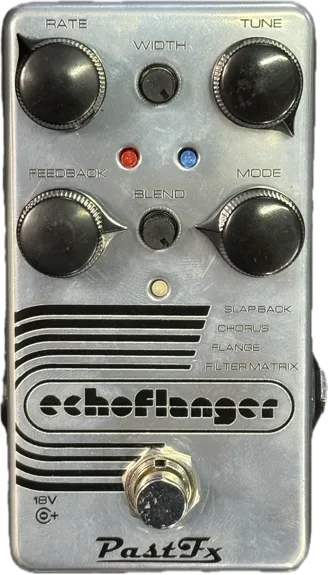
The PastFX Echoflanger is a compact, all-analog multi-modulation pedal that recreates the original 1970s Electro-Harmonix Echoflanger circuit in a pedalboard-friendly box. Where the vintage unit was a large floor piece, PastFX has squeezed the same circuit family into a 1590B enclosure, which the maker calls the smallest recreation of the original circuit they know of1.
It is a genuinely multi-function pedal. PastFX describes it as a multi all-analog effect that can produce up to five sounds: slapback delay and double tracking, chorus, vibrato, flanger, and filter matrix1. All of that comes from two vintage Panasonic bucket brigade device (BBD) chips, the analog delay-line parts that give vintage modulation pedals their character1.
Where it came from
The Echoflanger is one of Electro-Harmonix's vintage analog designs, and the original circuit has a documented history of use. PastFX notes that Kurt Cobain famously made use of feedback in chorus mode on Nirvana's In Utero track "Radio Friendly Unit Shifter"1. The pedal was designed with assistance from Scruffie, whom PastFX credits on the product page1.
PastFX released its Echoflanger in November 2025, while the original EHX circuit was still discontinued2. It is a multi all-analog effect pedal producing up to five effects: slap back delay/double tracking, chorus, vibrato, flanger, and filter matrix1. Kurt Cobain famously made use of feedback in chorus mode on Nirvana's In Utero song "Radio Friendly Unit Shifter"1, and the pedal was designed with assistance from Scruffie1.
Controls and what they do
The control set follows the original's logic but with some deliberate changes:
| Control | What it does |
|---|---|
| Blend | A knob instead of a switch, giving continuous control over the dry/modulated mix; in Chorus mode, turning it fully counter-clockwise produces a vibrato effect13 |
| Feedback | Available even in Chorus mode, an unusual aspect of the Echoflanger design1 |
| Input filter switch | Shapes the signal entering the circuit3 |
| Threshold trimpot (internal) | A rudimentary gating control at low levels to help prevent noise; calibrated by default to an "Off" setting1 |
| Volume trimpot (internal) | Compensates for the famous volume drop in the original3 |
The Blend control is the biggest functional difference from both the vintage unit and the EHX reissue. The original-style layout uses a rear-mounted Blend switch to toggle the dry signal between traditional modulation and intense vibrato textures4, while PastFX gives you a knob, which allows finer control and lets you park the mix anywhere between full chorus and full vibrato13.
An LED mode indicator shows what the LFO is doing: it flashes in time with the modulation in chorus and flanger modes, and stays static for the slapback and matrix settings1.
The internal volume trim pot exists specifically to compensate for the volume drop the original Echoflanger was known for3. If your unit seems quieter or louder than the rest of your board, that trimmer is the place to look.
Power and connections
The Echoflanger needs 18V DC from a 2.1mm Boss style jack with a negative tip, and draws 80 mA1.
18V is double what most pedals run on. A standard 9V supply will not power it correctly, so plan for a dedicated 18V output or adapter, and do not expect to share a 9V daisy chain with it.
On outputs: the original versions were always mono plus a dry output, but PastFX has omitted the dry out because of space restrictions in the smaller enclosure1. If you want to split your dry and wet signals, this pedal will not do it.
How it compares with the EHX reissue
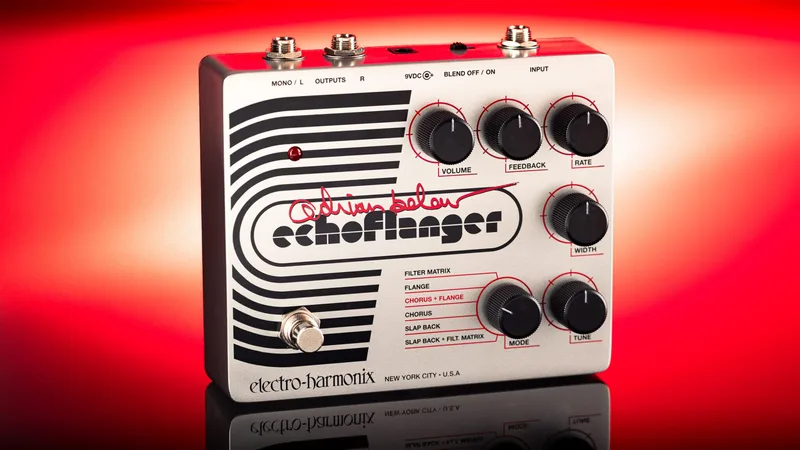
The EHX Adrian Belew Echoflanger is a limited reissue of the vintage analog pedal with an analog circuit5, and its control layout follows the original: Feedback, Rate, Width, Tune, Volume, and the rear-mounted Blend switch4. It ships with a standard EHX 9-volt power supply included6. The PastFX version, by contrast, is a mono, 18V, 1590B-boxed take with a Blend knob in place of the switch, an input filter switch, and internal threshold and volume trimmers13. Players comparing the two are essentially choosing between the EHX faithful layout at 9V and the PastFX compact layout at 18V with more mix control.
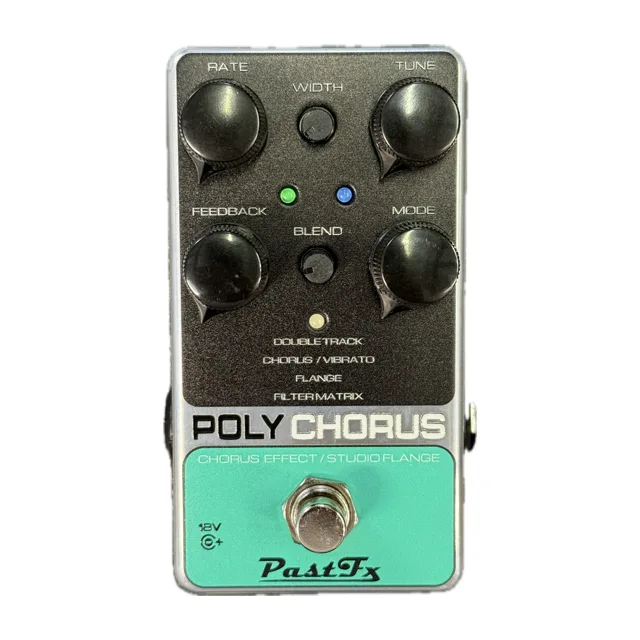
PastFX also makes a related compact take on the same circuit family, the PastFX Poly Chorus, for players after that side of the Echoflanger sound.
Questions
What power supply does the PastFX Echoflanger need?
It runs on 18V DC through a 2.1mm Boss style jack with a negative tip, and draws about 80 mA. That voltage is higher than the 9V most pedals use, so it needs its own supply rather than a standard 9V output or daisy chain.
Is the PastFX Echoflanger true bypass?
Yes. PastFX lists the Echoflanger as true bypass, so when the pedal is off the signal passes through without active buffering, which suits players who keep other pedals in the chain doing that job.
Is the PastFX Echoflanger all analog?
Yes. PastFX describes it as a multi all-analog effect, and it uses two vintage Panasonic BBD (bucket brigade device) chips to create its delay, chorus, vibrato, flanger and filter matrix sounds.
What size enclosure does the PastFX Echoflanger use?
It comes in a 1590B enclosure, which PastFX calls the smallest recreation of the original Echoflanger circuit they know of. That is a standard small-pedal footprint that fits easily on a pedalboard.
Does the PastFX Echoflanger have a dry output?
No. The original Echoflanger versions were mono plus a dry output, but PastFX omitted the dry output because of space restrictions in the smaller 1590B enclosure. It is a mono pedal.
What does the Blend control do on the PastFX Echoflanger?
Instead of a mode switch, the Blend control sets the mix between dry and modulated signal. In Chorus mode, turning it fully counter-clockwise removes the dry signal and gives a vibrato effect, and it also gives access to feedback control in Chorus mode.
Sources (6)
- Echoflanger, PastFx, 2026
- Guitar Pedal X, Guitar Pedal X, 2026-09-21
- Echoflanger by PastFx, RockBoard (rockboard.de PedalPedia), 2026
- Adrian Belew Echoflanger by Electro-Harmonix, RockBoard (rockboard.de PedalPedia), 2026
- Adrian Belew Echoflanger, Electro-Harmonix (ehx.com)
- Electro-Harmonix Unveils The Adrian Belew Echoflanger, Premier Guitar, 2026-09-16