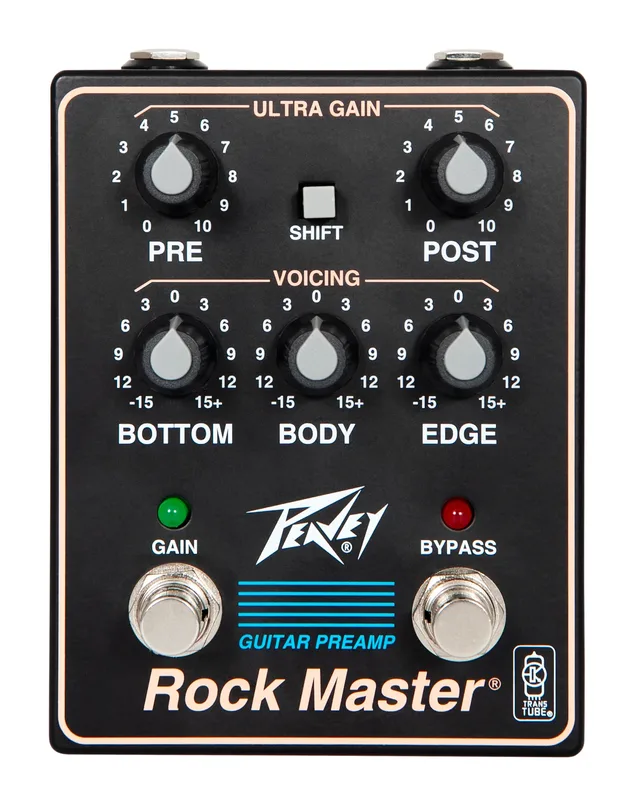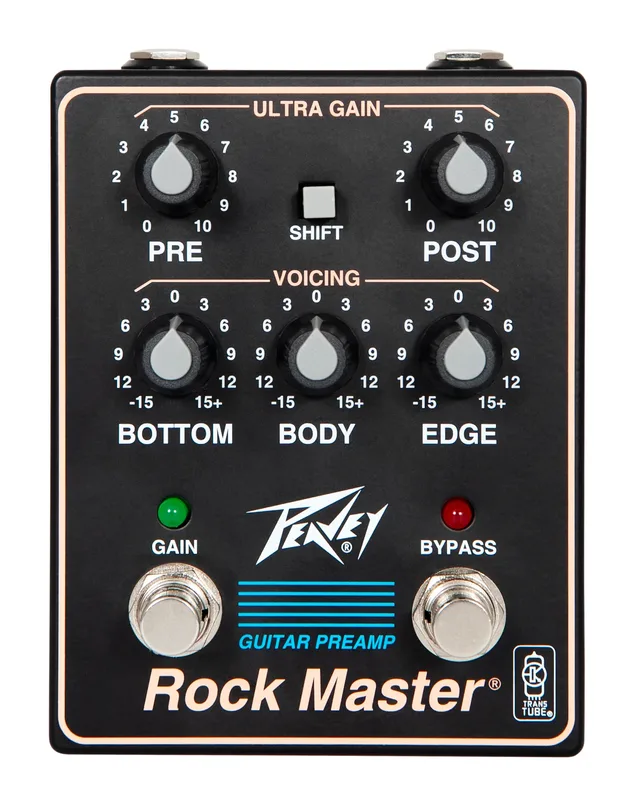


The Peavey Rock Master Preamp Pedal is an analog "amp in a box" preamp pedal that puts the Ultra Gain channel of Peavey's early 90s Rock Master Guitar Tube Preamp into a stompbox format. Peavey describes it as delivering high-gain rock and metal tones, "capable of super-saturated leads and punchy, tube-like clean tones"1. It is part of Peavey's Legacy Series of pedals, announced alongside four other preamp pedals based on classic Peavey amps2.
Internally the circuit is Peavey's TransTube technology: a transistor-based recreation of the circa-1990 Rock Master "Ultra" channel with soft-clipping distortion1. The pedal runs on stepped-up 30V internal rails, which Peavey says delivers the headroom high-gain players need3.
The controls
The pedal carries two gain controls and a three-band active EQ, plus two switches and two footswitches. PRE and POST gain are the core of the design: Peavey says the PRE control sets the amount of gain applied to the input signal, while the POST control sets the overall output volume1. That split lets a player push the preamp into saturation independently of how loud the pedal leaves the chain.
| Control | What it does |
|---|---|
| PRE | Sets the amount of gain applied to the input signal1 |
| POST | Sets the overall output volume1 |
| BOTTOM | Active +/- 15 dB shelving tone control for low frequency boost or cut1 |
| BODY | Active, peak/notch +/- 15 dB tone control for mid frequency boost or cut1 |
| EDGE | Treble control in the EQ set4 |
| Mid Shift switch | Selects a higher or lower operating frequency for the Body EQ control1 |
| Gain switch | Boosts overall system gain when engaged3 |
The EQ is unusually wide for a pedal, with a +/- 15 dB range on both the BOTTOM and BODY controls1. The Mid Shift switch moves the BODY control's center frequency up or down, which gives the midrange cut or boost two different landing spots, a useful trick for carving space in a band mix or pushing a scooped sound1.
Two footswitches handle Gain and Bypass1. The bypass is a hard bypass with anti-click circuitry, so switching is quiet rather than popping1.
Power and construction
The pedal runs on a 9V battery or a 9V DC barrel-type, negative-tip power supply1. Inside, an internal high-voltage TransTube supply steps that standard 9V input up to 30V rails, which is where the headroom comes from3. Peavey lists a compatible power supply, Peavey #309081801.
Construction is a die-cast metal enclosure with fiberglass PCBs using 2-ounce copper and plated through holes on all components13. Peavey's support line for the pedal is 877-732-8391, toll free in the US1.
There is no built-in speaker simulation. Peavey says the pedal is intended to supercharge the front end of your amplifier, plug into a power amp, or feed an external speaker emulator3. Players running it straight into a power amp or interface will need a separate speaker simulation pedal.
History: from the Rock Master tube preamp to the Legacy Series
The pedal traces back to the original Rock Master Guitar Tube Preamp of the early 90s. Peavey calls that unit "what some consider to be the granddaddy of what became the Peavey XXX and JSX guitar amplifiers, most notably the Ultra gain section"1. Premier Guitar repeated the same lineage in its announcement coverage2. The pedal is a re-creation of that original "Ultra" channel, with the mid-shift switch, wide +/- 15 dB EQ range and anti-click footswitches carried over4.
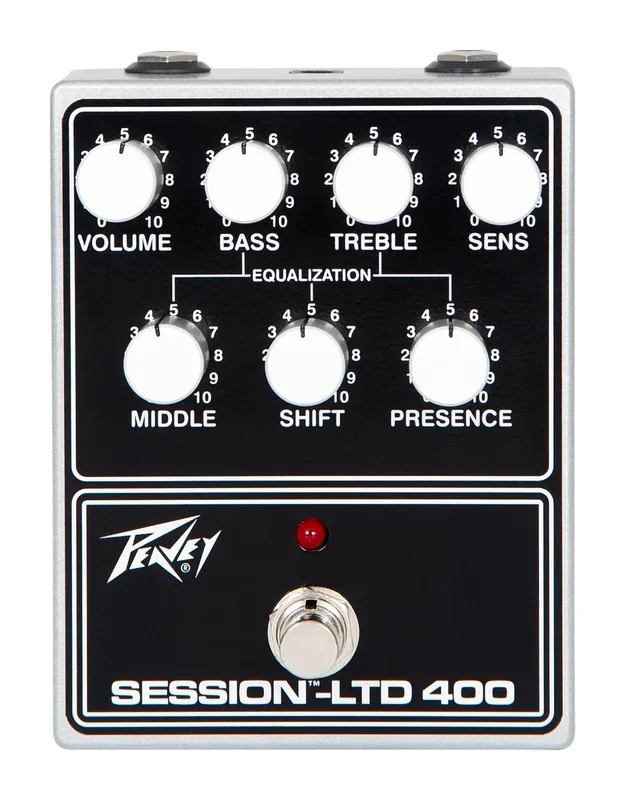
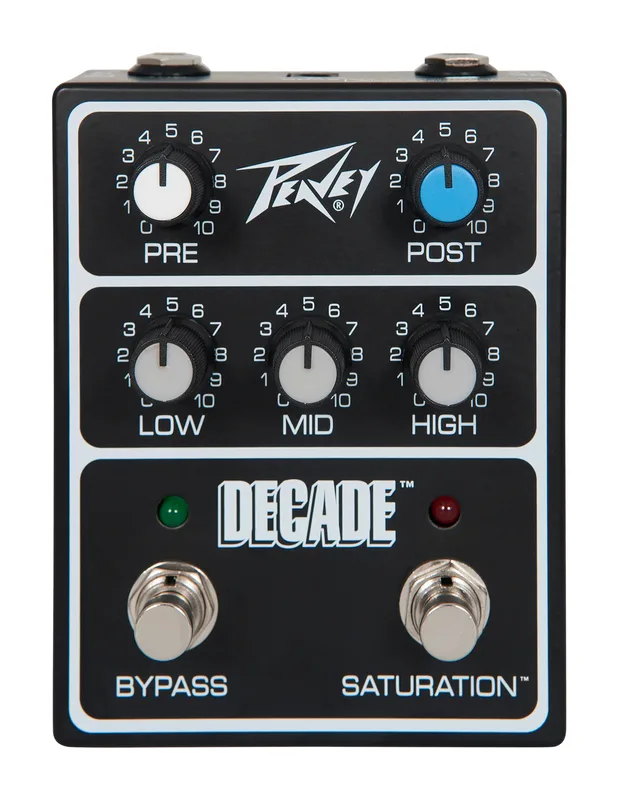
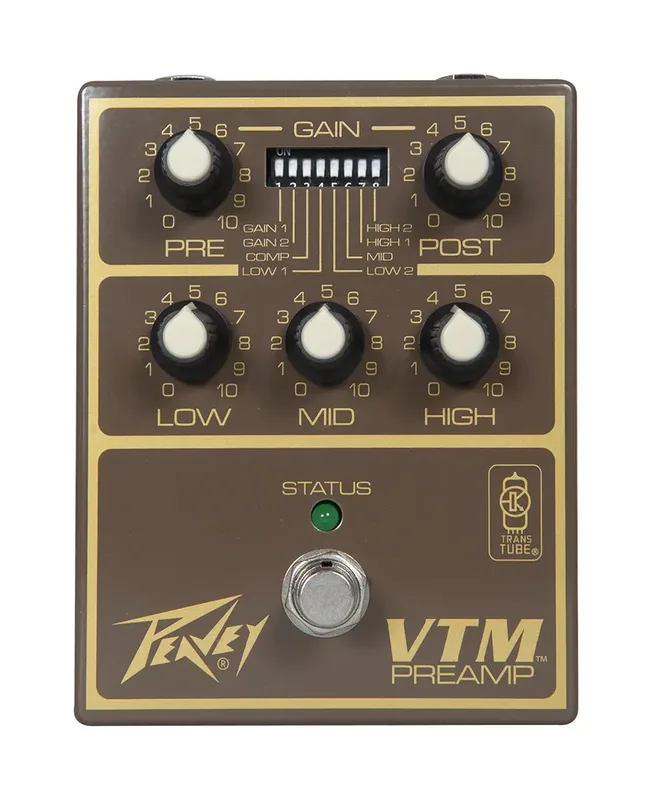
The Rock Master pedal is one of five preamp pedals Peavey announced based on classic amps, alongside the Session LTD 400 (1974), Decade (1980), VTM (1987) and Bandit 112 Supreme 160 Teal Stripe5. Peavey lists the Rock Master at $199.99 USD5.
Premier Guitar reported the pedal as the latest in Peavey's new Legacy Series, now shipping and available worldwide through local and online retailers, at a retail price of $199.99 USD2.
Videos
Tone Factory
AtomicMusicStore
low_e
Questions
Does the Peavey Rock Master pedal take a battery?
Yes. Peavey specifies power as a 9V battery or a 9V DC barrel-type, negative-tip power supply. The pedal's internal high-voltage TransTube supply steps the standard 9V input up internally, so a battery works the same as a supply.
Is the Peavey Rock Master pedal true bypass?
Peavey does not describe it as true bypass. The listed bypass is a hard bypass with anti-click circuitry, which Peavey pairs with anti-click footswitches across the Legacy Series pedals.
Does the Rock Master preamp pedal have a cab sim?
No. Peavey states there is no built-in speaker simulation. The pedal is intended to feed the front end of an amplifier, a power amp, or an external speaker emulator.
Can I run the Rock Master pedal into a power amp?
Yes. Peavey explicitly lists a power amp as one of its intended destinations, along with the front end of an amplifier or an external speaker emulator. Output impedance is 1 kΩ.
What is Peavey TransTube?
TransTube is Peavey's transistor-based approach to reproducing tube amp behavior. In the Rock Master pedal it is a transistor-based recreation of the circa-1990 Rock Master Ultra channel with soft-clipping distortion, running on stepped-up 30V internal rails for headroom.
Sources (5)
- Rock Master® Preamp Pedal, Peavey
- Peavey Rock Master Preamp Pedal Arrives, Premier Guitar, 2025-09-24
- Rock Master® Preamp Pedal, Peavey
- Decade™ Preamp Effects Pedal, Peavey
- Guitar Pedal X, Guitar Pedal X, 2025-01-27