
The Pelican NoiseWorks Pelitaur is a fuzz pedal with a twist: instead of one fuzz circuit, it carries two, running in parallel. Pedal of the Day, reviewing the Limited Silver Edition in February 2017, described the two sides this way: "one side is a giant, sputtery, vintage-sounding beast, while the other is a classic, mid-scooped, familiar-sounding fuzz." The same review notes this was Pelican Noiseworks' first pedal, and that the enclosure is 100% hand-built.1
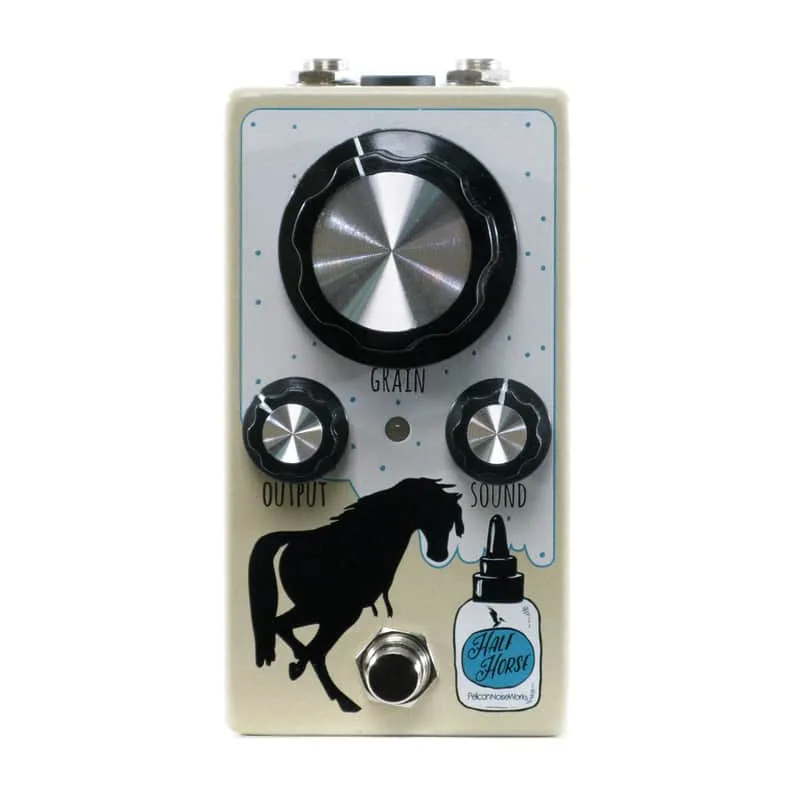
The pedal drew attention again later. In January 2019, Pedal of the Day recalled that the crew at Pelican NoiseWorks had released the Pelitaur Fuzz a couple of years earlier, when covering the maker's follow-up, the Half Horse Fuzz.2 And in a JHS Pedals piece on the greatest pedals of the century, Josh Scott, Jamie Stillman, Matthew Farrow and Brian Wampler placed the Pelitaur in a four-way tie for first in the fuzz category, alongside the Sola Sound D.A.M. Tonebender MKII and the WMD Geiger Counter Digital Destruction. Their comment on its look: "If you haven't seen it, it looks just like a Klon [Centaur], but it's really two different styles of fuzzes inside."3
Controls
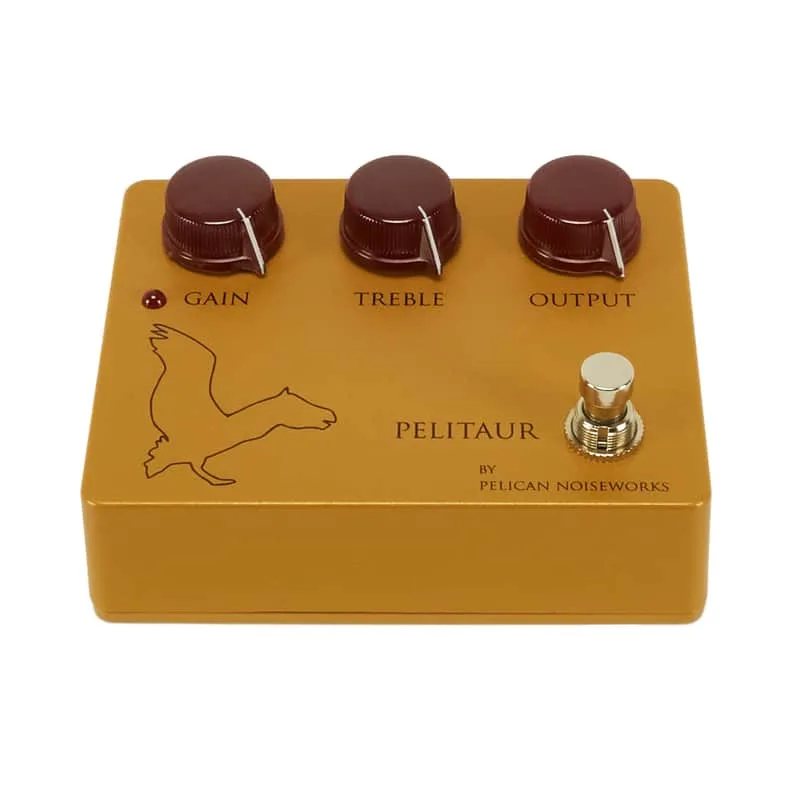
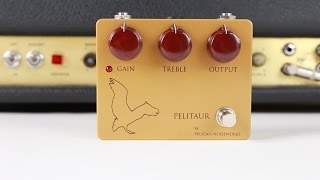
The front panel carries three knobs, each with a distinct job in shaping the parallel pair1:
| Control | What it does |
|---|---|
| Gain | Blends the two fuzz circuits, dialing in how much of each is present in the overall sound |
| Treble | A tone sweep control: as you raise the highs in one circuit, it also boosts the lows in the other |
| Output | Controls the overall output level of the Pelitaur |
The Treble control is the unusual one. Because it sweeps in opposite directions across the two circuits, moving it changes the balance between a brighter top end on one side and more low end on the other, rather than working like a conventional single tone knob. Pedal of the Day called it "a unique and welcome tone sweep control."1
Inside the pedal
Open the back plate and there is more to set. The Pelitaur has internal trim pots, which can be used to adjust the gain level of each fuzz circuit. Since the external Gain knob blends the two circuits, the trim pots let you set how much gain each side contributes before that blend, shaping the character of each half independently.1
Power
The Pelitaur runs on standard 2.1mm 9V negative center power, the connector used by most pedalboard power supplies, and draws an extremely low 3mA of current.1
Is it a copy?
The Klon-style enclosure invites the question, and Pedal of the Day's reviewer addressed it directly. The review opens by saying "This pedal is a fuzz, but not a normal one," and closes by noting that "yet it yields many tones and shapes to sculpt the nasty, dirty, gritty sounds we are all constantly in search of," describing it as not a mere copy of a famous pedal in overall sound.1
Videos
60 Cycle Hum
JayLeonardJ
shnobel
Questions
What do the internal trim pots on the Pelitaur do?
Inside the pedal there are internal trim pots that let you adjust the gain level of each of the two fuzz circuits separately. Since the Gain knob on the outside blends the two circuits together, the trim pots set how much gain each side contributes before the blend, letting you shape the character of each half of the parallel pair.
What power connector does the Pelitaur use?
The Pelitaur runs on standard 2.1mm 9V negative center power, the same connector used by most modern pedalboard power supplies. Pedal of the Day notes it draws an extremely low 3mA of current, so it sits comfortably on a shared supply.
Does the Pelitaur look like a Klon Centaur?
Yes. In a JHS Pedals discussion of the greatest pedals of the century, Josh Scott, Jamie Stillman, Matthew Farrow and Brian Wampler noted that the Pelitaur looks just like a Klon Centaur, but that inside it is really two different styles of fuzzes.
Is the Pelitaur just a copy of another fuzz?
Pedal of the Day's reviewer did not think so. The review describes the Pelitaur as a fuzz that is not a normal one, and concludes that while its enclosure may borrow a familiar look, it yields many tones and shapes for sculpting nasty, dirty, gritty sounds rather than being a mere copy of a famous pedal.
What is the Pelitaur Limited Silver Edition?
The Limited Silver Edition is a version of the Pelitaur that Pedal of the Day reviewed in February 2017. The review describes the pedal as 100% hand-built, and the Silver Edition was the version covered in that write-up of Pelican Noiseworks' first pedal.
Sources (4)
- Pelican NoiseWorks Pelitaur (Limited Silver Edition), Pedal of the Day, 2017-02-01
- Pelican NoiseWorks Half Horse Fuzz, Pedal of the Day, 2019-01-04
- GREATEST PEDALS OF THE CENTURY, JHS Pedals
- Pelican Noiseworks Pelitaur Fuzz, Pedal of the Day, 2017-01-30