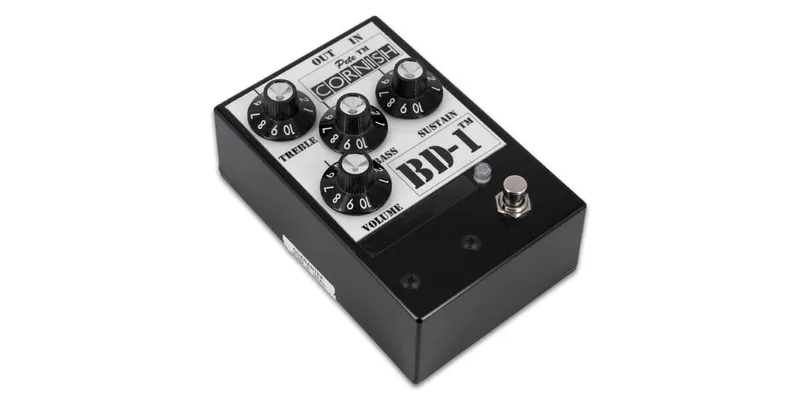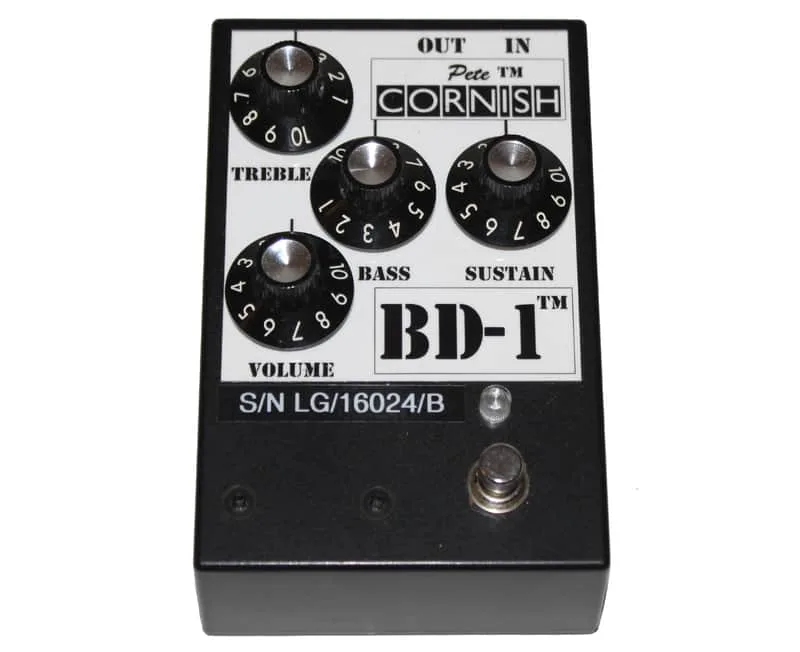


The Pete Cornish BD-1 is a bass driver pedal with heavy overdrive and active EQ, introduced by British maker Pete Cornish as new for 20141. Cornish describes it as a completely new and original design rather than a variant of any existing product, built with Germanium components for added musicality and featuring full bottom-end retention1. Aion FX, which traced the circuit in 2026, notes it is the only Cornish effect designed specifically for bass2.
Alongside the overdrive, the BD-1 carries a Class A input buffer with a radio frequency suppressor, and a low-impedance output buffer that Cornish says will drive long cables or other loads without loss of signal or tone1. Each unit is hand built, wired and tested by Pete, Lynda and Mingus Cornish1.
What the BD-1 does for a bassist
The BD-1 was initially designed for bass guitar, and Cornish says it has also proved popular with baritone guitars and dropped-tuned instruments1. The maker states the frequency response is flat down to below the bottom B on five-string basses, so the low fundamentals of an extended-range instrument are not lost when the overdrive engages1.
The drive character comes from Germanium components, which the maker credits with added musicality1. The overall boost is substantial: with Gain and Volume both at 100% and the tone controls at their neutral 12 o'clock point, the maker rates the boost at +55 dB, with a reference input of -52dBm(V) and output of +3dBm(V)1. Maximum signal output with Volume at 100% is +10dBm(V), 2.5V RMS, or 6V peak to peak at the clip point1.
The controls
The BD-1 carries Gain and Volume controls plus an active two-band EQ, and an output Master Volume is included to allow matching between bypassed, overdriven and EQ'd signal levels1. The tone controls are active boost and cut with a combined range of 34dB at maximum settings, and a zero point at 12 o'clock1.
| Control | What it does |
|---|---|
| Gain | Sets the amount of overdrive, up to the +55 dB overall boost figure at 100% with Volume at 100%1 |
| Volume (Master Volume) | Matches bypassed and overdriven, EQ'd signal levels; maximum signal output at 100% is +10dBm(V), 2.5V RMS, 6V peak to peak1 |
| Bass | Active boost and cut, range +16/-13dB at 30 Hz1 |
| Treble | Active boost and cut, range +12/-18dB at 3 kHz1 |
Aion FX's trace of the circuit confirms the bass control is centered at 30 Hz and the treble control at 3 kHz2. For a bassist, a 30 Hz center frequency sits at the fundamental of a five-string's low B, which is where the maker claims the pedal stays flat12.
The pedal is housed in a rugged die-cast box with easy-to-set number knobs, and switching is by a heavy-duty all-metal footswitch with a Hi-Brite LED1.
Power: 9V, 20mA
The BD-1 runs on a 9V DC supply that Cornish specifies must be noise free and fully stabilised, and capable of supplying 20mA1. The DC adapter input uses a 5.5/2.1mm coax connector with a center pin negative1. The Gray Series version also has an internal 9V DC battery, with an MN 1604 recommended3.
Cornish recommends the Voodoo Lab Pedal Power 2 Plus adapter, or a BOSS PSA series adapter if only a single unit is powered. AC voltage adapters must not be used and will permanently damage the pedal, which is not covered under warranty. Other effects should not be daisy-chained from the BOSS PSA adapter1.
The pedal carries a two-year warranty from date of purchase, covering repairs of original manufacturing faults, provided the guarantee labels are not damaged or removed. The warranty is not transferable and excludes the customer's own connected equipment, normal wear, misuse, unauthorized modifications and accidental damage1.
Where the BD-1 came from
The BD-1 is a hand-built unit: each one is wired and tested by Pete, Lynda and Mingus Cornish1. The maker presents it as a new design rather than a rework of an existing product, built around Germanium components and featuring full bottom-end retention, flat down to below the bottom B on five string basses1.
A later version, the Pete Cornish Deluxe BD-1, is documented on a product page dated 2017. It keeps the same design brief as an overdrive pedal for bass guitar, with an output Master Volume for level matching, an RFI rejecting input and bypass buffer, and a rugged die-cast box with lined control knobs. Its treble control range is the same +12/-18dB at 3 kHz, and its power requirements match the standard BD-1: 9V DC, fully stabilised, noise free, 20mA, on a 5.5/2.1mm connector with a center pin negative. The Deluxe version also makes battery replacement easy through a removable drawer, with the battery switching on when the IN/PWR ON jack is inserted, and an MN1604 preferred5.
Why the BD-1 costs what it costs
Cornish pedals have a reputation for high prices, and the BD-1 is no exception. The maker's own listing prices the pedal at 586.34 GBP including VAT, or 488.62 GBP excluding VAT, as of 31 March 20264.
Aion FX summarizes the reasons players commonly give:
- Extremely expensive, a reputation the maker's pricing reflects6
- Build quality and reliability, with each unit hand built, wired and tested by Pete, Lynda and Mingus Cornish1
- The obscured circuit, which keeps the design from being copied7
- An A-list of clients such as David Gilmour, Brian May and Pete Townshend7
"Cornish pedals are best known for being extremely expensive."
For players who want the BD-1's circuit without the price, Aion FX offers the Perseid, a documented bass drive project based on its trace of the BD-1, with the same 30 Hz bass EQ center frequency and 3 kHz treble EQ center frequency7.
Videos
Simon Gotthelf Music
Gearlovin
Questions
Why is the Pete Cornish BD-1 so expensive?
The BD-1 is hand built, wired and tested by Pete, Lynda and Mingus Cornish, and the maker's own listing prices it at 586.34 GBP including VAT, or 488.62 GBP excluding VAT, as of 31 March 2026. Aion FX notes that Cornish pedals are known for being extremely expensive, citing build quality, reliability, the obscured circuit and clients such as David Gilmour, Brian May and Pete Townshend.
Is the Pete Cornish BD-1 true bypass?
No. The BD-1 uses a buffered bypass. Pete Cornish fits his well established Class A input buffer with a radio frequency suppressor, and the output buffer has a low impedance designed to drive long cables or other loads without loss of signal or tone. The Deluxe BD-1 page likewise lists an RFI rejecting input and bypass buffer.
Does the BD-1 run on a battery?
The Grey Series version has an internal 9V DC battery, with an MN 1604 recommended. The standard BD-1 also has a DC adapter input on a 5.5/2.1mm coax connector with a centre pin negative. The Deluxe BD-1 makes battery replacement easy through a removable drawer, and the battery switches on when the IN/PWR ON jack is inserted.
Does the BD-1 work with five-string basses?
Yes. Pete Cornish states the design has full bottom-end retention and is flat down to below the bottom B on five-string basses. The bass EQ is centered at 30 Hz, below the fundamental of a five-string low B, and Aion FX notes the BD-1 is the only Cornish effect designed specifically for bass.
What is the Pete Cornish Deluxe BD-1?
A later version of the BD-1 overdrive pedal for bass guitar, documented on a Pete Cornish product page dated 2017. It keeps the same design brief, with an output Master Volume for matching bypassed and overdriven signal levels, an RFI rejecting input and bypass buffer, and a rugged die-cast box with lined control knobs.
Sources (7)
- Pete Cornish BD-1, Pete Cornish, 2014
- Tracing Journal: Cornish BD-1 Bass Drive, Aion FX, 2026-07-03
- Pete Cornish BD-1, Pete Cornish, 2014
- Grey Series Effects Pedals, petecornish.co.uk, 2026-03-31
- Pete Cornish Deluxe BD-1, Pete Cornish, 2017
- Soma Vintage Overdrive / Cornish SS-3, Aion FX, 2019-11-15
- Perseid Bass Drive / Cornish BD-1, Aion FX, 2026-07-03