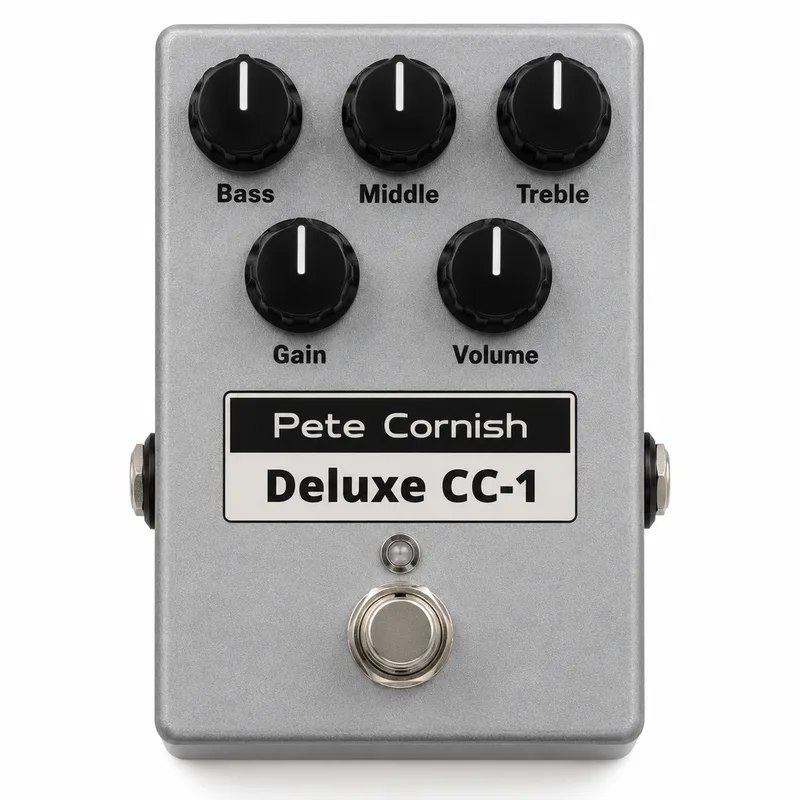


The Pete Cornish Deluxe CC-1 is an overdrive pedal with a built-in active three-band EQ, hand built by Pete Cornish in England. Pete Cornish describes it as "a completely new and original design" rather than a variant of any existing pedal: the signal runs from a variable gain linear preamp into two fixed low-gain soft clipping stages, then through an active Bass/Middle/Treble EQ, and out through a master Volume control1.
What sets it apart from most overdrives is how the drive and the EQ work together. The clipping is soft, meaning the circuit does not clamp the signal peaks, and the EQ that follows can cut or boost each band by up to 16 dB, so you can shape the driven sound rather than just accepting it. A Class A input buffer with radio frequency suppression and a low impedance output buffer are also built in, so the pedal drives long cables without losing top end1.
Controls and what they do
The Deluxe CC-1 has five knobs. The three tone controls are active, meaning they cut as well as boost, and each has its zero point at 12 o'clock, so the neutral setting is easy to find by feel12.
| Control | What it does | Range |
|---|---|---|
| Gain | Variable gain linear preamp; compensates for low output pickups and drives the soft clipping stages harder | Maximum +22 dB1 |
| Bass | Active cut and boost, zero at 12 o'clock | +/-13 dB at 70 Hz1 |
| Middle | Active cut and boost, zero at 12 o'clock | +/-15 dB at 1.5 kHz1 |
| Treble | Active cut and boost, zero at 12 o'clock | +/-16 dB at 5 kHz1 |
| Volume | Output master volume for matching bypassed and boosted/EQ'd levels | 1 |
The master Volume is there for level matching: Pete Cornish includes it "to allow for perfect matching between bypassed and boosted/EQ'd signal level"1, so you can dial in drive and EQ changes without a jump in loudness when you switch the pedal on.
How the soft clipping works
Soft clipping is the opposite of the hard clipping used in many distortion pedals. Instead of slicing the tops off the waveform at a fixed ceiling, the CC-1's two clipping stages engage gradually as the signal level rises. In Pete Cornish's words21:
"As the signal level increases due to stronger playing the soft clips gradually engage and start to add harmonics"
Because the peaks are never clamped, the dynamics and relative loudness of your playing survive: pick harder and you get more harmonics and drive, pick gently and the sound stays closer to clean. The maker also states that the clipping stages "are effectively (and automatically) removed from the audio path when the signal level drops below their transition point," which is what gives the CC-1 its complete cleanup when you roll back the guitar's volume knob1.
The Gain control feeds this whole system. Since the soft clips respond to signal level, the +22 dB preamp lets you push low output pickups hard enough to reach the clipping region, or back it off for a cleaner, more boost-like character1.
Boost and output levels
The overall boost depends on where the Gain knob sits. With Gain and Volume both at 100% and the tone knobs at their 50% neutral point, the pedal delivers +34 dB of overall boost. With Gain at 0% and Volume at 100%, it delivers +12 dB, which is the clean-boost end of its range1. Maximum signal output with Volume at 100% is +10 dBm, 2.5 V RMS, or 6 V peak to peak1.
Power and connections
The Deluxe CC-1 runs on a 9V DC adapter that Pete Cornish specifies must be noise free and fully stabilised, with a 5.5/2.1mm coaxial connector and a negative center pin, capable of supplying 20mA1. It also takes an internal battery through a removable drawer, with the battery switched on when you insert a plug into the IN/PWR ON jack; the preferred type is the MN1604 9V cell1.
The standard CC-1 differs from the Deluxe version on power: it is a battery-free pedal, running on an internal 9V battery only in the Gray Series version plus a 9V DC input on an M2.1 tip negative connector23. If you are comparing the two, check which version you are buying.
The pedal is housed in a rugged die-cast box with lined control knobs, and switching is by a heavy duty custom made all-metal footswitch with a large cap, a protection ring and a Hi-Brite LED1.
History, designer and related pedals
The CC-1 was designed by Pete Cornish and was available to order from January 20133. Each unit is hand built, wired and tested by Pete, Lynda and Mingus Cornish1. The circuit is not a clone or a variant of anything else: Aion FX, which traced the CC-1 circuit, describes it as "a fully original circuit that's not based on anything else," designed primarily with op-amps4.
The CC-1 sits in a small family of related Cornish pedals:
- CC-1: the original, described by the maker as "CORNISH CRUNCH WITH B/M/T ACTIVE TONE BOOST/CUT"25
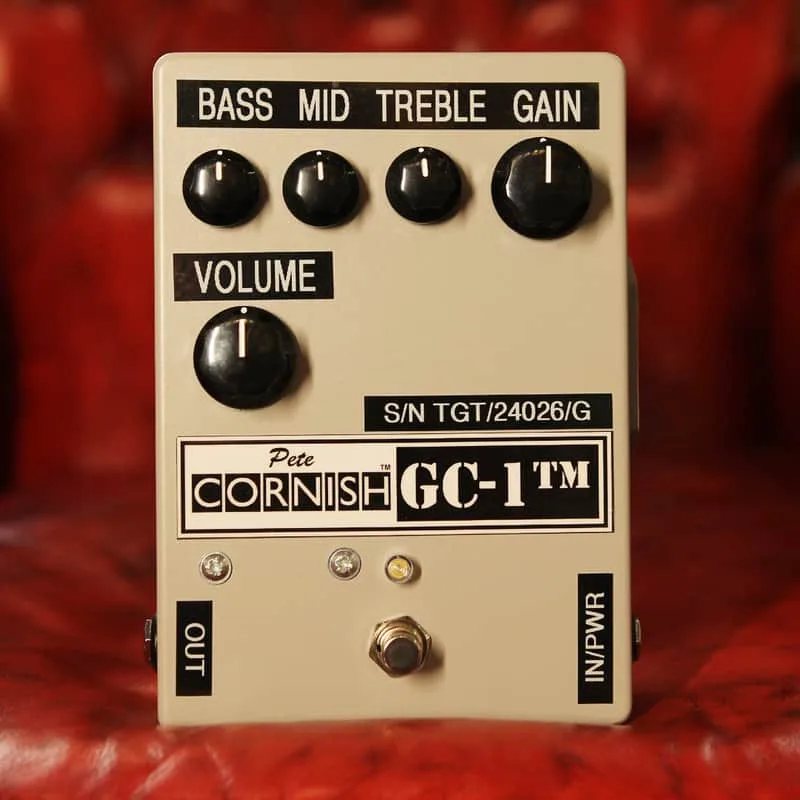
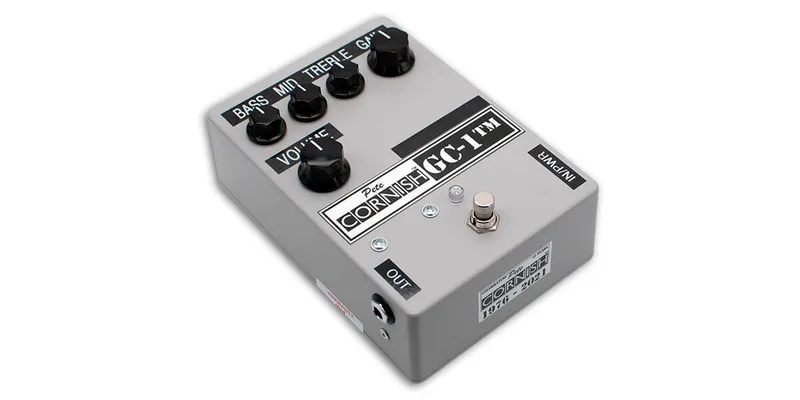
- GC-1: a later pedal that Aion FX traced in 2023 and found "identical to the CC-1 other than changes in component values"; its clipping is the same two soft clipping stages, with no hard clipping46
- Deluxe GC-1: a three stage design with both hard and soft clipping stages that switch automatically as gain increases, plus the same three band active EQ and master Volume7
- Battery Free GC-1: an overdrive/boost pedal with active EQ and buffer, introduced for 20218
The CC-1's warranty runs twelve months from purchase, covering repairs of original manufacturing faults; it is voided if the guarantee labels are damaged or removed, and it excludes normal wear, misuse, unauthorized modifications, accidental damage and faults in the customer's own connected equipment1.
Videos
Simon Gotthelf Music
Simon Gotthelf Music
Electric Mojo Guitars
Questions
Does the Pete Cornish Deluxe CC-1 take a battery?
Yes. The Deluxe CC-1 has a removable battery drawer, so the battery can be replaced without opening the case. The battery is switched on when you insert a plug into the IN/PWR ON jack, and Pete Cornish lists the MN1604 (9V) as the preferred type. The standard CC-1, by contrast, is a battery-free pedal.
What is soft clipping?
Soft clipping is a form of overdrive where the circuit does not clamp or cut off the signal peaks. Instead, as you play harder, the clipping stages gradually engage and add harmonics, so the dynamics and loudness of your playing are preserved. In the CC-1 the soft clipping stages drop out of the audio path entirely when the signal falls below their transition point, giving complete cleanup when you turn the guitar volume down.
How much boost does the CC-1 give?
With Gain and Volume both at 100% and the tone knobs at their 50% neutral point, the CC-1 gives an overall boost of +34 dB. With Gain at 0% and Volume at 100%, it gives +12 dB. The Gain control itself is a linear preamp with a maximum of +22 dB.
What power supply does the CC-1 need?
A 9V DC adapter, fully stabilised and noise free, feeding a 5.5/2.1mm coaxial jack with a negative centre pin, and able to supply 20mA. The standard CC-1 also runs on an internal 9V battery, but the adapter requirements are the same: 9V DC, tip negative.
Is the CC-1 an overdrive or an EQ?
It is both. The signal path runs from a variable gain preamp into two soft clipping overdrive stages, then into an active three-band EQ with cut and boost on Bass, Middle and Treble, and finally a master Volume control. Pete Cornish describes it as a completely new and original design rather than a variant of any existing pedal.
What is the CC-1 warranty?
Twelve months from the date of purchase, covering repair of original manufacturing faults when the unit is returned post paid. The warranty is voided if the guarantee labels are damaged or removed, and it excludes normal wear, misuse, unauthorized modifications, accidental damage and faults in the customer's own connected equipment.
Sources (8)
- Pete Cornish Deluxe CC-1, Pete Cornish, 2017
- Pete Cornish CC-1, Pete Cornish, 2025
- Pete Cornish CC-1, Pete Cornish Partnership, 2014
- Cepheus Amp Overdrive / Cornish CC-1 & GC-1, Aion FX, 2020-09-11
- Battery Free Effects Pedals, petecornish.co.uk, 2026-03-31
- Tracing Journal: Cornish GC-1, Aion FX, 2023-10-06
- Pete Cornish Deluxe GC-1, Pete Cornish, 2021
- PETE CORNISH Battery Free GC-1, Pete Cornish, 2021