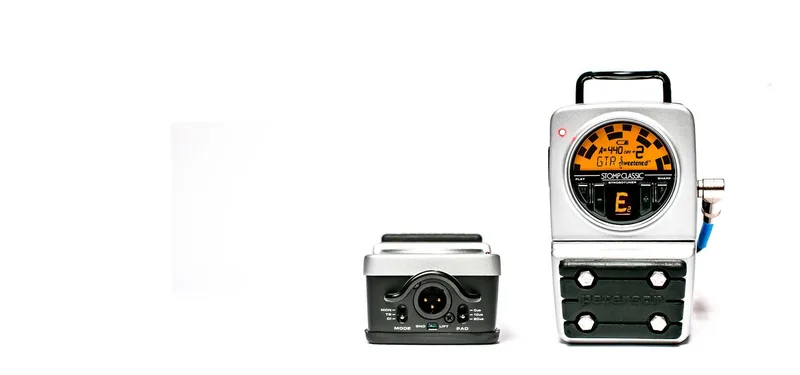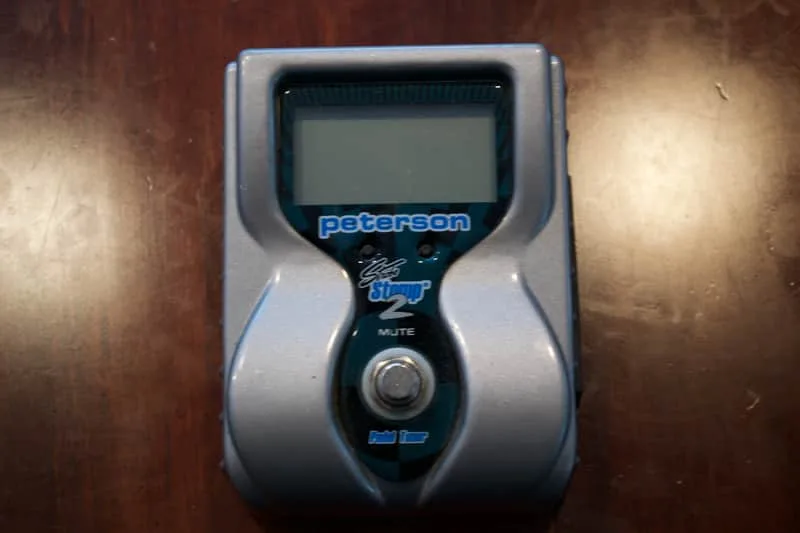


The Peterson Stomp Classic (sold as the StroboStomp Classic, model VSS-C) is a tuner pedal with a built-in active DI, made by Peterson. It is a strobe tuner: instead of a needle or simple LED ladder, it shows pitch on an LCD with 256 segments, 128 per row, and it is accurate within 0.1 cents1. Peterson lists it as discontinued, with a list price of $199.001.
Peterson calls it "THE ONLY true bypass, active DI-equipped tuning pedal with computer connectivity"1, and describes it as "an apt heir to the throne of the now world-famous Conn ST-11 analog tuner"1. Guitar World's 2012 review likewise noted that it "combines the familiar look and performance of the vintage Conn ST-11 Strobotuner" in a stomp box format2.
A strobe tuner and active DI in one pedal
The Stomp Classic is Peterson's retro stomp box tuner, a pedal tuner with an active DI on board, listing at $199.001. Its strobe display resolves pitch far more finely than a typical pedal tuner: Peterson specifies accuracy of 0.1 cents, and the display resolves across 256 segments, 128 per row1. By comparison, other pedal tuners are typically accurate to .5 or 1 cents, making the Stomp Classic five to 10 times more accurate2.
The second half of the pedal is the DI. Peterson describes it this way1:
"The professional-quality active DI on board is mutable and lets you select one of three stages of signal attenuation"1
That means the pedal can sit at the end of a pedalboard and feed a balanced line to a front-of-house console while still passing your signal through to an amp, with a mute switch for silent tuning and three attenuation stages to match the level hitting the desk1.
Peterson's product page shows a user rating of 4.9 out of 5 stars from 172 reviews, 94% five stars and 5% four stars1.
The display, inputs and outputs
The display is an LCD with 256 segments, 128 per row, and note selection is automatic, so it detects the pitch you play without manual note entry1. The note range runs from C0 to A#8, covering bass and guitar well beyond the fretted range of either, and the frequency response range is 16.35Hz to 7302Hz1.
| Connection | Type |
|---|---|
| Input | 1/4" mono1 |
| Through output | 1/4" mono1 |
| DI output | Balanced XLR1 |
| USB | Mini (firmware updates, Peterson Connect)1 |
Other display and tuning features from Peterson's specifications1:
- Concert A range: 390Hz to 490Hz
- Transposition range: -6 to +5
- Sweetened tunings: 25
- User presets: 10 locations
- Mute-able output: yes
- Historic temperaments: equal only
- No built-in speaker, headphone jack or built-in microphone
The enclosure is die cast, measuring 6" x 3.25" x 2.75" (LxWxH) and weighing 1.7lbs1.
Power and connections: 9V, 80mA
The Stomp Classic runs on 9V DC at 80mA nominal, with a negative center pin power supply (optional, not included with the supply spec) or a 9V battery, which Peterson included in the box1. Peterson advises checking voltage (9V regulated) and polarity (positive barrel, negative inner sleeve) first1.
The 80mA draw is modest by pedal standards, but the battery is a backup rather than a long-term plan. Peterson lists the pedal as not rechargeable, and a regulated 9V DC supply with the correct polarity is the reliable option1.
The pedal runs on 9VDC at 80mA nominal, from an optional 9VDC negative center pin power supply, and a 9V battery is included1. It is Peterson Connect compatible, so it can connect to Peterson's software for preset editing, with 10 user preset locations on board1. Peterson advises checking the voltage, 9V regulated, and polarity, positive barrel with negative inner sleeve, before powering the pedal1.
How it compares
The Stomp Classic's combination of a 0.1-cent strobe tuner, an active DI and Peterson Connect compatibility sets it apart from a straightforward pedal tuner1. Its display resolves 256 segments, 128 per row, and it carries a 3-year warranty at a list price of $199.001. With 10 user preset locations, it holds settings for different instruments and tunings ready to recall1.
Against a basic true bypass tuner, the Stomp Classic's distinguishing features are its on-board active DI, which is mutable and offers three stages of signal attenuation, and its Peterson Connect compatibility1. Its tuning range is wide, covering C0 to A#8 with a frequency response range of 16.35Hz to 7302Hz, and its concert A reference is adjustable from 390Hz to 490Hz1. Transposition runs from -6 to +5, and the die cast enclosure measures 6" x 3.25" x 2.75" at 1.7lbs1.
What reviewers said
Peterson specifies the Stomp Classic's accuracy at 0.1 cents, with a display resolution of 256 segments, 128 per row1. The pedal carries a 3-year warranty and lists at $199.001. Its note range spans C0 to A#8, with a concert A range of 390Hz to 490Hz and a transposition range of -6 to +51.
"Fitting the accurate performance and versatile features of a high-end strobe tuner into a stomp box, the Peterson Stomp"2
Guitar World's overall verdict was that it is essential for guitarists who want the best tuning capabilities available2.
Videos
Premier Guitar
PetersonTuners
OfficialFrankMarino
Questions
Is the Peterson Stomp Classic discontinued?
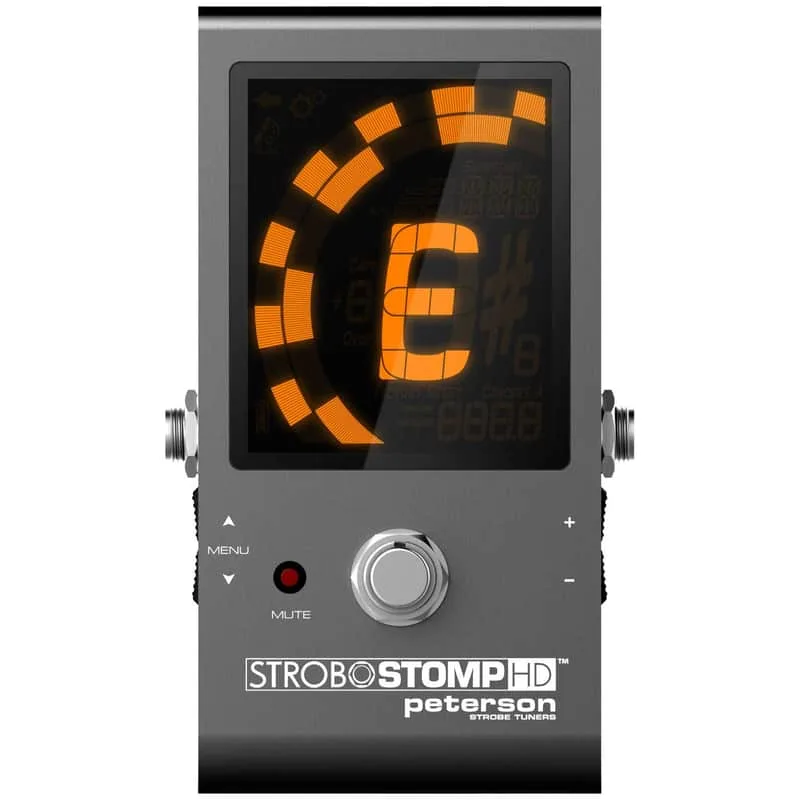
Yes. Peterson lists the Stomp Classic as discontinued on its product page. It was released at NAMM in January 2011 as the StroboStomp Classic, modeled on the vintage Conn ST-11 Strobotuner, and Peterson later replaced it in the lineup with the StroboStomp HD.
Does the Peterson Stomp Classic run on a battery?
Yes. It takes a 9V battery, which Peterson shipped with the pedal, and it also runs on a 9V DC power supply with a negative center pin. Nominal current draw is 80mA at 9V DC, so a fresh battery or a regulated supply is the practical choice.
Is the Peterson Stomp Classic true bypass?
Yes. Peterson specifies true bypass and describes it as the only true bypass, active DI-equipped tuning pedal with computer connectivity. There is no buffered output mode on this model, unlike the later StroboStomp HD, which offers both.
Can the Stomp Classic be used as a DI box?
Yes. It carries a professional-quality active DI that can be muted, with three selectable stages of signal attenuation, and a balanced XLR output alongside the 1/4 inch through output. That lets it feed a mixing desk directly while passing your signal on to an amp.
How do I update the Stomp Classic firmware?
The Stomp Classic is firmware updateable over its USB Mini port and is Peterson Connect compatible. Peterson issued several updates, most recently firmware 1.0.06 in May 2017 with bug fixes and performance improvements, through the Peterson Connect software.
What are sweetened tunings on a Peterson tuner?
Sweetened tunings are preset offsets from equal temperament that Peterson developed to make fretted instruments sound more in tune in common keys and tunings. The Stomp Classic includes 25 of them. Historic temperaments are limited to equal only on this model.
Sources (2)
- Stomp Classic, Peterson Electro-Musical Products, Inc.
- Review: Peterson Stomp Classic Strobotuner, Guitar World, 2012-11-09