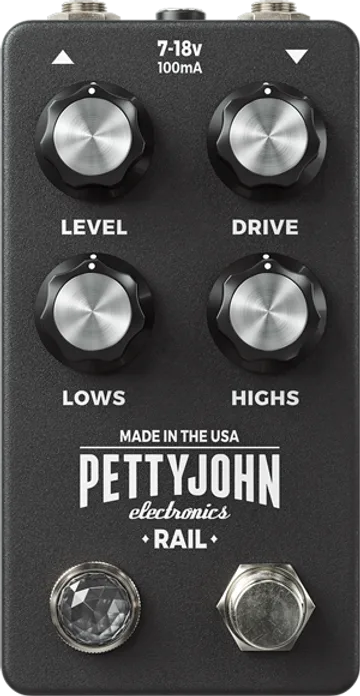


The Pettyjohn RAIL is a fuzz pedal from Pettyjohn Electronics, and the first pedal in the company's Core Series. The maker calls it "a true full range fuzz machine" and describes the goal as a "versatile fuzz for everyone at unmatched value"1. What sets it apart from most fuzz designs is how it generates the distortion: instead of clipping diodes or vintage transistors, the circuit boosts the signal with extreme levels of gain into the voltage rails, the maximum voltage the circuit can swing12.
How the circuit works
Most fuzz pedals shape their sound by clipping the waveform with diodes or transistors. The RAIL takes a different route. As Delicious Audio's Paolo De Gregorio put it, "it doesn't generate it through clipping diodes or transistors, but simply boosts the signal with extreme levels of gain" into the voltage rails2. The maker describes the same approach, noting the circuit "does not rely on clipping diodes or finicky vintage" transistors1.
One practical consequence is at the output: the Level control is fully buffered from the outside world and will not load or tone suck, which the maker says makes the RAIL one of the few fuzz pedals that behaves that way2.
Controls
| Control | What it does |
|---|---|
| Gain | An 8-way rotary switch for higher gain, offering a range of gain not found in standard pots2 |
| Level | Fully buffered from the outside world, will not load or tone suck2 |
| Lows and highs | The lows act as pre-drive emphasis, meaning you can distort using frequency3 |
The rotary gain switch is a deliberate choice. Because it provides "an increased range of gain which can not be found in standard pots," the RAIL covers more ground than a pedal whose gain is set by a conventional knob2.
Voltage as a tone control
The RAIL runs at 7 to 18 volts3, and the supply voltage is part of the design rather than just a power spec. The maker states that "the voltage you put in greatly affects the character of the distortion and fuzz as well as the output level"1. In practice, that means changing the power supply voltage changes the pedal's voice, giving players another way to shape the fuzz beyond the front-panel controls.
Because input voltage changes the character of the distortion and the output level1, the supply you use is effectively part of the circuit. Running the RAIL at different voltages within its 7 to 18 volt range3 produces different fuzz voices.
Where it sits in the Pettyjohn range
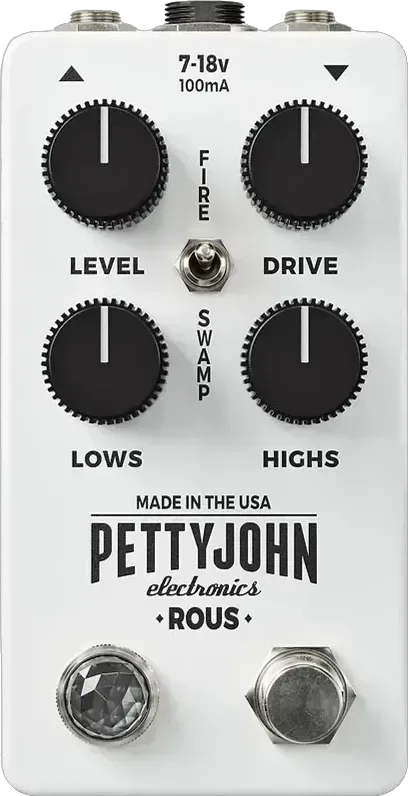
The RAIL is the first pedal in the Pettyjohn Electronics Core Series1. Players comparing it with other fuzz designs may also want to look at the Pettyjohn Electronics ROUS Fuzz/Distortion, the company's hybrid distortion/fuzz pedal.
Videos
Premier Guitar
Pettyjohn Electronics
AndyDemos
Sources (3)
- RAIL Info (Legacy Product), Pettyjohn Electronics, 2022-01-06
- PettyJohn Rail Fuzz, Delicious Audio, 2020-09-14
- PETTYJOHN ELECTRONICS, JHS Pedals