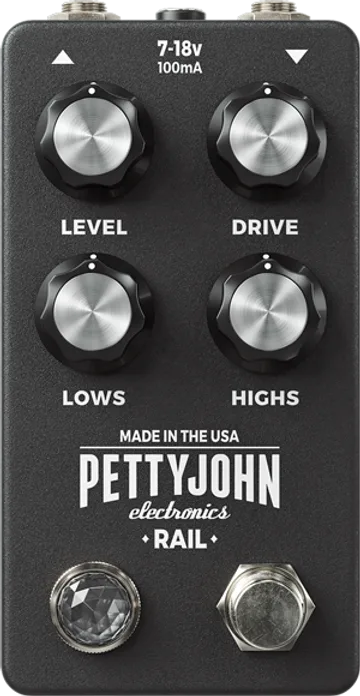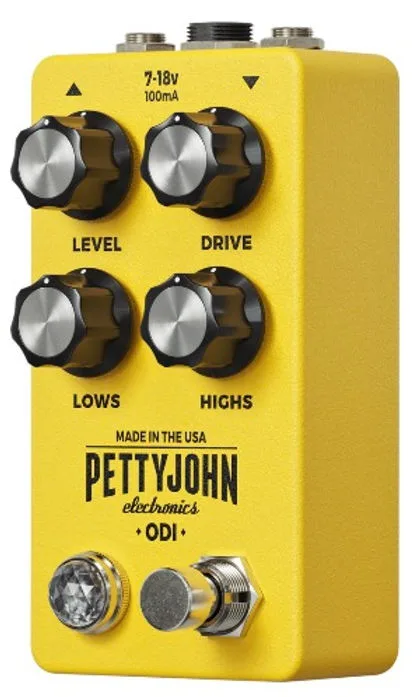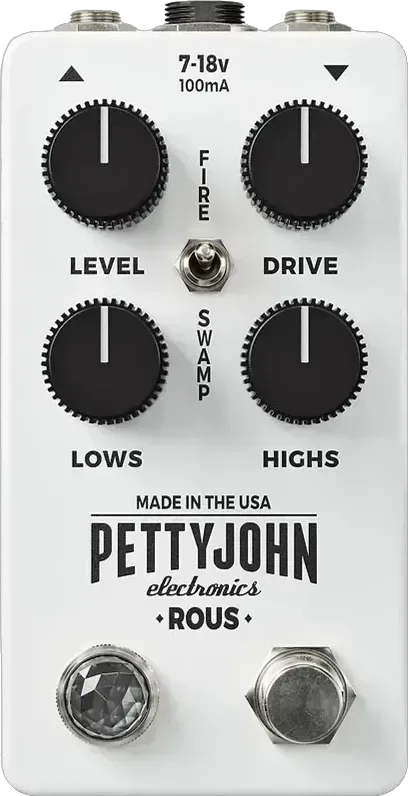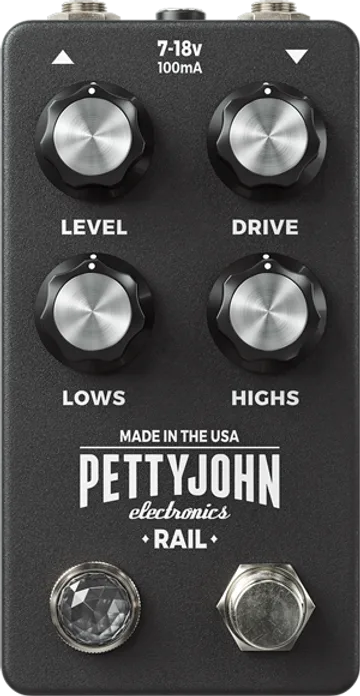


The PettyJohn Electronics Rail is a full range fuzz and distortion pedal, hosted in a black, blunt compact case1. Instead of the clipping diodes or vintage transistors most fuzz circuits rely on, the Rail boosts the signal with extreme levels of gain into the voltage rails of the circuit itself, and the distortion that results comes from the rails21. Its gain control steps from low gain distortion, which Pettyjohn says cleans up nicely, all the way up to Infinity mode1.
Pettyjohn describes the result as "a true full range fuzz machine" and says the goal was to "craft a versatile fuzz for everyone at unmatched value"2. Delicious Audio's Paolo De Gregorio characterized the range this way: at lower levels the Rail can deliver more subtle overdriven tones, while with the gain pushed to the maximum it can sound like a gated fuzz1.
A fuzz driven into the voltage rails
Most fuzz pedals generate their sound with clipping diodes or with vintage germanium or silicon transistors pushed into clipping. The Rail takes a different route. As Delicious Audio put it, the circuit "doesn't generate it through clipping diodes or transistors, but simply boosts the signal with extreme levels of gain" into the voltage rails1. Guitar Pedal X's Stefan Karlsson, reviewing the pedal in his 2020 roundup of new fuzzes, made the same point: the Rail "uniquely derives its tone and texture from the voltage rail of the circuit rather than any traditional clipping or opamp gain stage"3.
The practical consequence for a player is that the fuzz character is set by how hard the signal slams into the power supply limits of the circuit rather than by a diode threshold. The internal voltage can run from 7V to around 36V, achieved by doubling the 18V input, which gives the circuit a wide range of rail behavior to work with1.
"The RAIL circuit takes a unique approach to generating fuzz which does not rely on clipping diodes or finicky vintage transistors."
Karlsson's verdict on the controls was positive: "that combination of Level, Notched Drive, Lows and Highs really delivers something quite magical"3.
The controls
The Rail has a four knob control set: Level, Gain, Lows and Highs1. The Drive knob is a stepped rotary pot with 8 positions, each pushing a different amount of gain. In an interview with JHS Pedals, Stephen Pettyjohn explained how it works: "the drive control is a stepped rotary pot. So as I turn, it actually clicks into the different positions"4. The eighth position is Infinity mode.
| Control | What it does |
|---|---|
| Level | Sets output volume; fully buffered from the outside world, will not load or tone suck1 |
| Gain (Drive) | 8-position stepped rotary switch, each position a different amount of gain, from low gain distortion up to Infinity mode14 |
| Lows | Active 18 dB/octave high pass filter sweeping from sub 30Hz to beyond 1kHz, placed before the gain stage1 |
| Highs | Placed post-gain, to highlight or tame the fizziness; fully buffered against external loading1 |
The split placement of the tone controls matters. Because the Lows control is a high pass filter before the fuzz circuit, it decides how much low frequency content gets driven into the rails, which changes both the thickness and the character of the fuzz. The Highs control sits after the gain, so it shapes the fizz that the fuzz generates rather than feeding it1.
The rotary switch for gain is a deliberate design choice. Delicious Audio noted that the switch provides "an increased range of gain which can not be found in standard pots"1, so the Rail can reach both lower and higher gain extremes than a conventional knob would allow.
Infinity mode and the gain range
The eighth position on the gain switch is the INFINITY setting, which Pettyjohn describes as featuring "a musical gating effect and our highest gain fuzz"1. In the JHS Pedals interview, Pettyjohn described the last position as being "like an infinite sustain with tons of saturation and clipping"4. Guitar Pedal X called it a "High Gain velcro-style gating" mode3. The gating means the sound cuts in and out as you play, in the way a velcro-style fuzz does, rather than sustaining smoothly.
At the other end of the switch, the lowest gain step is described as a low gain distortion that cleans up nicely, so the pedal covers ground from overdrive-adjacent textures through full distortion to gated fuzz, all from one control1.
Power and switching
The Rail runs on a standard pedal adapter: 9V to 15V, center tip negative, drawing 200mA, and Pettyjohn specifies clean, regulated, isolated power1. Switching is true bypass, using a relay based system designed for minimum pop when the effect is engaged1.
Pettyjohn specifies clean, regulated, isolated power from a 9V to 15V center tip negative jack, a standard pedal adapter, with a 200mA draw1. The Rail's internal voltage can go from 7V to around 36V, achieved by doubling the 18V input1.
The buffered Level control is worth noting for pedalboard planning: because it is fully buffered from the outside world, the Rail will not load or tone suck whatever comes after it, which Delicious Audio pointed out makes it one of the few fuzz pedals that behaves well in that respect1.
Where it came from
The Rail is housed in a new enclosure by GORVA design1. Its Highs control was redesigned for the CORE series and is now fully buffered against any external loading1.
Videos
Premier Guitar
Pettyjohn Electronics
Pettyjohn Electronics
Questions
What is Infinity mode on the PettyJohn Rail?
Infinity mode is the eighth and highest position on the Rail's stepped gain switch. Pettyjohn describes it as the pedal's highest gain fuzz, with a musical gating effect that produces a velcro-style gated fuzz sound. It is the last click on the rotary Drive control, after the seven lower gain positions.
Is the PettyJohn Rail true bypass?
Yes. The Rail uses a true bypass, relay based switching system designed for minimum pop when the effect is engaged. The Level control is also fully buffered from the outside world, so the pedal will not load or tone suck when it is in the signal chain.
Where is the PettyJohn Rail made?
The Rail is hand made in Oregon, USA by Pettyjohn Electronics. It was the first release in the builder's Core Series, shown at the Portland Stompbox Exhibit in March 2020 and housed in a new enclosure by GORVA design.
Can the Rail do low-gain overdrive?
Yes. At lower gain settings the Rail delivers more subtle overdriven tones, and the lowest gain step is described as a low gain distortion that cleans up nicely. The gain range is set by an eight position rotary switch, which reaches further than a standard pot.
Sources (4)
- PettyJohn Rail Fuzz, Delicious Audio, 2020-09-14
- RAIL Info (Legacy Product), Pettyjohn Electronics, 2022-01-06
- Guitar Pedal X, Guitar Pedal X, 2020-12-18
- PETTYJOHN ELECTRONICS, JHS Pedals