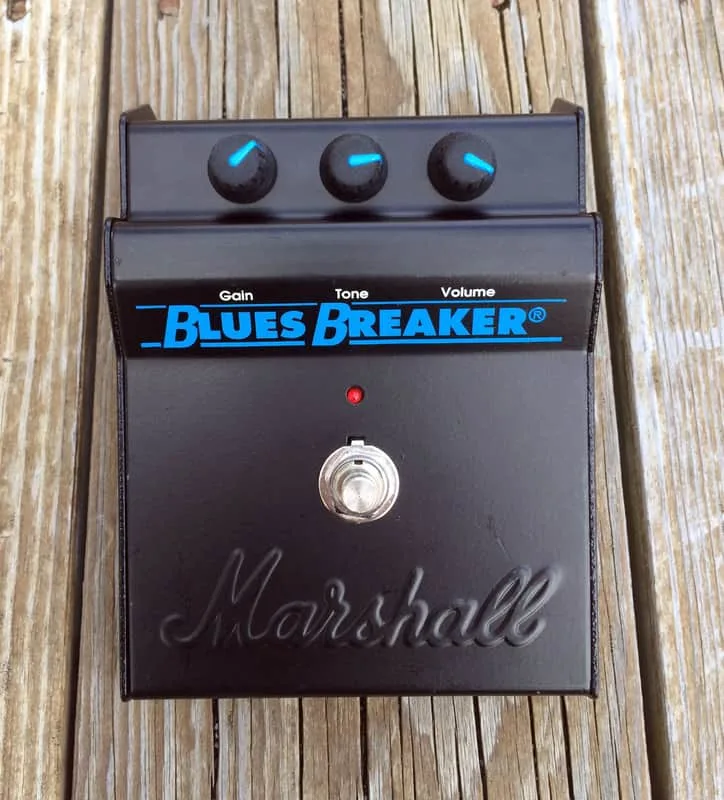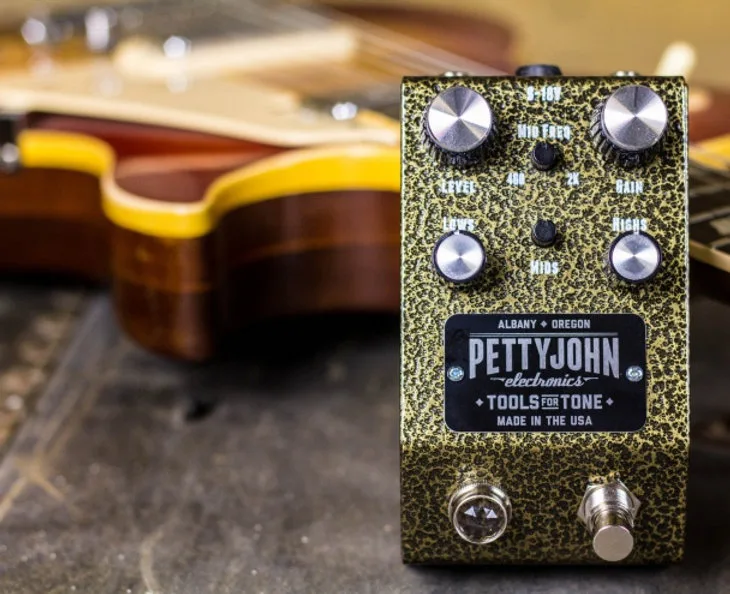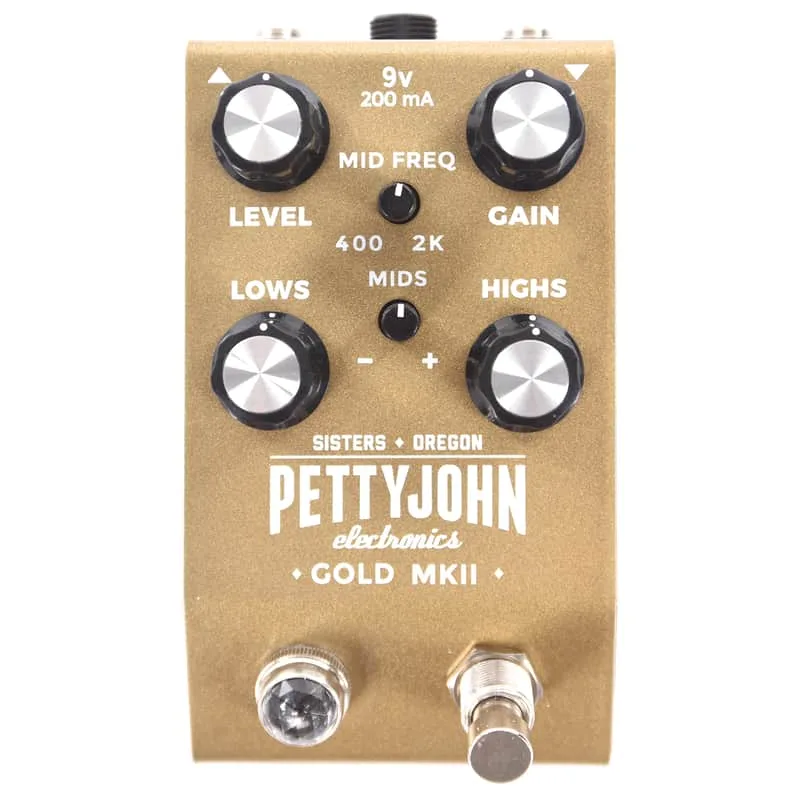



The Pettyjohn GOLD MKII is an analog overdrive and preamp pedal designed to capture the classic tones of the Marshall Plexi 1959SLP in the simple format of a guitar pedal1. Made by Pettyjohn Electronics, it is an update to the company's best selling golden amp overdrive, the Gold Version 1, and sits in the Foundry Series as a high gain Plexi overdrive23. Delicious Audio described the original as "a low noise, edge-of-breakup to distortion with amp-like dynamics and feel" that "ended up as so much more then just an amp-in-a-box"4.
The design brief, as Stephen Pettyjohn told it in a 2018 interview, was not a straight Marshall copy: "my goal wasn't to just create a Marshall emulation but to create a desert island golden overdrive that could go from low" gain, pushed amp, edge of breakup all the way to medium-gain distortion5. The MKII keeps that character and pushes further, with a gain control that tops out at almost twice the original amount2.
What it does to your sound
The Gold MKII is a Plexi-style overdrive in the amp-in-a-box tradition, but its designer framed the gain range conservatively: "It's more JCM800 and lower. But more of the Plexi range, the JTMs and the Blues Breakers," not the high-gain JCM-2000 territory5. On the MKII's Gain knob, low gain exists from 7 to 10 o'clock, adding punch to rhythm tones or fattening a bridge or hook1.
The MKII gain control extends the range at the bottom for preamp or clean boost settings and tops out with almost 2x the original gain amount2. Because the drive circuit has no EQ built in, all tone shaping happens in the knobs themselves, which keeps the overdrive character consistent as you dial the EQ5.
The controls: gain, lows, mids and highs
The original Gold carried a 3 band EQ with an adjustable mid bell curve plus Gain and Output6. The MKII refines that layout into Gain, Output, and a console-style EQ:
| Control | What it does |
|---|---|
| Gain | Extended at the bottom for preamp or clean boost settings; tops out with almost 2x the original gain2 |
| Lows | Pre-overdrive low cut, sweeping at 6dB per octave from sub-frequencies to 1kHz2 |
| Mids | Sweepable mid range bell filter, boost or cut up to 8 dB between 400 Hz and 2kHz2 |
| Highs | Sweepable high cut ranging from 20kHz down to 1kHz2 |
| Output | Sets overall level6 |
The mid circuit is unusual for a pedal. Rather than copying an amp tone stack, it is based on a recording console circuit: "let's create a sweepable bell that covers the entire range that any Marshall has ever had….plus a little bit"5. On the original Gold, the low-cut knob swept from 20Hz to 700Hz and was the only low-cut in the entire circuit, with the first third of the range covering 20Hz to 100Hz sub content and tightening around noon in the 200Hz to 300Hz range, which made it usable on bass and other instruments5.
Internal toggles: headroom, preamp mode and high-cut capacitor
Inside the pedal are mini toggles that change its character more than the face knobs suggest642.
- Headroom toggle: selects High Headroom or Low Headroom for the gain amp. The Gold shipped set in the High Headroom position for the most dynamic, touch sensitive drive experience4. The Low Headroom setting adds harmonics and an increased sense of breakup and gain with a slight tightening of the lows, pushing upper gain ranges into classic distortion territory4.
- Preamp mode: moving the internal clipping headroom toggle to the middle position bypasses the clipping section entirely, turning the pedal into a full range preamp2. With 20Hz to 20kHz of frequency range, the Gold line was described by its maker as a perfect always-on rock/blues preamp in this role7.
- High-cut capacitor toggle: switches the high cut cap between a clear, punchy Wima cap and a classic 716 Orange Drop cap for a smoother, vintage flavor2. On the original Gold this choice was between an Auri-Cap audiophile capacitor, described as super transparent and the stock setting, and a more vintage sounding Orange Drop6. Delicious Audio characterized the Auricap XO option as "smooth and a little bit compressed with tighter low-mids and more clarity and focus on the top end"2.
Power: 9V in, 36V of internal headroom
The MKII runs on a standard 9V DC center negative supply drawing 200mA1. From that input the internal circuit generates 36V of headroom1. Delicious Audio reported the same arrangement at launch, a 36V dual rail power supply fed from a 9V, 200mA standard adaptor21. High headroom and high voltage imparts an openness and 3D quality, according to the same coverage2.
The 200mA draw is well above what a typical 9V battery or a low-current daisy chain output supplies, so plan on a dedicated isolated output. The original Gold accepted anywhere from 9 to 18V of DC power61, but the MKII's internal voltage doubling means a plain 9V supply is all that is required1.
The bypass system is also part of the power story: the MKII uses a relay based true bypass circuit with a soft touch switch, and it auto-bypasses when power is disconnected2. RockBoard's product page calls it "a totally quiet bypass switching system, that won't obliterate your delay's and reverb's when the unit is engaged"1.
History and versions: from the Gold to the Gold MKII
The Gold Overdrive was designed by Stephen Pettyjohn, who described the circuit's origins this way: "I was exploring a combo of my take on a Plexi amp with a little bit of Klon influence on the circuitry. I ended up going" in more of a Marshall direction than the Klon idea5. Delicious Audio called the result "a simple box inspired by classic 'Golden amps from Britain'" and part of what the company felt was the new golden standard of its Foundry line4.
Even the finish has a story: the gold powder coating came from a color swatch from the powder coating company Pettyjohn uses for its enclosures5.
The MKII, announced in September 2019 and initially on preorder, brought several changes over the Gold Version 12:
- Gain range extended at the bottom, topping out with almost 2x the original gain2
- Relay based true bypass with soft touch switch and auto-bypass on power loss2
- Foundry Series MKII custom enclosure with in-set screws2
- NOS germanium diode upgrade, offering a classic sound, tighter low end, richer mids and smoother highs; the diodes are rumored to be found in the original golden centaur pedal2
- Burr Brown OPA input and output buffer2
Is it a Klon clone?
The question comes up because of the germanium diodes, but the answer is no. RockBoard's product page states plainly that "the low headroom section is not a 'klone' circuit," though it likens the pedal to a Klon1. The designer's own account puts the circuit firmly in Marshall territory with only "a little bit of Klon influence on the circuitry"5. The Klon association rests mainly on the NOS germanium diodes, which Delicious Audio notes are "rumored to be found in the original golden centaur pedal"2.
Videos
Pettyjohn Electronics
Pettyjohn Electronics
Shawn Tubbs
Questions
Is the Pettyjohn Gold a Klon clone?
No. Stephen Pettyjohn describes the circuit as his take on a Plexi amp with a little Klon influence on the circuitry, going in more of a Marshall direction than the Klon idea. RockBoard's product page states the low headroom section is not a klone circuit, though it likens the pedal to a Klon. Delicious Audio notes the MKII's NOS germanium diodes are rumored to be found in the original golden centaur pedal.
What is preamp mode on the Pettyjohn Gold MKII?
Preamp mode is accessed by moving the internal clipping headroom toggle to the middle position, which bypasses the clipping section entirely. With a 20Hz to 20kHz frequency range, the pedal then works as an always-on rock or blues preamp rather than an overdrive, with the EQ controls still shaping the tone.
What is the difference between the Pettyjohn Gold and Gold MKII?
The MKII extends the gain range at the bottom for preamp or clean boost settings and tops out with almost twice the original gain amount. It also adds a relay based true bypass circuit with a soft touch switch, a Foundry Series MKII custom enclosure with in-set screws, and an NOS germanium diode upgrade.
Is the Pettyjohn Gold MKII true bypass?
Yes. Delicious Audio reports the MKII uses a relay based true bypass circuit with a soft touch switch, and that it auto-bypasses when power is disconnected. RockBoard's page describes it as a totally quiet bypass switching system that will not obliterate delays and reverbs when the unit is engaged.
How much gain does the Pettyjohn Gold MKII have?
The gain control tops out with almost twice the original Gold's gain amount, and the range is extended at the bottom for preamp or clean boost settings. Low gain sits from 7 to 10 o'clock on the knob, adding punch to rhythm tones. The original Gold was described as covering low-gain pushed amp sounds through medium-gain distortion, more JCM800 and lower.
What does the germanium diode upgrade change on the Gold MKII?
According to Delicious Audio, the NOS germanium diodes offer a classic sound with tighter low end, richer mids and smoother highs. Those diodes are rumored to be the type found in the original golden centaur pedal, which is the Klon connection often mentioned alongside this pedal.
Sources (7)
- GOLD MKII by Pettyjohn, RockBoard PedalPedia, 2026
- Pettyjohn Electronics Gold MKII Overdrive, Delicious Audio, 2019-09-09
- Pedal Demos, Pettyjohn Electronics
- Pettyjohn Electronics Gold Overdrive, Delicious Audio, 2018-03-17
- The Inspiration Behind The Gold Overdrive By Pettyjohn Electronics, Pettyjohn Electronics, 2018-05-14
- MIAB GOLD Rush, Pettyjohn Electronics, 2018-12-06
- A Drive For All Occasions, Pettyjohn Electronics, 2018-12-13