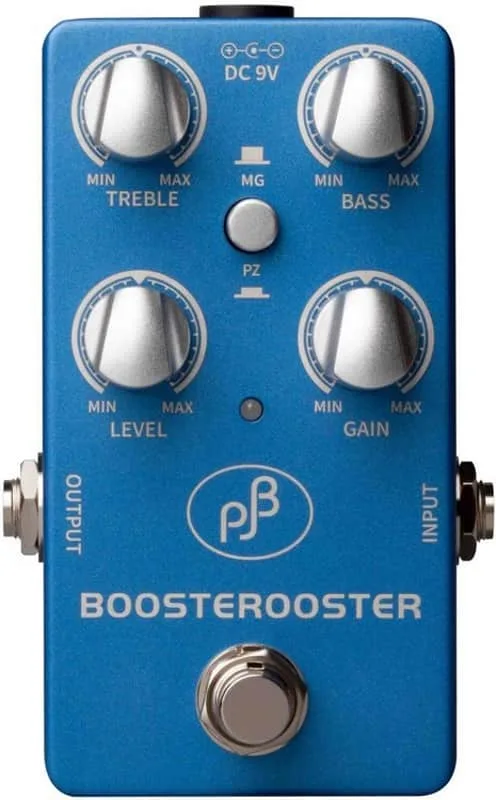


The Phil Jones Bass Boosterooster PE-2 is a compact preamp, EQ and clean boost pedal built for bass. Phil Jones Bass, a maker better known for bass amplification, introduced it in May 2026 as a precision two-band EQ, preamp and clean booster for electric and upright bass12. It packs up to +18dB of clean gain, which the maker says drives amplifiers into their optimal operating range, compensates for passive or low-output instruments, and maintains signal strength through long cable runs or complex pedalboards with no distortion, no compression and no coloration2.
Bass Magazine's reviewer, Jon D'Auria, summed up the idea behind it:
- Type: Preamp, two-band EQ and clean boost pedal for bass1
- Maker: Phil Jones Bass2
- List price: $159.99 (May 2026)1
- Bypass: True bypass1
- Power: 9 to 18V DC via external supply, no battery compartment2
- Gain range: −6 to +18dB1
- Input impedance: 2MΩ (MG) / 4.7MΩ (PZ)1
- Max input: 4V p-p1
- Dimensions: 60 x 112 x 52.5mm1
- Weight: 209g1
What it does for a player
The PE-2 is aimed at two jobs at once. As a clean boost, its +18dB of gain can push a passive bass or a quiet pickup up to the level an amplifier wants, without adding overdrive or compression24. As a preamp and EQ, it shapes tone at the fundamental frequencies that matter to bass, and Phil Jones Bass positions it for connecting to PAs, recording interfaces or unfamiliar backline, situations where you cannot predict what amp you will be playing through3.
The two-band EQ allows up to 12dB of cut or boost, which D'Auria found gives "a wide range of dynamics regardless of what bass you're playing"4.
The controls
The pedal carries four large knobs plus a switch4:
| Control | What it does |
|---|---|
| Gain | Sets gain from −6 to +18dB14 |
| Level | Sets the output level4 |
| Bass | ±12dB at 60Hz; targets true fundamentals, adding weight and authority without boom or speaker overload1 |
| Treble | ±12dB at 6kHz; adds clarity and articulation without harshness1 |
| MG/PZ switch | Selects a 2MΩ input for magnetic pickups or 4.7MΩ for piezo12 |
The EQ frequencies are worth noting for bass players. The bass band sits at 60Hz, in the region of a bass's low fundamentals, and the maker says it adds weight without boom or overloading the speaker. The treble band at 6kHz is about articulation and string definition rather than high-end sparkle1.
Magnetic and piezo inputs
The MG/PZ switch is the feature that sets the PE-2 apart from a generic boost pedal. D'Auria describes it as "one button that switches the unit from MG to P2, which shifts it from magnetic to piezo sources"4. Piezo pickups, common on upright bass, want a much higher input impedance than magnetic pickups to sound full. The 4.7MΩ piezo input extends effective bandwidth to approximately 30Hz, well below the 41Hz low E, which the maker says restores the full character of the instrument12.
That makes the pedal a practical choice for a player who moves between an electric bass and an upright with a piezo pickup, since one switch adapts the input to each13.
Power and size
The PE-2 uses 9 to 18V DC power via an external supply and has no battery compartment2. D'Auria's review unit ran on a 9V DC power cable4. Running it at the higher end of its voltage range is an option for players whose pedalboard supply offers more than 9V.
There is no battery compartment, so the PE-2 needs a powered pedalboard or a wall adapter. Plan a power lead for it before a gig.
It is a small box: 60 x 112 x 52.5mm, about 2 by 4.4 by 2.3 inches as D'Auria measured it, and 209g14.
What reviewers said
Bass Magazine's Jon D'Auria reviewed the PE-2 and framed it as portable tone shaping, calling it a preamp, booster and EQ that "gives you tone on the go"4. He noted the gain range of −6 to +18dB and the ±12dB of EQ cut or boost on each band, and his overall verdict was that the pedal preserves your sound whatever you plug into4.
Videos
Official Phil Jones Bass
Official Phil Jones Bass
Brittany Frompovich
Questions
Is the Boosterooster PE-2 true bypass?
Yes. Both the launch press release and Premier Guitar's news coverage describe the PE-2 as true bypass, so with the pedal off your signal passes through without active circuitry in the path.
Can I use the PE-2 with an upright bass piezo pickup?
Yes. The MG/PZ switch selects a 2MΩ input for magnetic pickups or a 4.7MΩ input for piezo. Phil Jones Bass says the 4.7MΩ piezo input extends effective bandwidth to approximately 30Hz, below the 41Hz low E, restoring the full character of the instrument.
Can the Boosterooster PE-2 run on a battery?
No. Premier Guitar reports the PE-2 uses 9 to 18V DC power via an external supply and has no battery compartment, so it needs a pedalboard power supply or a wall adapter.
Can I use the PE-2 as a preamp straight into a PA or audio interface?
Yes, that is one of its intended uses. Phil Jones Bass positions it for connecting to PAs, recording interfaces or unfamiliar backline, and Bass Magazine's reviewer found it lets you keep your tone regardless of what you are plugged into.
How big is the Phil Jones Bass PE-2?
The PE-2 measures 60 x 112 x 52.5mm, about 2 by 4.4 by 2.3 inches, and weighs 209g, so it fits easily on a small pedalboard.
Can the PE-2 BOOSTEROOSTER be used with an upright bass?
Yes. It was engineered specifically for electric and upright bass, and its piezo input mode with a 4.7MΩ impedance is aimed at the piezo pickups common on upright bass.
Sources (4)
- Phil Jones Bass Launches the BOOSTEROOSTER Model PE-2, Bass Magazine, 2026-05-27
- Phil Jones Bass Launches the Boosterooster PE-2 Pedal, Premier Guitar, 2026-05-28
- New Gear: PJB Boosterooster Pedal, Bass Musician Magazine, 2026-05-30
- Review: Phil Jones Bass PE-2 BOOSTEROOSTER, Bass Magazine, 2026-09-21