

The Pigtronix Class A Boost is a clean boost pedal from Pigtronix, released in 2011 with a list price of $1491. It is a compact preamp and booster built around a Class A J-FET design with a discrete transistor topology and no op-amps, and it can deliver up to 20 dB of clean boost23. Pigtronix described it as a high-performance guitar preamp that keeps your instrument's tone and expressive character intact, thanks to a flat frequency response from 20 Hz to 20 kHz2.
The idea is simple: one knob, one footswitch, and a lot of extra level. Premier Guitar's reviewer found it can be set to deliver a hefty 20 dB of extra push, and MusicRadar's Trevor Curwen called it a pedal you can kick in to get solos cutting through34.
What it does: a clean J-FET boost of up to 20 dB
The Class A Boost raises the level of whatever you feed it without changing its character. Pigtronix said it can boost passive or active pickups and even line level signals up to 20 dB without ever clipping, and its noise-free performance lets you place it anywhere in your pedal chain2. The maker also described what it does in a chain: it adds punch and extra output after a classic overdrive, pushes gain pedals into new levels of saturation, and adds sweetness and fat tone to a tube amp's front end without unwanted clipping or noise2.
The measured limits behind those claims, from Pigtronix's launch specifications1:
| Specification | Value |
|---|---|
| Gain range | 0 to 10.5 |
| Max input before overdrive clipping | 3.3V p-p |
| Max output before clipping | 8.0V p-p |
| Frequency response | 20 Hz to 20 kHz, flat2 |
That 3.3V p-p input limit is why the pedal handles active pickups and line level sources without breaking up on the way in12.
One knob: the Gain control
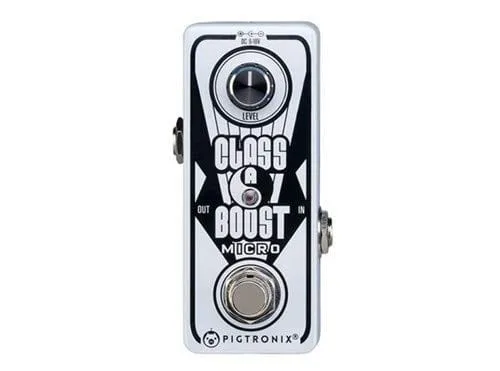
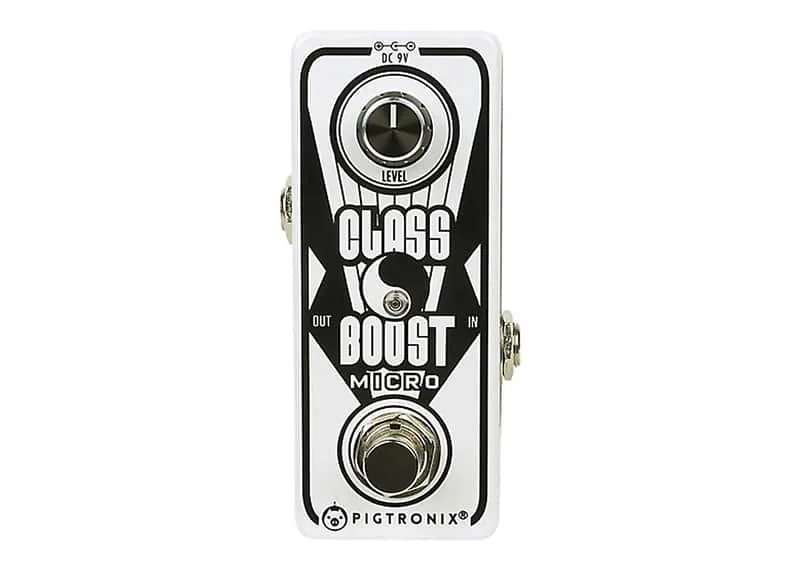
The control layout is as simple as a boost pedal gets. MusicRadar's Trevor Curwen noted it has just a single knob and one function, and that you can kick it in to get solos cutting through4. Pedal of the Day's Zac R described the single Gain knob as offering 20 dB of volume boost, with input and output jacks and a footswitch to engage the effect64.
| Control | What it does |
|---|---|
| Gain knob | Sets the boost level, up to 20 dB of volume boost64 |
| Footswitch | Kicks the pedal in and out4 |
The enclosure is painted in a tuxedo design, which Pedal of the Day said shows off its classiness6.
Power: 9V or 18V, and how each sounds
The Class A Boost does not accept batteries and can only be powered from either a 9V or 18V wall wart3. It originally came packed with an 18VDC 300mA power supply for maximum headroom15.
Premier Guitar's reviewer found the two voltages give it two personalities. With the 18V supply, the pedal has excellent headroom and great detail in the high end. Switching to a 9V supply softens and cuts the high end of the boosted tone, but also gives the pedal a lower, slightly fuzzy drive character at higher settings5. The reviewer's verdict summed it up:
"Pros: Great detail in the high end. Excellent headroom with 18V wall wart. Cons: Requires a power supply."
Because the pedal runs on wall wart power only, it needs a spot on your power supply, and the 18V supply it ships with takes up more pedalboard real estate than a standard 9V adapter3.
Where it came from
Pigtronix announced the Class A Boost in July 2011, available at Pigtronix dealers with a list price of $14912. The circuit was designed in conjunction with famed pedal designer Howard Davis, who designed legendary Electro-Harmonix pedals including the Electric Mistress and the Deluxe Memory Man, with sound design by David Koltai31.
The Class A Boost Micro
Pigtronix also makes the Class A Boost Micro, a smaller booster in the same family. It delivers the same up to 20 dB of clean boost and remains effective with both instrument and line level signals, and RockBoard's PedalPedia says it will fatten up and boost anything you feed it78. Unlike the original, the Micro runs on 9V DC, center negative78.
| Class A Boost | Class A Boost Micro | |
|---|---|---|
| Boost | Up to 20 dB34 | Up to 20 dB8 |
| Power | 9V or 18V wall wart, no battery3 | 9V DC, center negative7 |
| Inputs | Passive or active pickups, line level2 | Instrument and line level signals7 |
Videos
ProGuitarShopDemos
Pigtronix
Pigtronix
Questions
Does the Pigtronix Class A Boost take a battery?
No. Premier Guitar's reviewer noted the pedal doesn't accept batteries, and it can only be powered from either a 9V or 18V wall wart. It originally shipped with an 18VDC 300mA power supply in the box, so you need a power supply to run it.
Can the Class A Boost be used with active pickups?
Yes. Pigtronix's announcement said the device can boost passive or active pickups and even line level signals up to 20 dB without ever clipping. Its maximum input before overdrive clipping is 3.3V p-p, which covers the output of active pickups.
What is the difference between the Class A Boost and the Class A Boost Micro?
The Class A Boost is the original full-size pedal, released in 2011 with a $149 list price, powered at 9V or 18V. The Class A Boost Micro is a smaller booster that delivers the same up to 20 dB of clean boost and runs on 9V DC, center negative.
Does the Class A Boost use op-amps?
No. The circuit uses a discrete transistor topology with no op-amps, built around a Class A J-FET design. MusicRadar's Trevor Curwen described it as a compact preamp/booster based around a J-FET transistor.
Sources (8)
- Pigtronix Releases Class A Boost Pedal, No Treble, 2011-07-20
- Pigtronix Announces Release of Class A Boost, Guitar World, 2011-08-10
- Top Boost Pedals Reviewed: Lotus, Pigtronix, & More, Premier Guitar, 2012-02-08
- Pigtronix Class A Boost review, MusicRadar, 2012-01-11
- Top Boost Pedals Reviewed: Lotus, Pigtronix, Olympia, Premier Guitar, 2012-02-07
- Pigtronix Class A Boost, Pedal of the Day, 2015-07-20
- Class A Boost Micro by Pigtronix, RockBoard PedalPedia, 2026
- Class A Boost Micro (white) by Pigtronix, RockBoard PedalPedia, 2026