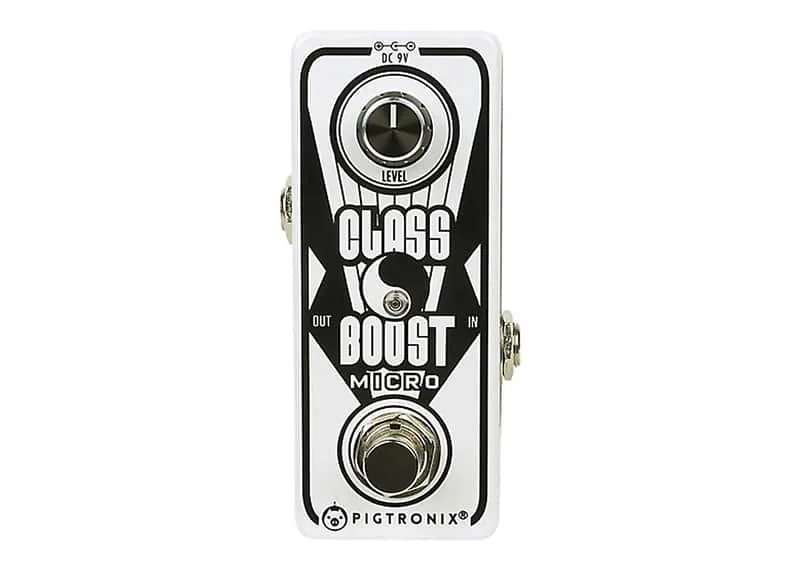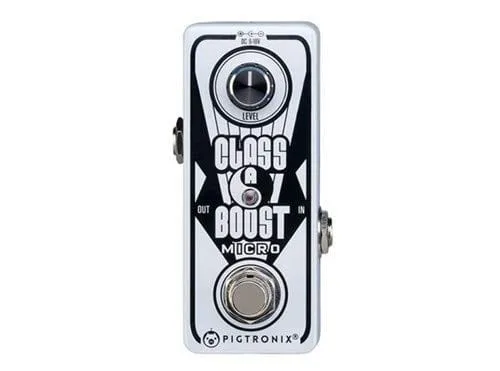


The Pigtronix Class A Boost Micro is a compact boost pedal from Pigtronix, the miniaturized version of the company's Class A Boost. It is a clean boost with a single control: one Gain knob offering up to 20dB of volume boost1. Pigtronix describes the design in plain terms:
"Class A Boost will fatten up and boost anything you feed it."
Pigtronix, maker product page2
The pedal achieves its clean boost using Class A FET transistors, which Pedal of the Day's reviewer said keep the boost "balanced and pure"1. MusicRadar's Trevor Curwen describes the full-size original as a compact preamp/booster based around a J-FET transistor3.
What it does to your sound
The Class A Boost Micro delivers up to 20dB of clean boost and, according to RockBoard's PedalPedia, remains effective with both instrument and line level signals4. That amount of gain has several practical uses:
- Kicking a solo above the band, which MusicRadar's reviewer described as "a pedal that you can kick in to get solos cutting through"3
- Adding punch and extra output to a classic overdrive sound4
- Pushing distortion pedals into aggressive crunch4
- Hitting the front end of a tube amp harder, which RockBoard's PedalPedia calls an ideal use for the pedal4
Premier Guitar's reviewer found the full-size Class A Boost could be set to deliver "a hefty 20dB of extra push"5, and noted it is voiced to act well with an overdriven amp or overdrive pedal5. If you are exploring what a boost can do compared with other gain pedals, see the site's pages on overdrive, distortion and fuzz.
Controls and connections
The layout is deliberately simple. The original's announcement described it as an elegant exterior and single-knob layout clothing a Class A J-FET design7:
| Control or jack | What it does |
|---|---|
| Gain knob | Offers 20dB of volume boost1 |
| Footswitch | One switch, kicks the boost in and out3 |
| Input and Output jacks | Standard instrument connections1 |
Where it goes in a pedal chain
A common question with any boost is placement, and here the Class A Boost is flexible. RockBoard's PedalPedia says its superior signal-to-noise performance allows you to put the Class A Boost anywhere in your pedal chain4. The 2011 announcement made the same claim, stating that its noise-free performance allows you to put the effect anywhere in your pedal chain7, and Premier Guitar's reviewer confirmed the noise floor is so low that it can be patched into the signal chain wherever desired5.
That flexibility means you can run it early in the chain to push overdrives and distortions harder, or late in the chain as a pure volume lift for solos435.
Power
The full-size Class A Boost does not accept batteries5. It shipped with an included 18VDC 300mA power supply, which No Treble listed among its specifications at launch6, and Premier Guitar noted it comes packed with an 18V power supply for maximum headroom8. MusicRadar's reviewer points out a practical trade-off: the pedal runs from a 9V PSU, and the 18V PSU takes up more pedalboard real estate3.
The full-size Class A Boost does not accept batteries5, so it needs a power supply on the board. It runs from a 9V PSU, with the included 18V supply offering maximum headroom at the cost of extra space38.
Micro versus full-size
The Class A Boost Micro is the compact version of the original Class A Boost6. The core function is the same: both are clean boost pedals that work with instrument and line level signals24. The Micro's advantage is board space, since the smaller enclosure leaves more room for other pedals on a crowded board3.
What reviewers said
Published reviewers have been positive about the full-size original. MusicRadar's verdict highlighted it as a transparent boost3. Premier Guitar's reviewer found it voiced to work well with an overdriven amp or overdrive pedal, with a noise floor low enough for placement anywhere in the chain5. Pedal of the Day's Zac R highlighted the Class A FET transistor design as what keeps the boost balanced and pure1.
"Transparent boost; compact; runs from 9V PSU."
Videos
Musician's Friend
famusictv
Whatever works, Works.
Questions
Can the Pigtronix Class A Boost be used with line level signals?
Yes. Pigtronix says the Class A Boost delivers up to 20dB of clean boost and remains effective with both instrument and line level signals. The original 2011 announcement also noted it can boost passive or active pickups and even line level signals up to 20dB without clipping.
Where should a clean boost go in a pedal chain?
Almost anywhere. Pigtronix says the Class A Boost's superior signal-to-noise performance lets you place it anywhere in your pedal chain, and reviewers noted its noise floor is low enough that it can be patched in wherever you want it. It is voiced to work well with an overdriven amp or overdrive pedal.
Does the Pigtronix Class A Boost run on 18V?
The full-size Class A Boost shipped with an included 18VDC 300mA power supply for maximum headroom, though MusicRadar notes it runs from a 9V PSU and that an 18V supply takes up more pedalboard space. It does not accept batteries.
Is the Class A Boost Micro different from the full-size Class A Boost?
The Micro is a smaller-format version of the same booster concept. Both deliver up to 20dB of clean boost and work with instrument and line level signals. The full-size original launched in 2011 with a $149 list price and an included 18V power supply.
Sources (8)
- Pigtronix Class A Boost, Pedal of the Day, 2015-07-20
- Class A Boost Micro by Pigtronix, RockBoard PedalPedia, 2026
- Pigtronix Class A Boost review, MusicRadar, 2012-01-11
- Class A Boost Micro (white) by Pigtronix, RockBoard PedalPedia, 2026
- Top Boost Pedals Reviewed: Lotus, Pigtronix, & More, Premier Guitar, 2012-02-08
- Pigtronix Releases Class A Boost Pedal, No Treble, 2011-07-20
- Pigtronix Announces Release of Class A Boost, Guitar World, 2011-08-10
- Top Boost Pedals Reviewed: Lotus, Pigtronix, Olympia, Premier Guitar, 2012-02-07