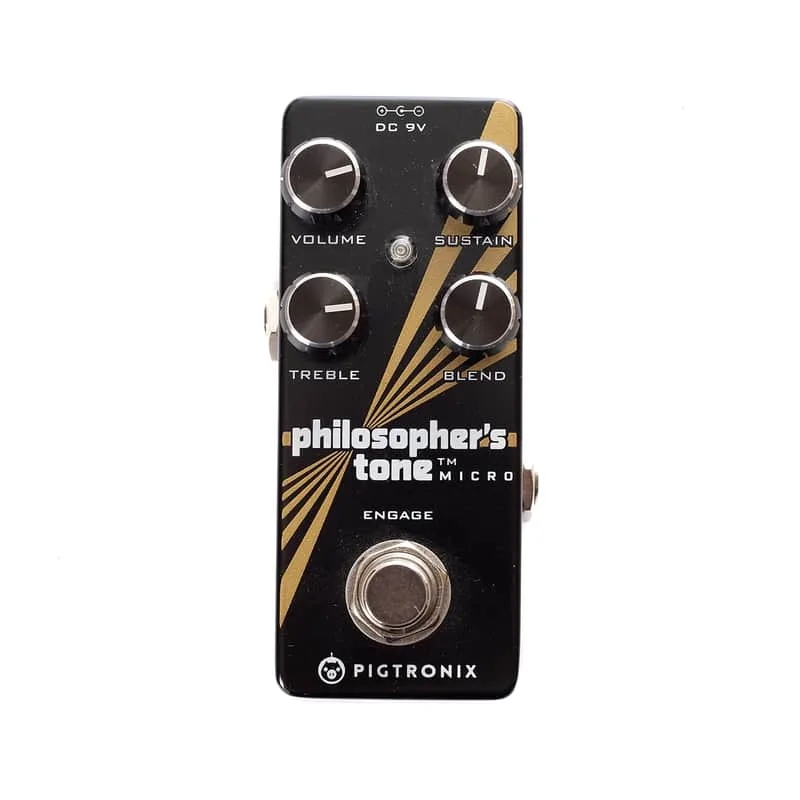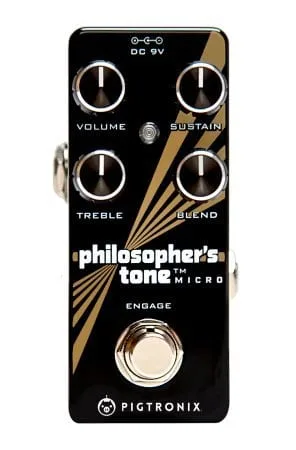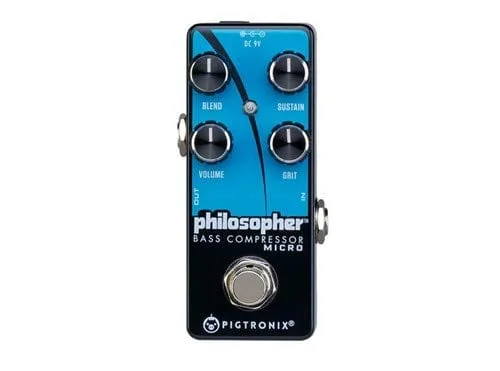


The Pigtronix Philosopher Bass Compressor Micro is a compact bass compressor pedal from Pigtronix that combines compression with an overdrive tone the maker describes as mighty1. Its key control is Blend, which determines the balance of clean-versus-effected tones, and blending some clean signal back in restores the instrument's natural string attack while adding punch and sustain23. A Grit control modulates the drive tone, moving from a smooth, synth-like fuzz to a doomy wail, and the whole thing fits in a micro enclosure measuring 3.75" x 1.5" x 1.75"23.
Although it is marketed primarily as a compressor, MusicRadar's review found its most prominent feature is the overdrive side of its character, calling it a "Super-useful, affordable compressor/overdrive"1. For a bassist, that means one small box can even out dynamics and add sustain while also serving as a source of drive.
What it does to your sound
The pedal is built on the Philosopher's Tone compressor circuit, which Pigtronix brought to bassists with the original Philosopher Bass Compressor in 2013, promising "infinite" sustain and a harmonic distortion "tuned especially for low frequency domination"4. The Micro carries that circuit forward in a smaller box2.
The compression itself is optical and analog. Bass Gear Magazine's review of the full-size pedal describes "high-quality analog, optical circuitry," and the Micro uses the same approach52. Optical compressors read the input signal with a light-dependent element rather than sensing it electrically, which many players find gives a smoother, more musical response.
The BLEND knob is central to how the pedal works on bass: it lets your clean signal be heard in parallel with the compressed signal. As Guitar Interactive Magazine put it when the Micro launched213:
"Blending some clean signal into the mix restores the instrument's natural string attack, while simultaneously providing the musical benefits of additional punch and sustain."2
That parallel approach is what keeps a compressed bass from losing its pick or finger attack, a common complaint with fully wet compression2.
The controls: sustain, grit, volume and blend
The Micro has four controls. MusicRadar's review walks through what each one does1:
| Control | What it does |
|---|---|
| Sustain | Varies the compression threshold, from subtle peak limiting to infinite clean sustain21 |
| Grit | The distortion, tuned "especially for low-frequency domination"1 |
| Volume | Sets the level of the effected overdrive tone1 |
| Blend | Determines the balance of clean-versus-effected tones1 |
MusicRadar found the Sustain control "does a great job of varying the effect threshold and limiting (or delimiting) the peaks and spikes caused by your playing, while keeping the bottom end intact"1. The Grit control earned particular praise: the reviewer found you can modulate the drive tone effortlessly, "moving from a smooth, synth-like fuzz to a doomy wail"1. Blend is described as the key control, since it governs how much of your untouched tone sits under the compressed and driven signal1.
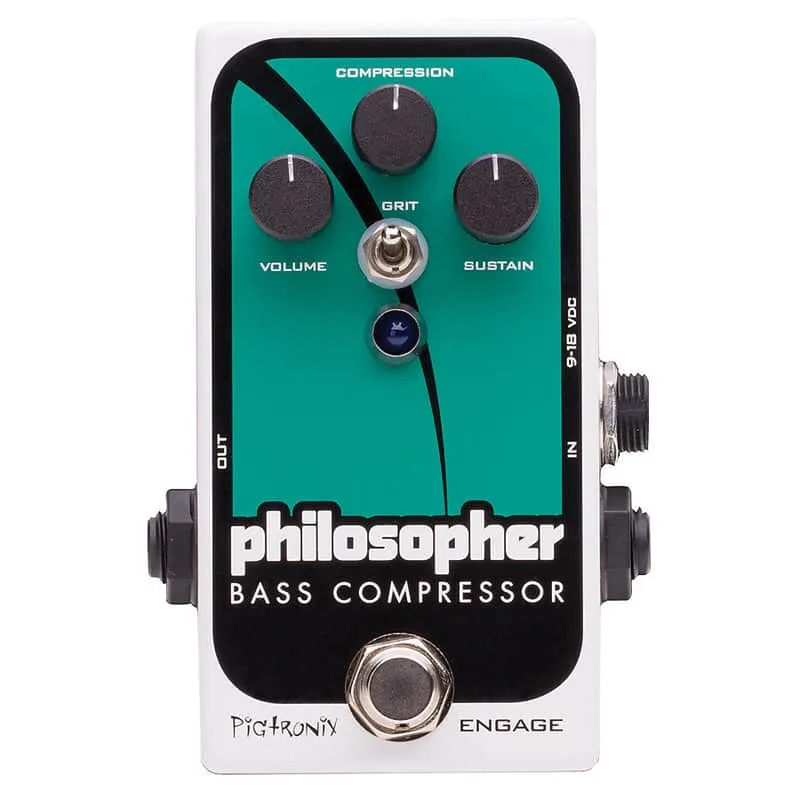
The full-size Philosopher Bass Compressor handled grit differently, with a toggle switch for harmonic grind rather than a knob, alongside volume, compression and sustain controls63. Bass Musician Magazine's Ty Campbell described that switch as giving "a subtle distortion"6.
Power: 9V doubled to 18V rails
The Micro runs on standard 9VDC external power, but an internal voltage-doubling circuit provides 18VDC power rails, which Pigtronix describes as delivering superior performance2. MusicRadar's review frames the benefit in practical terms: "there's an internal voltage-doubling circuit that gives you and your active bass 18 volts of DC"1. Higher internal rail voltages give a circuit more headroom, which matters for the hot output of active basses.
The full-size pedal took a different route: it accepts 9 to 18VDC, and shipped with an 18VDC 300mA supply included73. Pedal of the Day's reviewer noted it "can run on either 9v or 18v for more headroom"3. With the Micro, you get the 18V rails from an ordinary 9V supply instead.
The Micro's voltage doubling happens inside the pedal. You feed it standard 9VDC; you do not need an 18V supply as you optionally would with the full-size Philosopher Bass Compressor27.
From the Philosopher's Tone to the Micro
The circuit's family tree runs through several steps. Pigtronix's original Philosopher's Tone was the company's flagship compressor. In 2016 the company announced the Philosopher's Tone Micro, a miniature, 1590A-sized version with true-bypass switching, volume and sustain controls87. Gearnews reported it as "a new miniature version of their popular compressor pedal"9.
Independent technical analysis by Aion FX, which traced the Philosopher's Tone Micro circuit, found two changes that matter to bass players: a charge pump was added so the pedal could run on a standard 9V adapter, and an adjacent coupling capacitor was raised from 560n to 1uF. As Aion FX explains, "The capacitor increase would cause it to pass more low frequencies to the compressor portion, which makes the circuit more suitable for bass guitar"7. That low-frequency pass-through is the technical basis for the bass-specific versions.
The Philosopher Bass Compressor itself debuted at Winter NAMM 2013, alongside the Bass FAT Drive and the Bass Envelope Phaser, as Pigtronix's first bass effects pedals4. The Philosopher Bass Compressor Micro followed in June 2018, compressing the bass compressor into the micro format2.
What reviewers said
Reviews of the family have been positive across the board. Pedal of the Day's Jay Y called the full-size Philosopher Bass Compressor "a compressor specifically tuned to the lower frequencies of a bass that is quiet, easy to use, and affordable," with "a great compression circuit that responds very well to the lower frequencies of a bass signal"310. He reported keeping one on his board for about a year10.
Bass Musician Magazine's Ty Campbell reviewed the full-size pedal after using it on a small club gig and an outdoor festival, noting its grit function and 9V/18V power options63. Pedal of the Day's reviewer also uses the pedal at churches, mostly with passive basses3.
On the Micro itself, MusicRadar's verdict was concise:
"Super-useful, affordable compressor/overdrive."1
The same review noted the true-bypass switching "ensures that the unit doesn't muddy up your tone when you're going straight through it," and that the pedal "doesn't cost a crippling amount"1.
Videos
Premier Guitar
Sweetwater
Pigtronix
Questions
Does the Philosopher Bass Compressor Micro work with active basses?
Yes. The pedal runs on standard 9VDC power but uses an internal voltage-doubling circuit that provides 18VDC power rails, which Pigtronix describes as giving superior performance with active basses. MusicRadar's review notes the 18 volts of DC is there for you and your active bass.
Is the Pigtronix Philosopher Bass Micro true bypass?
Yes. MusicRadar's review of the Philosopher Bass Compressor Micro reports true-bypass switching, which keeps the unit from muddying your tone when you are going straight through it. The larger Philosopher Bass Compressor and the Philosopher's Tone Micro are also reported as true bypass.
Is the Philosopher Bass Compressor Micro analog?
Yes. Guitar Interactive Magazine describes it as a wide-range analog compression circuit with unrivaled sustain and parallel blend. The larger Philosopher Bass Compressor it is based on uses high-quality analog, optical circuitry, according to Bass Gear Magazine's review.
Where is the Pigtronix Philosopher Bass Micro made?
MusicRadar's review describes the Philosopher Bass Compressor Micro as a US-made pedal. The larger Philosopher Bass Compressor is likewise listed as made in the USA in Bass Gear Magazine's quick look at Pigtronix's bass pedal line.
What is the difference between the Philosopher Bass Compressor and the Micro?
The Micro is a smaller version of the Philosopher Bass Compressor, measuring 3.75 by 1.5 by 1.75 inches, built around the same Philosopher's Tone compressor circuit. The full-size pedal runs on 9V or 18V and shipped with an 18VDC 300mA supply, while the Micro takes standard 9VDC and doubles it internally to 18V rails.
Sources (10)
- Pigtronix Philosopher Bass Compressor Micro review, MusicRadar, 2019-03-05
- Pigtronix Compresses Bass Compressor into a Micro Pedal, Guitar Interactive Magazine, 2018-06-26
- Pigtronix Philosopher Bass Compressor, Pedal of the Day, 2015-06-19
- Pigtronix Debuts Bass Pedal Line, Premier Guitar, 2013-01-15
- Quick Look, Bass Gear Magazine, 2019-05-13
- Pigtronix Philosopher Bass Compressor Review, Bass Musician Magazine, 2014-09-10
- Tracing Journal: Pigtronix Philosopher’s Tone Micro, Aion FX, 2025-03-28
- Pigtronix Unveils the Philosopher's Tone Micro, Premier Guitar, 2016-06-25
- Summer NAMM 2016: Pigtronix Philospher's Tone Micro, gearnews.com, 2016-06-28
- Pigtronix Bass FAT Drive, Pedal of the Day, 2015-10-16