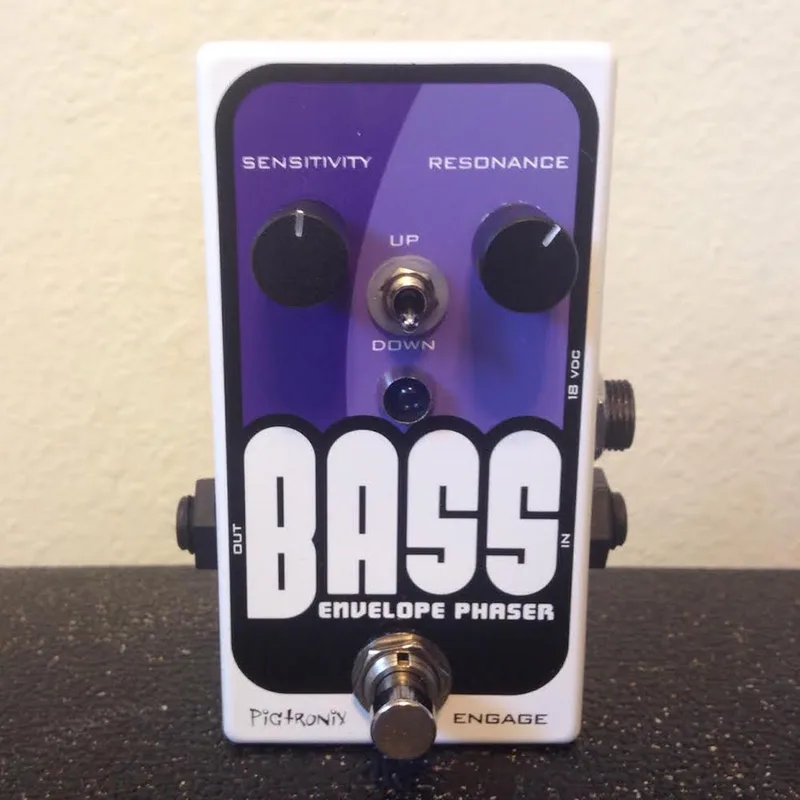


The Pigtronix Philosopher Bass Compressor is an analog optical compressor pedal made for bass, introduced by Pigtronix at Winter NAMM 2013 as one of the company's first bass effects pedals, alongside the Bass Fat Drive and the Bass Envelope Phaser12. It carries the Philosopher's Tone compressor circuit, retuned for the lower frequencies of a bass signal, and adds a blend control for parallel compression plus a grit stage voiced for low-end domination1.
Reviewers have described it as a compressor specifically tuned to bass frequencies that is quiet, easy to use, and affordable3. Bass Gear Magazine's Lonnie NaVeau called it the most consistently useful of the three Pigtronix bass pedals, one that could be used at every gig4.
What it is and what it does
The Philosopher Bass Compressor is one of Pigtronix's first bass effects pedals, announced at Winter NAMM 201312. It brings the Philosopher's Tone compressor circuit to bassists, with what Premier Guitar's press release described as infinite clean sustain, a blend knob for preserving natural string attack via parallel compression, and a harmonic distortion tuned especially for low-frequency domination1.
Bass Gear Magazine describes the compressor as having high-quality analog, optical circuitry4. Optical compression uses a light-dependent element to control gain reduction, which many players value for its smooth, gradual response compared with VCA or FET designs.
The pedal is compact, about the size of an MXR pedal3, and was designed by a named team: circuit design by Howard Davis and sound design by David Koltai3. During development, Pigtronix brought in Long Island bassist Danny Miranda, whose credits include Queen, Meatloaf and Blue Oyster Cult, to test a few different versions of the pedal4.
The controls
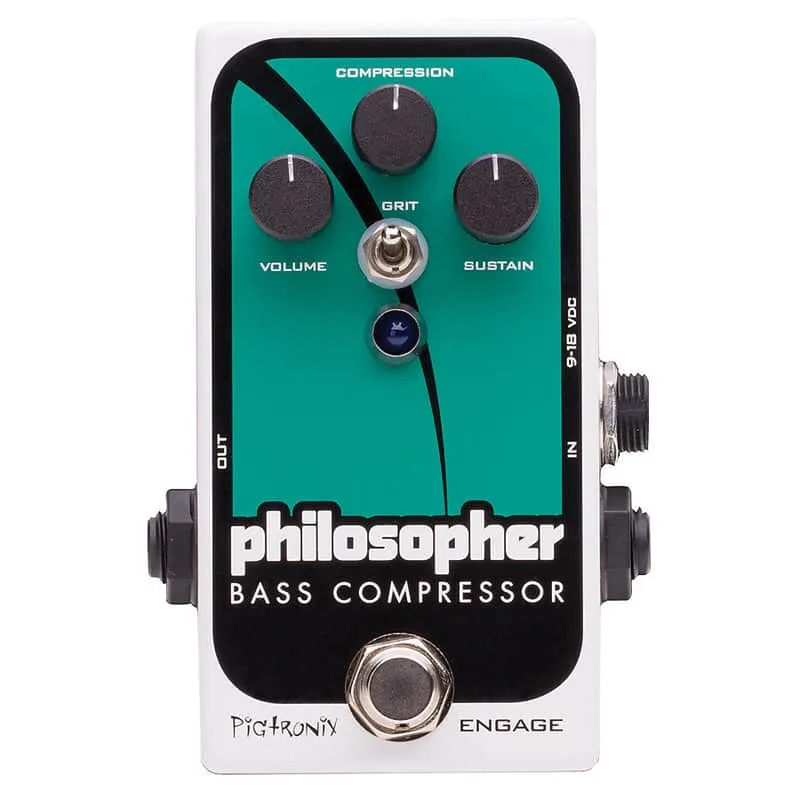
The original pedal keeps things simple, with three knobs and a switch:
| Control | What it does |
|---|---|
| Sustain | Controls the threshold at which compression begins to kick in4 |
| Compression | A blend between the clean attack of your signal and the compressed signal4 |
| Volume | The main output level, or gain, of the pedal4 |
| Grit switch | Preset grit, a very mellow tube-like tone, with no knob to control the level of grit4 |
The Compression knob is the parallel-compression control: rather than setting a ratio, it mixes your clean, uncompressed attack with the compressed signal, so the front of each note stays articulate while the sustain is smoothed out4. Bass Musician Magazine's Ty Campbell described it the same way, as a blend of dry signal and compression5.
The grit stage is fixed rather than adjustable. Bass Gear Magazine's reviewer found it gives a very mellow tube-like tone, similar to an old Jack Bruce tone, without taking low end out4.
Power: 9V or 18V
The pedal accepts 9 to 18VDC through a negative-tip adapter input, and running it at 18V gives more headroom34. Pedal of the Day reported that an 18VDC 300mA supply was included with the pedal3. There is no battery power option4.
Because the pedal has no battery compartment and uses a negative-tip barrel input, it needs an external power supply or an isolated pedalboard supply4.
The Micro version
The Pigtronix Philosopher Bass Compressor itself is a compact pedal, about the size of an MXR pedal, measuring 4.4" L x 2.4" W x 1" H4. Its circuit design is by Howard Davis, with sound design by David Koltai3. It carries a list price of $209, with a street price of $169, and is made in the USA with a 1 year warranty4.
The Micro's controls differ slightly from the original:
| Control | What it does |
|---|---|
| SUSTAIN | Varies the compression threshold, from subtle peak limiting to infinite clean sustain6 |
| BLEND | Lets the clean sound of your instrument be heard in parallel with the optical compression6 |
| GRIT | Blends in a harmonic distortion tuned especially for low-frequency domination1 |
On the Micro, grit becomes a knob rather than a preset switch, so the level of distortion is adjustable4. MusicRadar reviewed the Micro as a "super-useful, affordable compressor/overdrive," and found the Sustain control does a great job of varying the effect threshold and limiting the peaks and spikes while keeping the bottom end intact7.
How it relates to the Philosopher's Tone
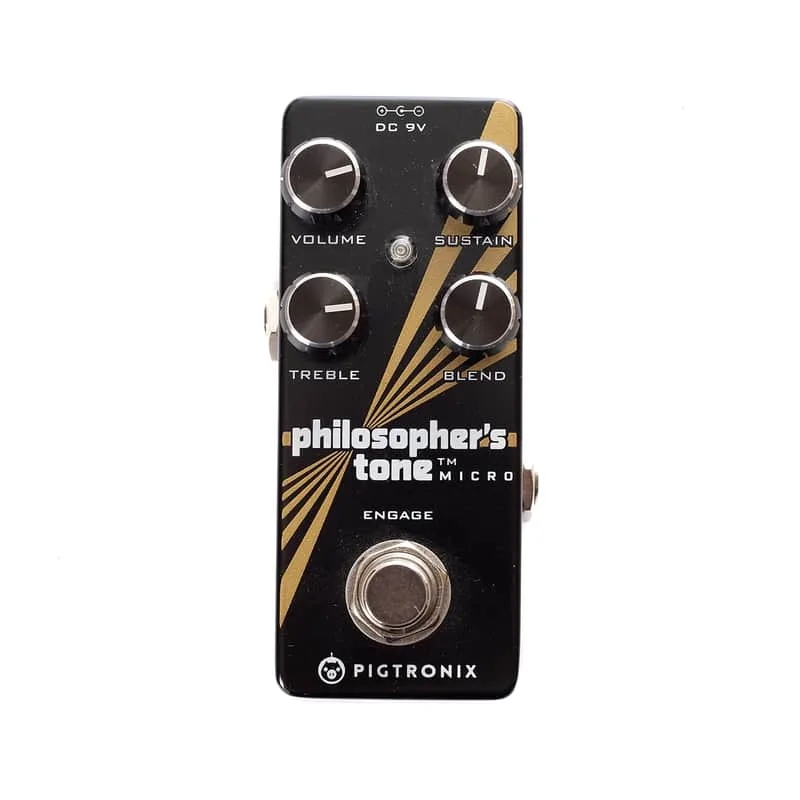
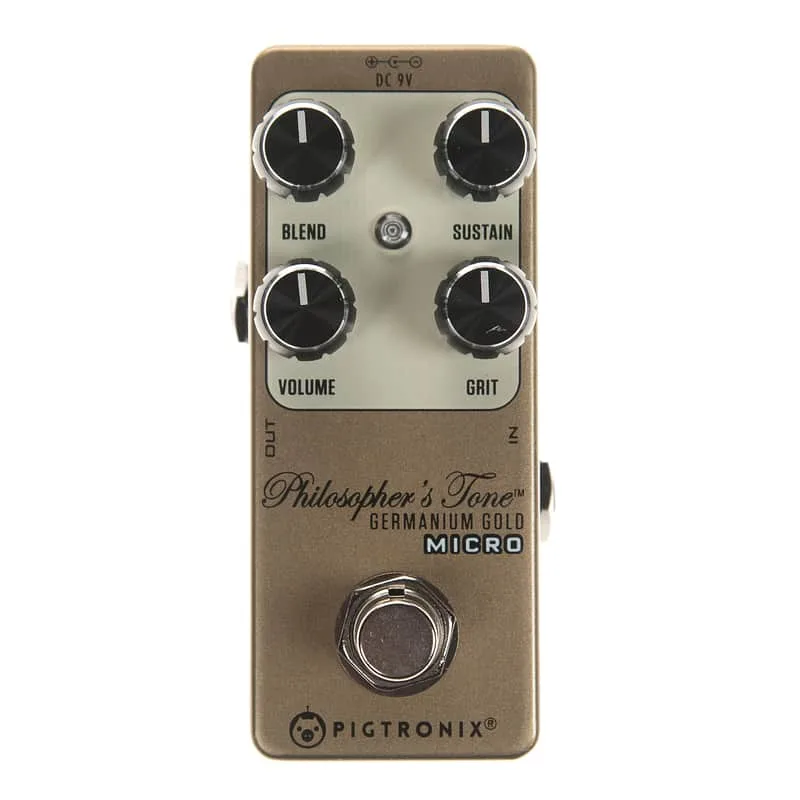
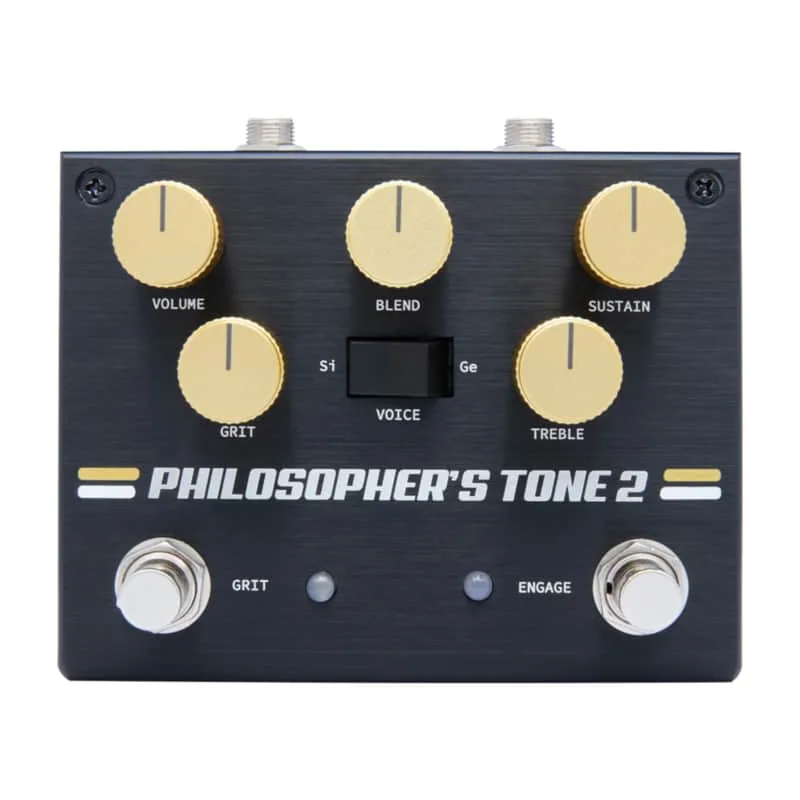
The Philosopher Bass Compressor is the bass-specific version of Pigtronix's Philosopher's Tone compressor, using the same optical circuit but tuned for low frequencies and fitted with a blend control and a bass-voiced grit stage1. Pigtronix has since extended the Philosopher line with the Philosopher's Tone Micro, the Germanium Gold Micro and the Philosopher's Tone 2, which adds a footswitchable grit channel of its own.
What reviewers said
Published reviewers were positive across the board:
- Bass Gear Magazine's Lonnie NaVeau called it "one of the easier to use compressors that was actually useful in a live setting," and her favorite of the three Pigtronix bass pedals, "the most consistently useful," usable at every gig4.
- Pedal of the Day's Jay Y, who kept it on his board for about a year and used it at churches, mostly with passive basses kept at 18V, praised "a great compression circuit that responds very well to the lower frequencies of a bass signal"38.
- MusicRadar's review of the Micro called it a "super-useful, affordable compressor/overdrive"7.
Bass Gear Magazine's Lonnie NaVeau found the Philosopher Bass Compressor to be one of the easier to use compressors that was actually useful in a live setting4.
Videos
Premier Guitar
Sweetwater
Pigtronix
Questions
Does the Pigtronix Philosopher Bass Compressor take a battery?
No. Bass Gear Magazine's review notes that the pedal has no battery power option, so it runs from an external 9 to 18VDC adapter with a negative-tip barrel input. Pedal of the Day reported that an 18VDC 300mA supply was included with the pedal.
Is the Philosopher Bass Compressor true bypass?
Yes. Bass Gear Magazine lists true bypass switching among the pedal's additional features, and Guitar Interactive Magazine reports the same true-bypass switching on the later Micro version.
Is the Philosopher Bass Compressor optical?
Yes. Bass Gear Magazine describes it as having high-quality analog, optical circuitry. The pedal carries the Philosopher's Tone optical compressor circuit, retuned for the lower frequencies of a bass signal.
What is the difference between Philosopher's Tone and Philosopher Bass Compressor?
The Philosopher Bass Compressor takes the Philosopher's Tone compressor circuit and tunes it for bass, adding a blend control for parallel compression and a grit stage voiced for low frequencies. The original Philosopher's Tone is the guitar compressor the bass version is based on.
Sources (8)
- Pigtronix Debuts Bass Pedal Line, Premier Guitar, 2013-01-15
- NAMM '13: Best Pigtronix Bass Pedals Review, Premier Guitar, 2013-01-26
- Pigtronix Philosopher Bass Compressor, Pedal of the Day, 2015-06-19
- Quick Look, Bass Gear Magazine, 2019-05-13
- Pigtronix Philosopher Bass Compressor Review, Bass Musician Magazine, 2014-09-10
- Pigtronix Compresses Bass Compressor into a Micro Pedal, Guitar Interactive Magazine, 2018-06-26
- Pigtronix Philosopher Bass Compressor Micro review, MusicRadar, 2019-03-05
- Pigtronix Bass FAT Drive, Pedal of the Day, 2015-10-16