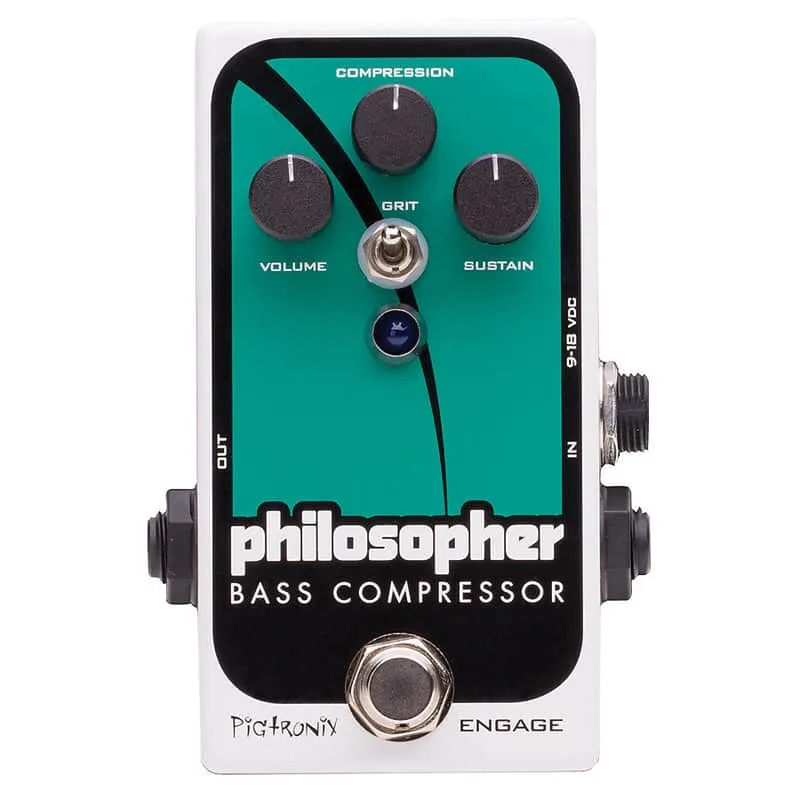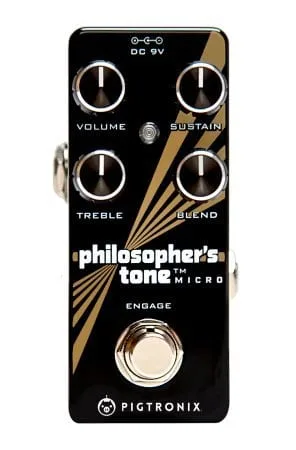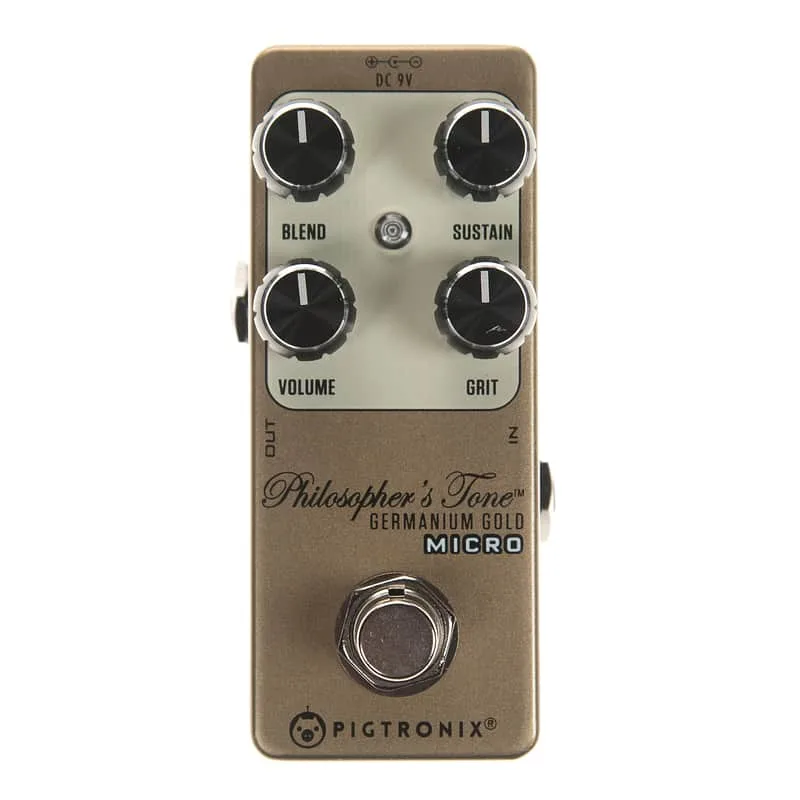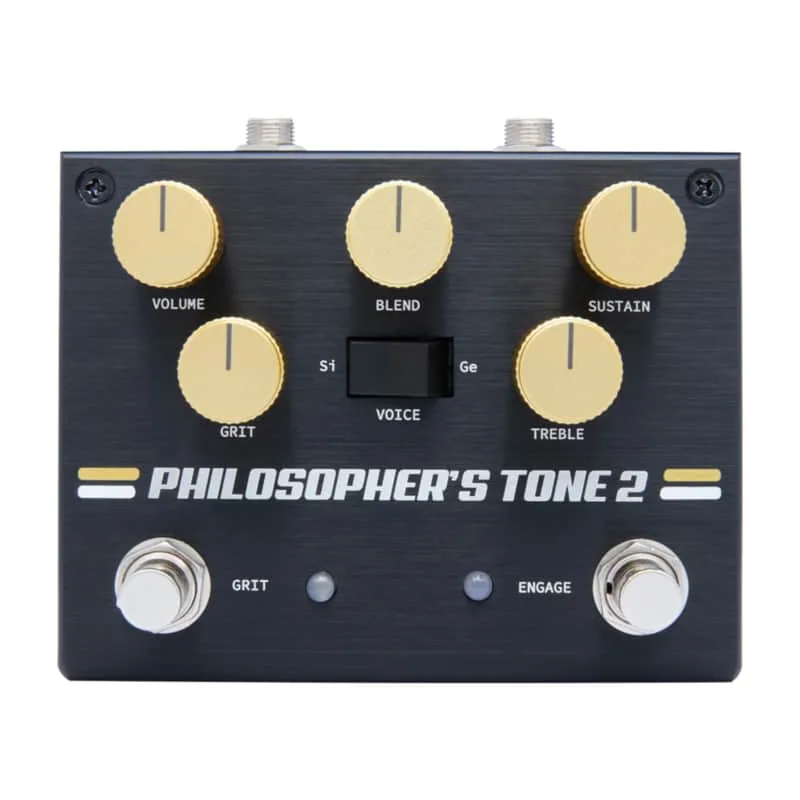


The Pigtronix Philosopher's Tone is an analog compressor and sustainer pedal, a vactrol-based compressor and overdrive first released in 2009 and designed by Howard Davis1. What set it apart from most compressor pedals of its era is its parallel design: the compressed signal sits alongside your untouched dry signal, and a Blend knob lets you mix the two, so you can add sustain without losing the snap and dynamics of your original tone23.
Pigtronix built the pedal around optical compression, using a vactrol (a light element and a light-sensitive resistor in one package) as the gain-control element rather than the chip-based voltage-controlled amplifiers in many studio-style pedals1. Premier Guitar's demo from the 2009 NY Amp Show described it simply as "an analog compressor and sustainer"2, and the pedal went on to be described in Pigtronix press material as award-winning and top-selling4.
What it does: parallel optical compression with clean sustain
The core idea of the Philosopher's Tone is clean sustain. Pigtronix's own description, quoted in the press release for the Micro version, calls it famous for "noiseless clean sustain" and says it "stands out as a uniquely powerful guitar effect"7. Because the compressor works on a parallel path, the effect can push a note into long sustain while your dry signal keeps its attack, which is what the Blend knob controls.
MusicRadar's Trevor Curwen, reviewing the original, found it useful in two very different jobs: it "can tighten up dynamics for arpeggiated chords or country picking as well as delivering a shedload of clean sustain," and he noted the pedal also offers "smooth diode clipping distortion on tap"5. That distortion side is the overdrive half of the circuit, and it became the seed for several later versions of the pedal.
"Compression and distortion in one pedal? We'll certainly have some of that. A versatile addition to any pedalboard."
The controls
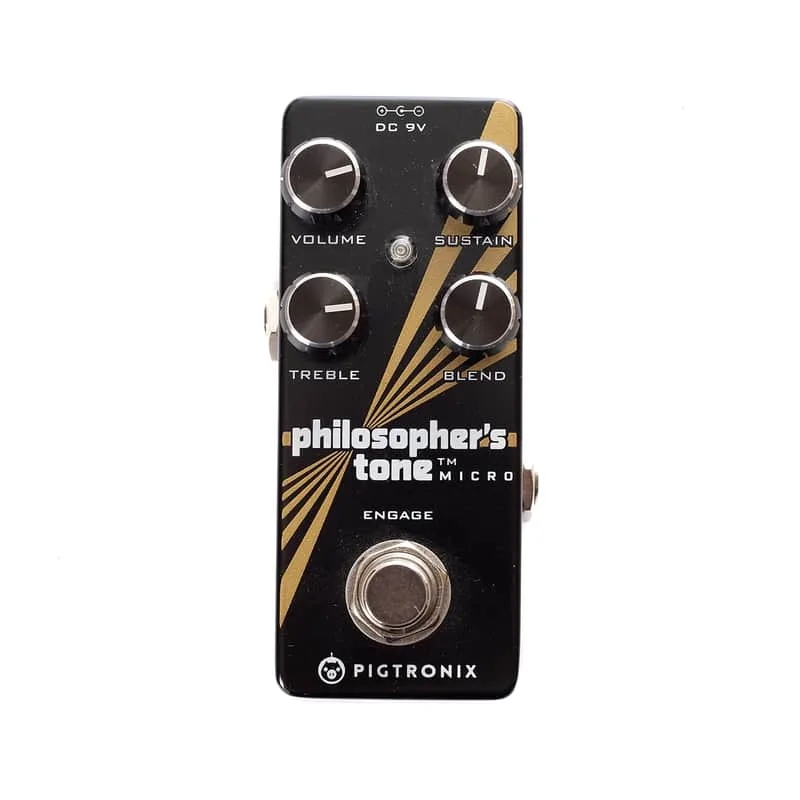
The original pedal carries five knobs and a bright LED indicator6. Across the Philosopher's Tone family, the control set stays consistent:
| Control | What it does |
|---|---|
| Sustain | Sets the amount of compression8 |
| Volume | Sets overall output level9 |
| Blend | Mixes your dry signal with the compressed signal, from a little parallel compression up to fully compressed310 |
| Treble | Cut or boost at 2kHz, up to 6dB, for fine-tuning the top end5 |
The Blend knob is the one that defines the pedal. Pigtronix's own artist page explains that it "allows you to mix your original tone with the compressed sound, making even the mos[t] extreme settings" usable3. MusicRadar's review of the Micro put the same idea in player's terms: the Blend knob "means you can add in gradual amounts of compression in parallel with your dry signal, right up to a fully compressed signal"10. Guitar World's mini-pedal buying guide listed the Micro's blend control for parallel compression and its treble EQ among the pedal's strengths, along with noiseless clean sustain, and observed that it doesn't get as "squashy" as some compressors11.
The manual takes an unusual approach for a pedal: Delicious Audio's review noted that it "describe[s] the philosophy behind the pedals, provide[s] starting point settings which are quite useful"6.
History and versions
The Philosopher's Tone line grew into one of Pigtronix's most revised pedals, with the original 2009 vactrol-based compressor & overdrive followed by later editions such as the Philosopher's Tone Micro, released August 1, 201617.
Philosopher's Rock and Philosopher's Bass
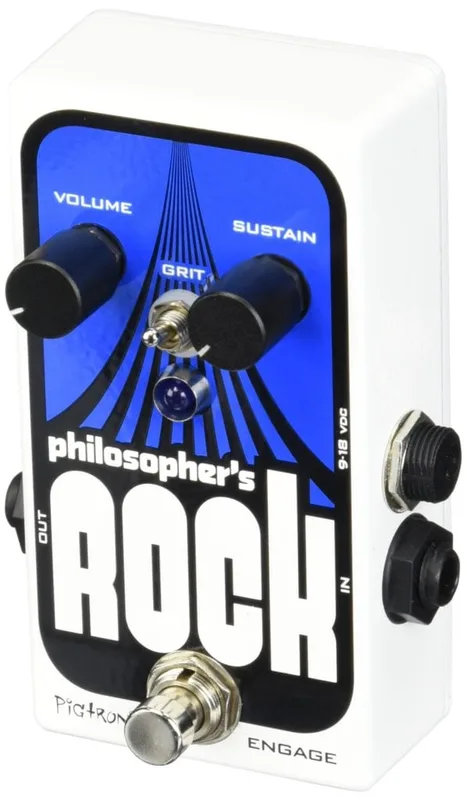
The Philosopher's Rock is a simpler version of the Philosopher's Tone that emphasized the overdrive component112. Pedal of the Day called it "a simpler version of another Pigtronix classic, the Philosopher's Tone"13, and Premier Guitar's review noted that "Volume and sustain controls remain, however" from the original12. Aion FX also records a Philosopher's Bass variant, "which was tuned for bass frequencies," both versions replacing the original in the lineup1.
Philosopher's Tone Micro (2016)
Available as of August 1, 2016, the Philosopher's Tone Micro condensed the Philosopher's Tone, the vactrol-based compressor and overdrive Pigtronix first released in 2009, into a smaller enclosure71415. Pigtronix described the original as its award-winning and top-selling compressor4. Aion FX traced the circuit and found a gain resistor, labeled R7 in the SMD 1590B version, marked "6802", which is 68k, on a unit dated around 2011 to 201215.
Germanium Gold Micro (2018)
The Philosopher's Tone Germanium Gold Micro is another compact version of the Philosopher's Tone, the vactrol-based compressor and overdrive first released in 200921. Like the original, it carries a Blend knob that lets a player mix their original tone with the compressed sound83. MusicRadar's reviewer called the Philosopher's Tone "a versatile addition to any pedalboard"5, and Guitar.com's Richard Purvis also reviewed it5.
Philosopher's Tone 2 (2024)
The Philosopher's Tone 2 is a second-generation version of the Philosopher's Tone, the vactrol-based compressor and overdrive Pigtronix first released in 20097116. Its Blend knob allows the player to mix the original, uncompressed tone with the compressed sound31718. Reviewers have found the Philosopher's Tone a versatile pedal, with MusicRadar calling it "a versatile addition to any pedalboard"5. ===
What reviewers said
MusicRadar's review of the original praised its versatility, calling it "a versatile addition to any pedalboard" and noting that its horizontal layout helps with pedalboard positioning5. Guitar World's mini-pedal guide highlighted the Micro's noiseless clean sustain, parallel blend control and treble EQ11. For the Germanium Gold Micro, Guitar.com's verdict was 9/1019, and MusicRadar's review credited the Blend knob for letting you set a mix of dry and compressed sound8.
The original Philosopher's Tone was replaced in the lineup by the Philosopher's Rock and Philosopher's Bass, and the line continues today through the Micro, Germanium Gold Micro and Philosopher's Tone 2 versions1720.
Videos
ProGuitarShopDemos
Pete Thorn
Pigtronix
Questions
Who designed the Pigtronix Philosopher's Tone?
The Philosopher's Tone was designed by Howard Davis for Pigtronix. It is a vactrol-based compressor and overdrive, first released in 2009. The vactrol, a light-sensitive component, is what gives the pedal its optical compression character.
Is the Philosopher's Tone Micro the same circuit as the original?
Very nearly. Aion FX traced the Micro, a 1590A-sized enclosure, and found it pretty well identical to the original Philosopher's Tone overall. The one difference the trace found was a gain resistor valued at 68k rather than the 6k8 shown in an earlier trace of the original, and Pigtronix had been using 68k within a year or two of the original release.
What is the difference between Philosopher's Tone and Philosopher's Rock?
The Philosopher's Rock is a simpler version of the Philosopher's Tone that emphasized the overdrive component. Volume and sustain controls remain, but the Rock drops other features of the original. Aion FX also notes a Philosopher's Bass variant, tuned for bass frequencies, that likewise replaced the original.
Is the Philosopher's Tone analog?
Yes. Premier Guitar described the Philosopher's Tone as an analog compressor and sustainer, and Pigtronix's press material for the Micro called it futuristic analog technology. The Philosopher's Tone 2 keeps the optical compression approach of the original.
What does the Blend knob do on the Philosopher's Tone?
The Blend knob mixes your original dry tone with the compressed signal. Because the compression runs in parallel, you can add gradual amounts of compression on top of your untouched sound, right up to a fully compressed signal. Pigtronix says this lets even extreme settings keep the character of your original tone.
Sources (20)
- Polyphemus Optical Compressor / Pigtronix Philosopher’s Tone, Aion FX, 2023-07-03
- NY Amp Show '09-Pigtronix Philosopher's Tone Demo, Premier Guitar, 2009-06-28
- Artists - Pigtronix, Pigtronix, 2023-10-12
- Philosopher’s Tone Germanium Gold Micro by Pigtronix, Premier Guitar, 2018-04-23
- Pigtronix Philosopher's Tone review, MusicRadar, 2012-01-11
- Pigtronix Philosopher's Tone & Aria Disnortion Reviews, Delicious Audio, 2010-06-28
- Pigtronix Unveils the Philosopher's Tone Micro, Premier Guitar, 2016-06-25
- Pigtronix Philosopher's Tone Germanium Gold Micro review, MusicRadar, 2018-08-03
- NAMM 2024: Pigtronix unveils the revamped the Philosopher's Tone 2, an optical compressor with a switchable Si/Ge drive and blend control to take you to “a new plane of tonal enlightenment”, MusicRadar, 2024-01-30
- Pigtronix Philosopher's Tone Micro review, MusicRadar, 2017-05-23
- Best mini-pedals for guitarists: top space-saving stomps, Guitar World, 2020-09-25
- Pigtronix Philosopher's Rock Pedal Review, Premier Guitar, 2012-09-05
- Pigtronix Philosopher's Rock Compressor/Sustainer, Pedal of the Day (pedal-of-the-day.com), 2014-05-10
- Summer NAMM 2016: Pigtronix Philosopher's Tone Micro promises miniaturised compression alchemy, MusicRadar, 2016-06-30
- Tracing Journal: Pigtronix Philosopher’s Tone Micro, Aion FX, 2025-03-28
- Pigtronix Disnortion Micro review, MusicRadar, 2017-08-27
- Pigtronix, Pigtronix
- Pigtronix, Pigtronix
- Review: Pigtronix Philosopher's Tone Germanium Gold Micro, Bob Weir's Real Deal & Ringmaster, Guitar.com, 2019-01-10
- NAMM 2024: “This pedal facilitates an alchemical dance”: Pigtronix's Philosopher's Tone 2 is the sequel that looks set to top the original, Guitar World, 2024-01-30