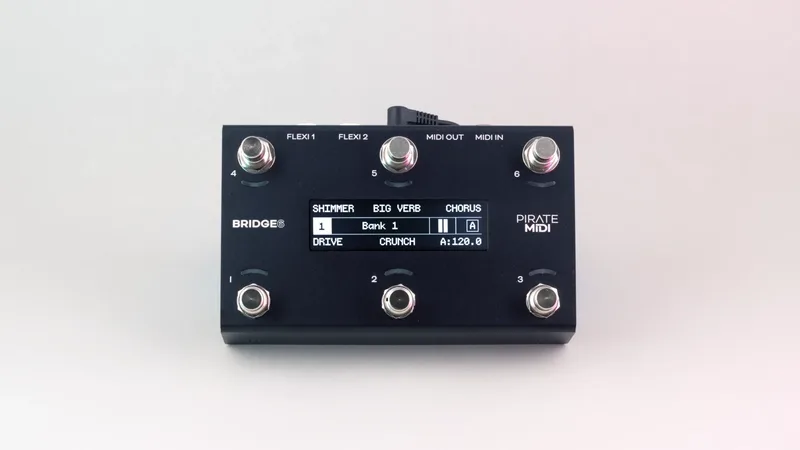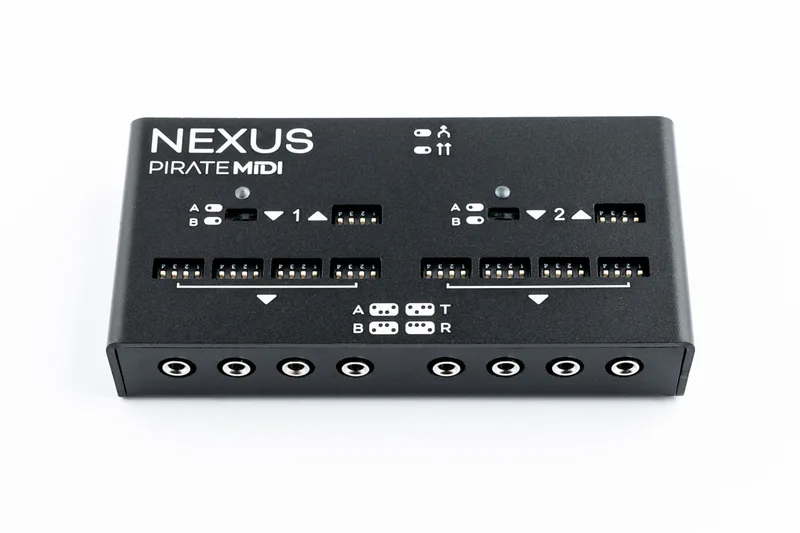

The PIRATE MIDI CLiCK v2 is a small box that turns MIDI into real-world switching: the maker describes it as a USB MIDI interface, dual relay switcher, and MIDI-to-expression converter1. For a player, that means a MIDI controller or computer can do jobs that normally need a footswitch plugged straight into an amp, such as changing channels or hitting a tap tempo jack. It sits in the wider family of MIDI pedals and switching pedals, alongside PIRATE MIDI's larger controllers like the PIRATE MIDI BRIDGE6 and PIRATE MIDI Nexus.
What it switches
The CLiCK v2 carries two switching relays. PIRATE MIDI describes their purpose plainly: "Control your amp channels, aux jacks, tap tempo jacks, and other footswitch jacks using the two switching relays"1. Each relay can independently or simultaneously control Tip, Ring, or Tip+Ring on its jack1, which matters because amps and effects use different TRS switching conventions: some switch on the tip, some on the ring, and some short both. Being able to address Tip, Ring or Tip+Ring means one relay can match whichever convention the target gear expects.
MIDI in: wired, USB, Bluetooth and Wi-Fi
The unit's MIDI In/Out uses 3.5mm TRS jacks, supporting both MIDI Type A and the original MIDI Org Standard wiring1. The inputs go beyond cable, though. PIRATE MIDI lists:
- 3.5mm TRS MIDI cable
- USB MIDI Device
- USB MIDI Host
- passive Aux Switch
- BLE MIDI
- Wi-Fi RTP MIDI1
Bluetooth Low Energy (BLE) MIDI In and Out1 lets a phone, tablet or computer send MIDI wirelessly, and Wi-Fi RTP MIDI1 extends that to network MIDI. USB MIDI Device and USB MIDI Host1 mean it can act either as a device plugged into a computer or as a host for a USB MIDI controller. A passive Aux Switch input1 also lets a plain footswitch feed it.
Power and size
Power it with USB or 9V DC, with a current draw of 150mA1. At 51.5mm (including jacks) x 78mm x 26mm and 105 grams1, it is small enough to tuck into a pedalboard gap or a gig bag, which is part of its role: it is the adapter-style piece of a MIDI rig rather than a controller in its own right.
The 150mA current draw1 is worth checking against a pedalboard power supply's per-output budget before wiring it to a 9V DC outlet; USB power is the alternative.
Videos
The Guitar Effect
Questions
Does the CLiCK v2 have Bluetooth MIDI?
Yes. PIRATE MIDI lists Bluetooth Low Energy (BLE) MIDI In and Out on the CLiCK v2, so it can send and receive MIDI wirelessly from a computer, tablet or phone that supports BLE MIDI, without a cable to the device. It also accepts Wi-Fi RTP MIDI and wired connections, so Bluetooth is one of several ways to get MIDI into the unit.
What kind of MIDI jacks does the CLiCK v2 use?
The CLiCK v2 uses 3.5mm TRS jacks for MIDI In and Out, supporting both MIDI Type A and the original MIDI Org Standard wiring. That means a standard 3.5mm TRS MIDI cable connects it to pedals and other gear, and the Type A/Org Standard support covers the two TRS MIDI conventions players are most likely to meet.
Can the CLiCK v2 be powered over USB?
Yes. PIRATE MIDI says you can power it with USB or 9V DC, and the current draw is 150mA. USB power makes it easy to use with a computer or a USB power bank, while the 9V DC option lets it run from a pedalboard power supply.
How many amp channels can the CLiCK v2 switch?
The CLiCK v2 has two switching relays. Each relay can independently or simultaneously control Tip, Ring, or Tip+Ring on its jack, which is how it switches amp channels, aux jacks, tap tempo jacks and other footswitch jacks. The Tip/Ring/Tip+Ring control is what lets one relay handle different switching conventions.
Does the CLiCK v2 work with Wi-Fi MIDI?
Yes. Among its inputs the maker lists Wi-Fi RTP MIDI alongside 3.5mm TRS MIDI cable, USB MIDI Device, USB MIDI Host, passive Aux Switch and BLE MIDI. RTP MIDI is the standard for sending MIDI over a network, so the CLiCK v2 can take MIDI in over Wi-Fi as well as by cable or Bluetooth.
Sources (1)
- CLiCK v2, PIRATE MIDI