
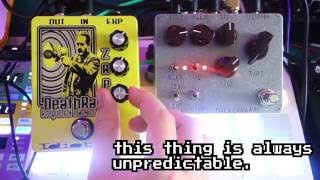
The Pladask Elektrisk Gjengangar is an experimental gate-delay pedal: a delay whose repeats are controlled by a gate, so what you hear depends on how you play. Pladask Elektrisk describes it as "an experimental gate-delay with unique capabilities," built as an original circuit around the popular PT2399 delay chip1. A send/return loop lets you insert other pedals into the delay's feedback path, so your own effects get applied to each repeat2.
The core idea is dynamic feedback control. The gate decides when the delay path opens and closes, based on your playing level and the settings you choose. Set the threshold to minimum and the gate is effectively removed, leaving what the maker calls "a pretty normal delay pedal"2. Set it higher and repeats only appear when you play hard enough, or a single stroke can produce a repeating phrase that escalates toward runaway feedback and then drops to silence1.
The v2, the current version, keeps the same concept with an increased delay range, an active tone control and a release knob compared to the first generation2.
What the gate does
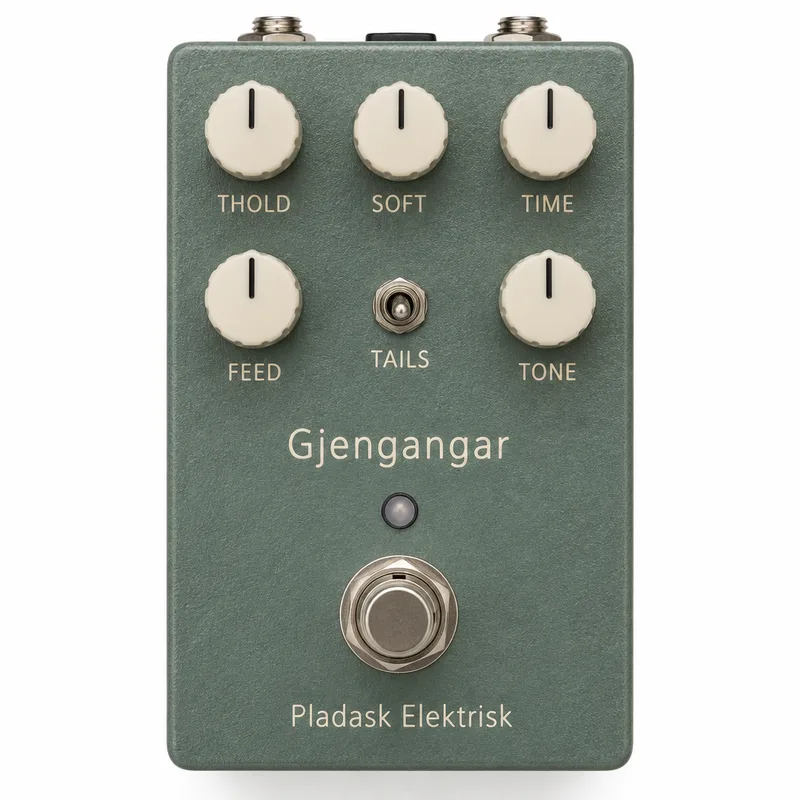
A conventional delay pedal repeats everything you play. The Gjengangar puts a gate in the delay path, and three knobs shape how that gate behaves2:
| Control (v2) | What it does |
|---|---|
| THOLD | Sets the threshold for the gate to open. MIN: always open. MAX: always shut. When open, delay level and feedback follow their knobs; when shut, the delay and feedback loop is muted2 |
| SOFT | Sets the gate softness, the speed at which the gate shifts between open and shut: fast, medium or slow propagation2 |
| TIME | Sets the delay time, ~60 to ~800ms2 |
| FEED | Sets the delay feedback/regeneration, from a single repeat to runaway feedback2 |
| TONE | Sets the tone of the repeats: dark, mild or very bright, interactive with the feedback and mix knobs2 |
The gate is also playable in the moment. On the v2, holding the foot switch down for more than about 600ms momentarily opens the gate, overriding the THOLD setting until you release it, and the effect can be momentarily engaged by holding down the bypass switch2. Bypassing the pedal closes the gate2.
The maker's own sample settings show the range of behavior1:
- High THOLD, med RLEAS, med SOFT, long TIME, near-max FEED: a single stroke produces a repeating phrase escalating in intensity toward runaway feedback, then dropping to silence, usable to emphasize key notes.
- Medium THOLD, short RLEAS, max SOFT: dynamic playing produces delays that fade in, and a compressed delay feeling can be achieved as feedback and softness work against each other.
- Min THOLD: effectively removes the gate, leaving a pretty normal delay pedal.
The send/return loop
The Gjengangar's other defining feature is its effects loop. The v2 has send/return jacks for integrating external effects, with a LOOP toggle: set to DIR, loop effects are applied to the delay repeats and the direct signal; set to REP, they are applied to the delay repeats only2. On the original, effects in the loop are applied to each delayed repeat and the direct signal1.
This is where the pedal becomes a system: put a fuzz or filter pedal in the loop and every repeat passes through it, while your dry signal stays clean. Two internal toggles on the original reverse the phase of the loop signal, a fix the manual suggests if you notice a drop in signal level with effects connected1.
The TAILS toggle interacts with the loop. It chooses between relay-based true bypass (toggle down) and a buffered bypass in which any effects in the S/R loop remain active and blend with the dry signal according to the MIX knob1.
How it sounds
Pladask Elektrisk is direct about the pedal's character: "As this is a medium fidelity delay, some grit and character should be expected"2. The original manual puts it as "some grit, warmth and character"1. On the v2, the TONE knob's brightest option can cause distinct signal degradation at longer delay times, which the maker notes suits drum machines or percussive sounds without tonal content2.
Delay time and the internal trim-pot
The v2's TIME knob covers roughly 60 to 800ms, an increase over the original's ~70 to 600ms21. Inside the v2, a trim-pot at the top left can be adjusted to push the maximum delay time up to about 1500ms2.
The maker cautions that going past the stock maximum is beyond the pedal's intended range: distinct signal degradation is expected, and the TIME knob's linearity may be skewed2.
Power and specifications
The Gjengangar does not support battery operation; both versions run on a 9V DC center-negative supply, the normal Boss/Ibanez/1Spot type2. The v2 draws about 85 mA, the original about 100 mA21.
| Spec | Gjengangar v2 | Gjengangar (original) |
|---|---|---|
| Delay time | ~60 to ~800ms2 | ~70 to ~600ms1 |
| Current draw | ~85 mA2 | ~100 mA1 |
| Dimensions | 120 x 96 x 57 mm2 | 120 x 94 x 55 mm1 |
| Weight | 375 g2 | ~400 g1 |
| Input impedance | 1 MΩ2 | 1 MΩ1 |
| Output impedance | ~1 kΩ2 | ~1 kΩ1 |
| Power | 9V DC center negative2 | 9 VDC center negative1 |
| Battery | Not supported2 | Not supported1 |
Pladask Elektrisk and the Gjengangar's place in the range
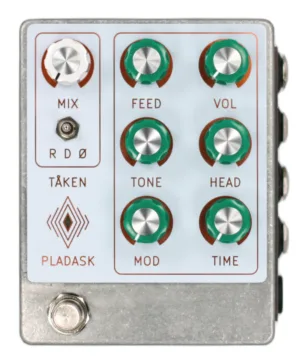
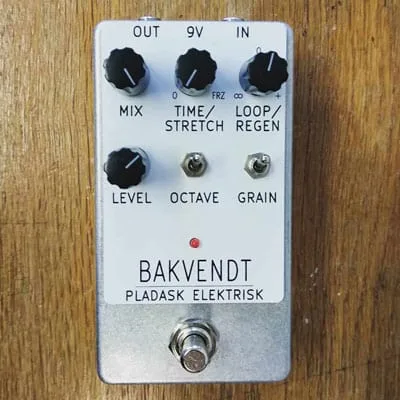
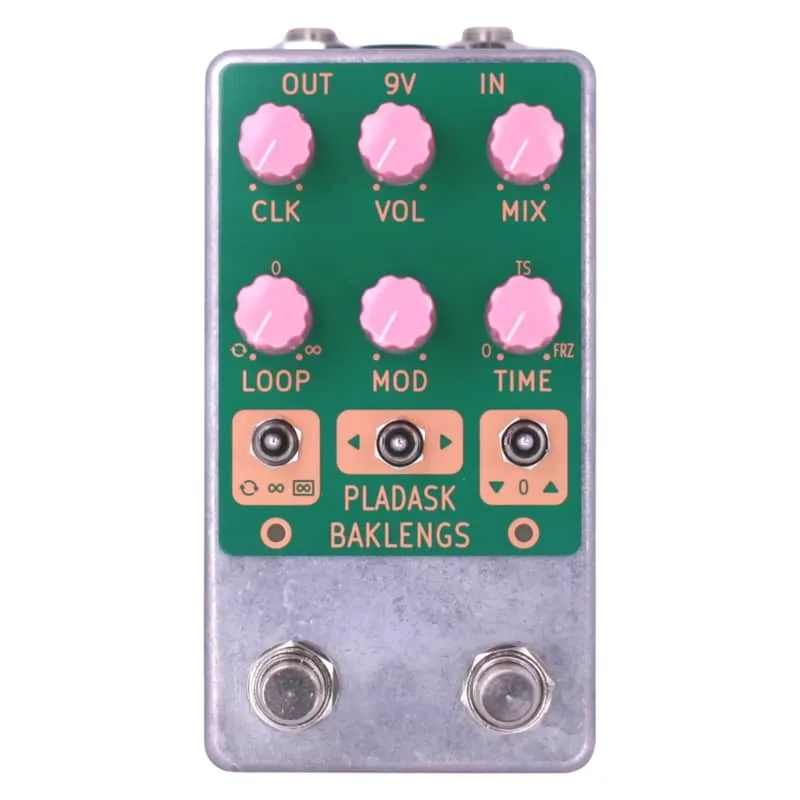
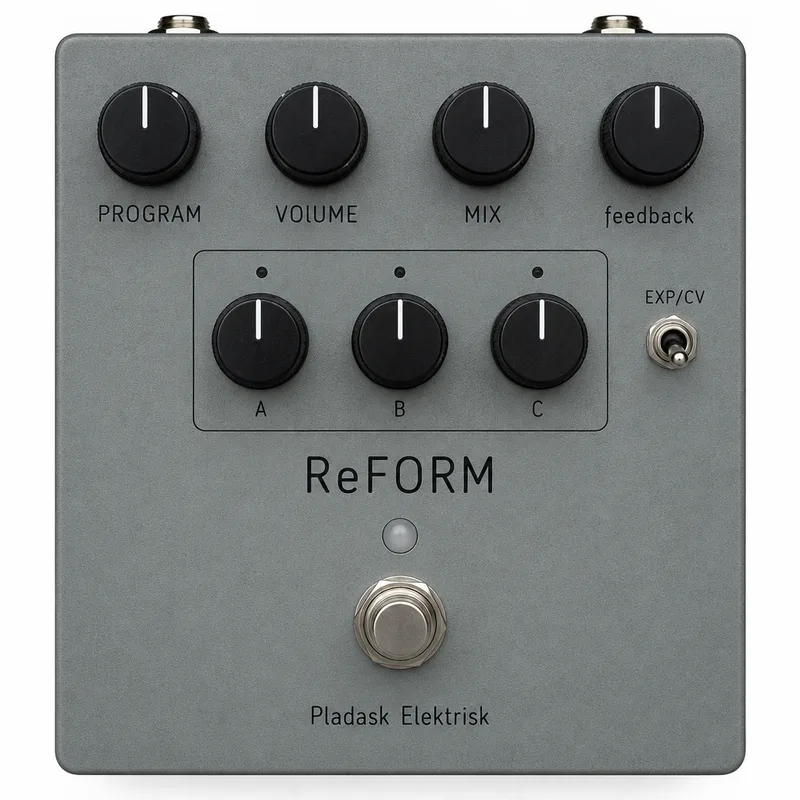
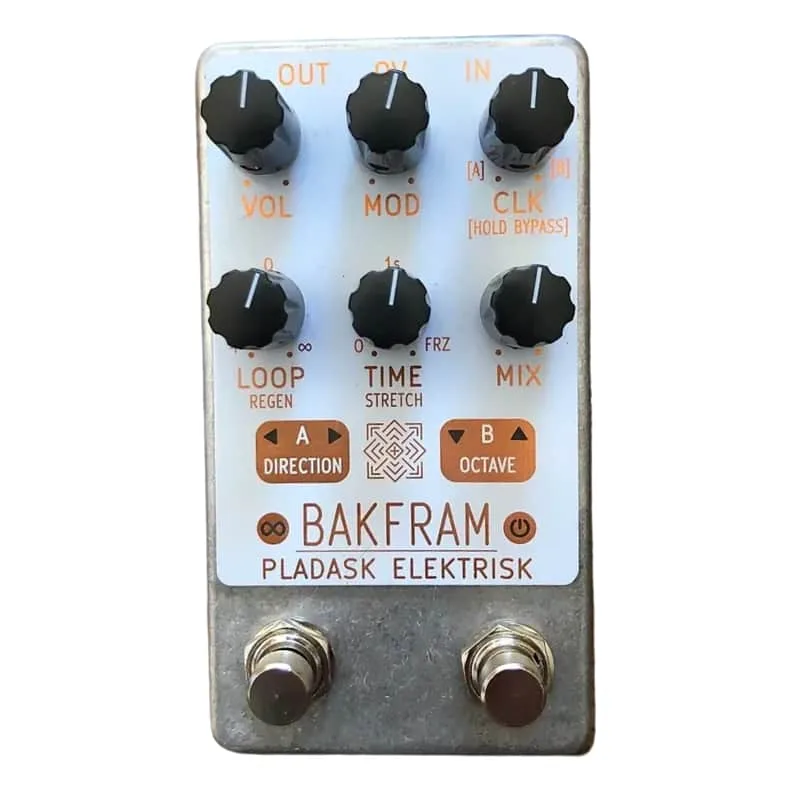
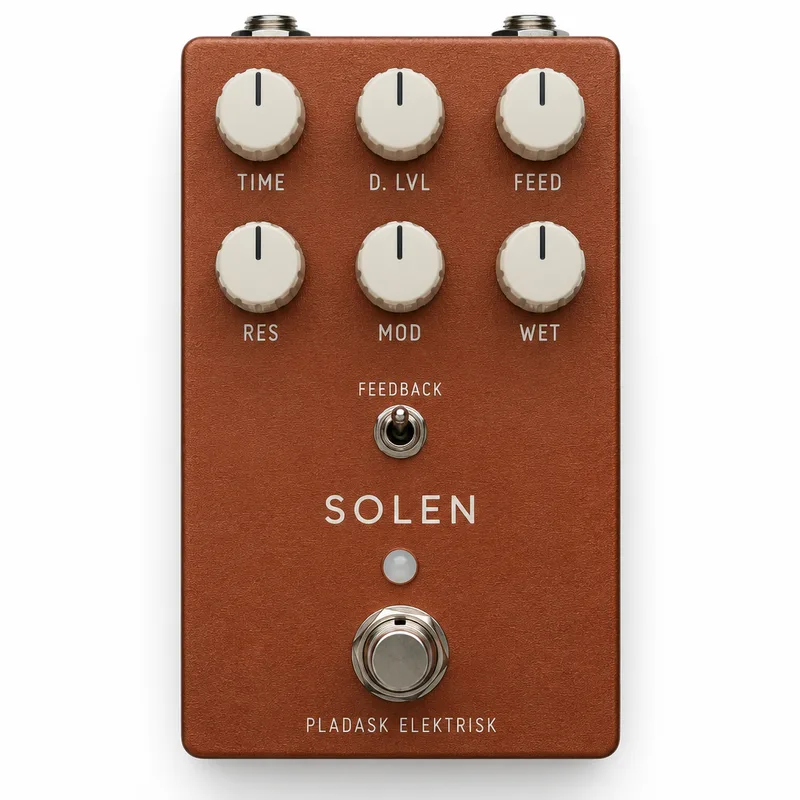
Pladask Elektrisk is a Norwegian effects maker whose other pedals include the Tåken dual-head delay, the BAKVENDT reverse granular pedal, the Baklengs granular synth glitch delay, the ReFORM DIY multi-effect and the BAKFRAM and SOLEN pedals. The Gjengangar sits apart from these as the maker's gate-delay: where the granular pedals chop and reassemble sound, the Gjengangar keeps a conventional delay line and adds a gate that decides when it speaks1.
Videos
Pladask Elektrisk
Pedals and Effects
Stephen McLeod
Questions
What delay chip does the Gjengangar use?
Both the original Gjengangar and the Gjengangar v2 are original circuits built around the PT2399 delay chip, the same chip found in many compact delay pedals. Pladask Elektrisk describes the result as a medium-fidelity delay where some grit, warmth and character should be expected.
What is the delay time range of the Gjengangar v2?
The v2's TIME knob sets the delay time from roughly 60 to 800ms. That is an increased range over the first-generation Gjengangar, whose TIME knob covered roughly 70 to 600ms.
Can you increase the Gjengangar delay time past 800ms?
Yes. The v2 has an internal trim-pot at the top left that can be adjusted to raise the maximum delay time up to about 1500ms. The maker cautions that this goes beyond the intended range, with distinct signal degradation expected and possible skewing of the TIME knob's linearity.
Does the Gjengangar run on batteries?
No. Both versions of the Gjengangar run on a 9V DC center-negative power supply, the normal Boss/Ibanez/1Spot type, and do not support battery operation. The v2 draws about 85mA and the original about 100mA.
Is the Gjengangar true bypass?
It can be. The TAILS toggle chooses between relay-based true bypass (toggle down) and a buffered bypass. In buffered bypass, any effects in the send/return loop remain active and blend with the dry signal according to the MIX knob.
Sources (2)
- Manual_Gjengangar_ENG.pdf, Pladask Elektrisk, 2023
- Manual_Gjengangar2_ENG.pdf, Pladask Elektrisk, 2023