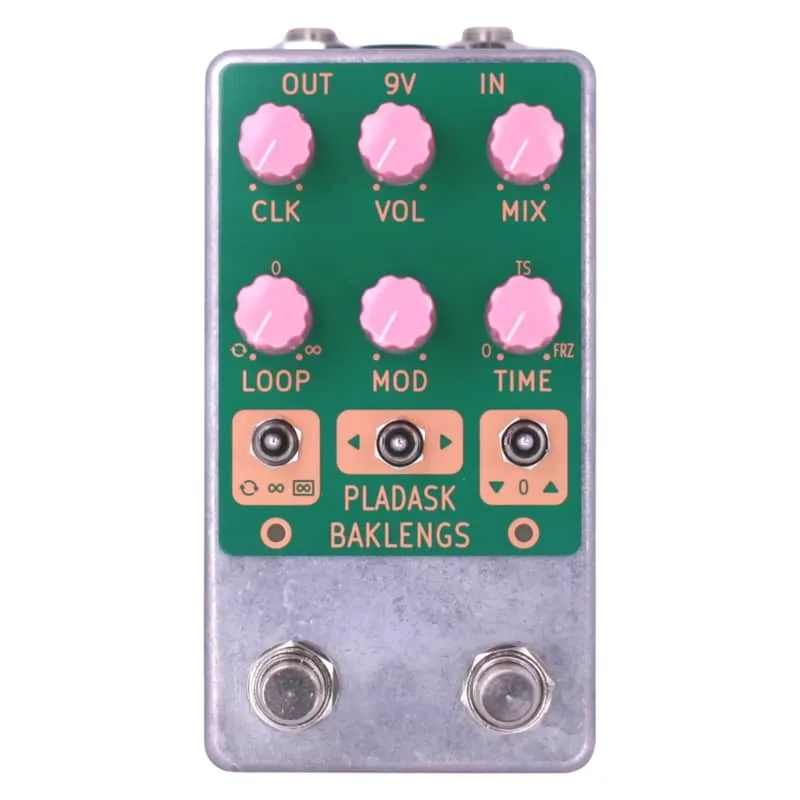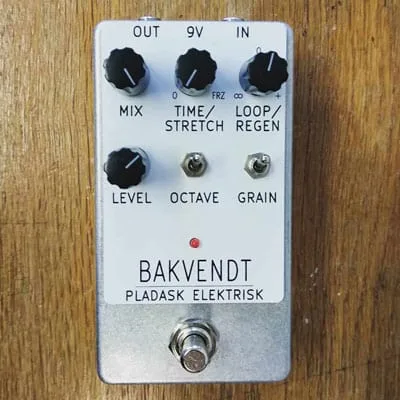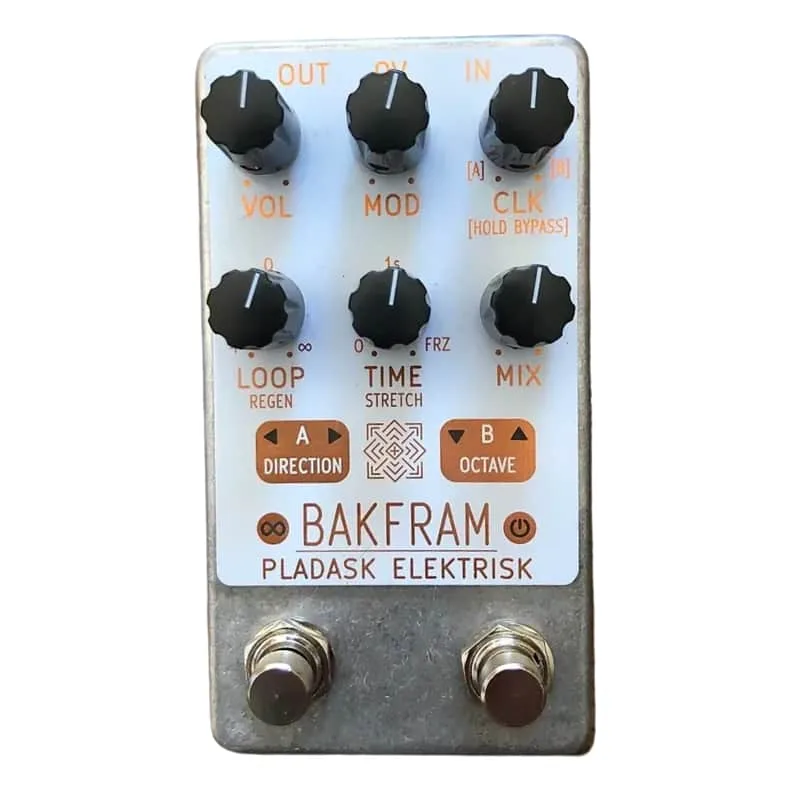


The Pladask Elektrisk BAKFRAM is, in the maker's own words, "a granular synthesizer masquerading as a forward and reverse delay." Granular synthesis chops audio into tiny fragments, or grains, and rearranges them, and the BAKFRAM uses that engine inside a delay pedal format. Pladask Elektrisk's manual says it "can delay stuff, timestretch stuff, freeze stuff, pitch stuff upwards, pitch stuff downwards and generally make lots" of sounds beyond what a conventional delay does1. It sits in the wider world of delay pedals, alongside the maker's related granular designs like the BAKVENDT and BAKLENGS.
The BAKFRAM does not run on a battery. It needs a 9VDC center negative supply delivering 100mA1.
Controls
| Control | What it does |
|---|---|
| CLK | Sets the digital signal processor system clock frequency, from approximately 12kHz to 50kHz. Sets the sampling rate, grain size, modulation speed and delay buffer length. Clockwise rotation shifts the pitch upwards. Very low clock settings produce some noise on the wet signal path. |
| DIRECTION | Selects between forward and reverse granular delay/stretch. Not a true reverse delay, but an effect where the grains of audio can be arranged in reverse. |
| OCTAVE | Selects between -1, regular and +1 octave pitch shifting, plus two glitchy bonus programs. |
| LEVEL | Master volume. Unity gain is around noon; max gain is +16dB. |
| MIX | Dry/Wet mixer. |
| MOD | Random tape flutter modulation depth, applied only to the wet signal. |
| LOOP/REGEN | Feedback. With looping feedback, clockwise of noon, the modulation and octave effects are not regenerated, so modulation depth and pitch stay the same at every repeat cycle. |
Two of these controls are hidden functions reached through the bypass switch. To change direction, hold down the bypass switch, turn the CLK knob from noon to minimum, then release. To change octave, hold down the bypass switch, turn the CLK knob from noon to maximum, then release1.
Footswitches and buffer
The right switch is the bypass; the left switch is the LOOP parameter maximizer. Holding down either switch for more than 500ms changes its state only momentarily, so either function can be used as a momentary effect1.
The buffer length varies from approximately 2700 to 650 ms, moving counterclockwise to clockwise, depending on the CLK parameter1. Because CLK also sets grain size, sampling rate and modulation speed, it is the pedal's central control: turning it reshapes the whole character of the effect, not just the delay time.
Power and specifications
| Specification | Value |
|---|---|
| Voltage | 9VDC center negative |
| Current | 100mA |
| Input impedance | 1MΩ |
| Output impedance | < 1kΩ |
| Size | 125 x 66 x 60 mm |
Videos
aBunchOfPedals
Ambient Endeavors
Qualia
Questions
Does the Pladask Elektrisk BAKFRAM run on a battery?
No. The manual states plainly that there is no battery operation. The BAKFRAM needs a 9VDC center negative power supply delivering 100mA, so it should be fed from a supply with enough current headroom rather than a low-output outlet on a daisy chain.
What power supply does the BAKFRAM need?
A 9VDC center negative supply rated for 100mA. The pedal has an input impedance of 1MΩ and an output impedance of less than 1kΩ, so it sits comfortably in a standard pedalboard signal chain once it is powered correctly.
What does the CLK knob do on the BAKFRAM?
CLK sets the digital signal processor's system clock frequency, from approximately 12kHz to 50kHz. It sets the sampling rate, grain size, modulation speed and delay buffer length, and clockwise rotation shifts the pitch upwards. Very low clock settings produce some noise on the wet signal path.
What does the left footswitch do on the BAKFRAM?
The right switch is the bypass and the left switch is the LOOP parameter maximizer. Holding down either switch for more than 500ms changes its state only momentarily, which lets you use either function as a momentary effect.
How long is the BAKFRAM's buffer?
The buffer length varies from approximately 2700 to 650 ms, moving counterclockwise to clockwise, depending on the CLK parameter. The CLK knob sets the system clock frequency from roughly 12kHz to 50kHz, which in turn determines the buffer length.
What are the BAKFRAM's dimensions?
The BAKFRAM measures 125 x 66 x 60 mm, according to the manual from Pladask Elektrisk.
Sources (1)
- BAKFRAM_2_Manual.pdf, Pladask Elektrisk, 2023